
Executive Overview
For millions of immigrants navigating the invisible fault lines of cultural dislocation, identity is rarely inherited through geography alone; it is often constructed out of symbols, memory, and media. This journalistic inquiry explores the lifelong intersection of soccer, ancestral heritage, and transnational family trauma through the lens of one Ecuadorian-American writer’s life. Spanning decades of cultural isolation in small-town Ohio, a fateful, harrowing reconciliation with an estranged father in the high-altitude sprawl of Quito, and a vibrant, multigenerational pilgrimage to a World Cup group-stage match in Kansas City, this narrative maps how a simple television screen—and the glowing, saturated rectangle of a soccer pitch—can serve as both an anchor and an anesthetic.
More than a personal memoir of sports fandom, this account offers a revealing sociological study of the Latin American diaspora in the United States. It examines how athletic spectacles transform isolated enclaves into collective communities, bridging decades of geographic and emotional distance. Through historical context, personal reckoning, and an examination of modern soccer culture, this report illuminates how communities separated by thousands of miles reclaim their roots through the universal language of the game.
Detailed Chronology: From Ohio Suburbs to the High Andes
The Invention of a Heritage (1980s–1990s)
Growing up in the American Midwest during the early 1980s, the author’s connection to Ecuador was largely self-invented. Having arrived in the United States in 1981 as part of an early wave of Latin American migration that preceded sprawling enclaves like Jackson Heights, the family found themselves isolated in small-town Ohio. In these decades before the internet, satellite television, or widespread demographic visibility, cultural heritage required active imagination.
Read Also
With a distinctively Serbian surname and little spoken Spanish, the author anchored his identity to soccer, leveraging vague family lore about an older generation of male relatives who purportedly favored the sport. In American schools where soccer was emerging as an organized youth activity, this fabricated lineage was accepted at face value. It provided a useful mechanism for self-distinction in environments devoid of tropical fruit, cultural institutions, or fellow expatriates.
By high school, however, athletic reality intervened. Initially celebrated as a prodigy upon moving to Bexley, Ohio, due to foundational youth training in Perrysburg, the author’s playing career peaked at age fifteen. The arrival of more skilled peers, coupled with chronic tendonitis, ended his playing days by his senior year. Yet, the persona of the "soccer guy" persisted. Throughout the 1990s, following the sport in the United States required quiet resilience, sustained by rare television broadcasts and an instinctive affinity for being an outsider.
The Reckoning in Quito (Post-College)
The abstract connection to Ecuador transformed into a visceral, complex reality shortly after college, when the author saved enough money to return to the country of his birth. The primary objective was a long-delayed confrontation with his estranged father, a man who had been violent and threatening toward his mother, leading to a permanent separation when the author was eight years old.
Staying with cousins in Quito, the author traveled daily to San Antonio, near the equatorial Mitad del Mundo monument, intending to spend two weeks establishing rapport before asking difficult questions about years of absence, financial abandonment, and familial estrangement.
However, the trajectory of the visit shifted violently on the day the reckoning was scheduled to begin. An answering phone call brought broken, garbled German—a symptom of an impending stroke. The father’s turbulent life history unfolded in the crisis: as a fourteen-year-old in the former Yugoslavia, he had served as a machine gunner alongside his older sister in the partisan resistance against Nazi forces. Later, facing mandatory military service under Tito without accounting for his underage wartime deployment, he stole his sister’s pistol, fled across borders through Vienna, a displaced persons camp in Naples, Panama, and Chile, finally arriving in Ecuador to settle permanently.
True to a lifetime of defying official structures, the father had refused passports and medical care. Years earlier, a neglected leg infection turned gangrenous, requiring forcible extraction by Serbian friends to undergo an amputation by a Chilean doctor. The accumulated trauma, combined with the new cerebral event, robbed him of his linguistic faculties, reducing him to a handful of Spanish words.
Amidst the exhausting daily caregiving—navigating a fraught household dynamic with a much younger stepmother and the constant fear of medical neglect—the author discovered an unexpected psychological refuge. Each evening, returning shattered to his cousins’ home, he would stare at the television screen broadcasting domestic, Mexican, and Argentine soccer matches.
[Ohio Suburbs: Fabrication of Identity]
       │
       ▼
[Quito, Ecuador: Family Reckoning & Stroke Trauma]
       │
       ▼
[Television Screen: Soccer as Psychological Refuge]
       │
       ▼
[Kansas City: Multigenerational Diaspora Pilgrimage]
This passive viewing became a ritualistic anchor. The glowing green rectangle offered a homeopathic dose of reality: pure witnessing stripped of consequence, providing aesthetic relief and a meditative space to process a slow-motion family catastrophe.
The Diaspora Converges in Kansas City
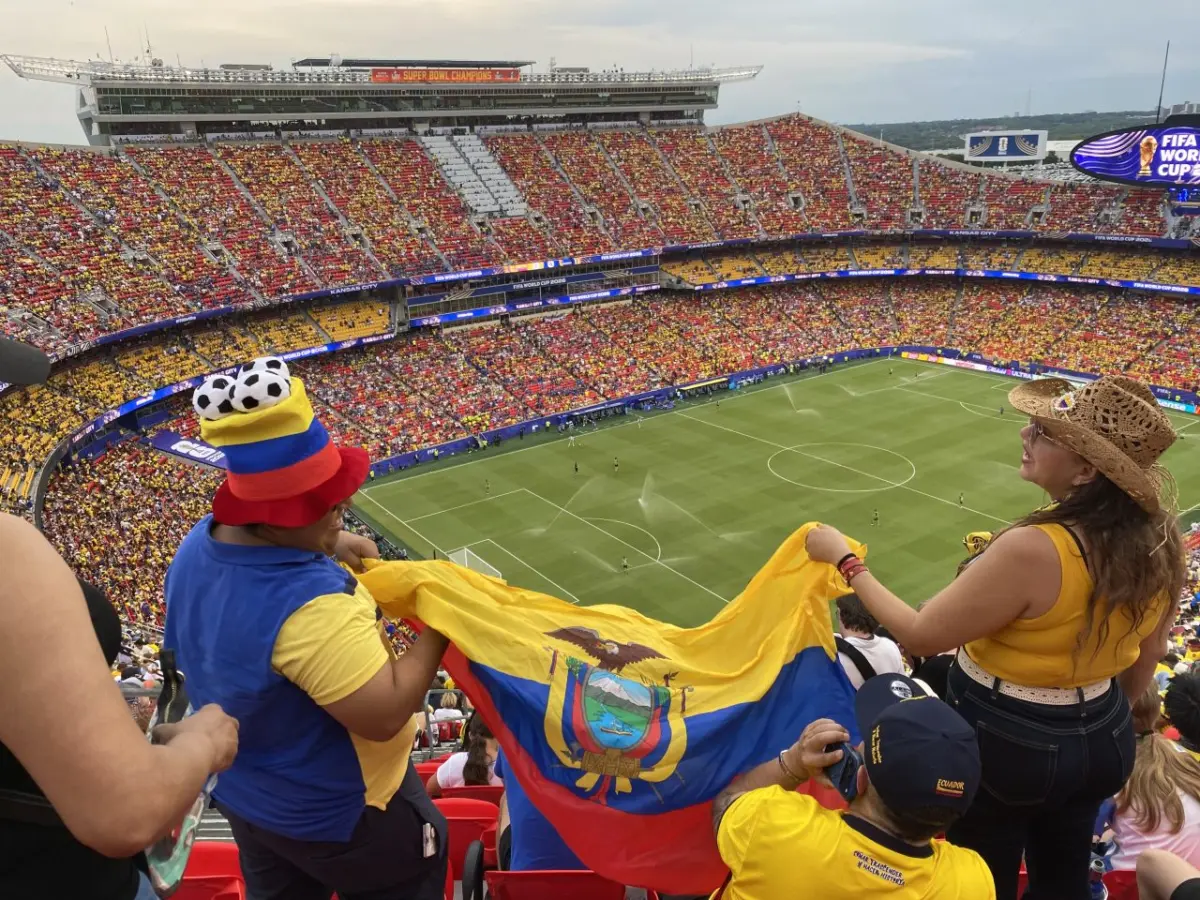
Decades later, televised soccer remained a structural constant of the author’s weekly routine, migrating from cable broadcasts and pubs to internet streams and family plan app projections. A profound shift occurred when his mother funded a surprise trip for him and his brother to attend a World Cup group-stage match between Ecuador and Curaçao in Kansas City.
Upon arriving in Missouri, the brothers stepped into a cultural phenomenon they had spent lifetimes missing: a dense, vibrant diaspora. The local hotels were flooded not with conventional tourists, but with a sea of bright yellow jerseys, draped flags, and collective chants of "Vamos, carajo!" For a family that had spent decades isolated in the American Midwest without access to everyday touchstones of Ecuadorian life, the stadium convergence felt like an emotional homecoming.
Old age pensioners, families, and young people moved together through security checkpoints and stadium ramps in an atmosphere of mutual recognition. Despite the match ending in a scoreless draw against an underdog opponent—a result that frustrated the diaspora’s high expectations—the event cemented a vital intergenerational connection to their heritage. A subsequent redemption occurred weeks later in New York City’s Jackson Heights, where crowded restaurants and honking cars celebrated a historic upset victory over Germany, affirming that the bonds of culture can survive decades of geographic dispersion.
Supporting Context & Metrics: The Sociology of the Latin American Diaspora
To fully understand the emotional resonance of the Kansas City pilgrimage, one must examine the broader socioeconomic and demographic realities of South American migration to the United States.
- The Shift in Migration Patterns: According to demographic data from the Pew Research Center, Ecuadorian migration to the United States accelerated significantly during the late 20th century, transitioning from small, highly dispersed pockets in Midwestern industrial towns and rust-belt suburbs to massive urban concentrations in New York (such as Jackson Heights, Queens) and New Jersey.
- The Isolation Metric: Early migrants of the 1970s and 1980s frequently experienced high cultural isolation. Unlike subsequent decades characterized by digital connectivity, instant messaging, and accessible ethnic commerce, first-wave arrivals often lived for years without access to foundational cultural goods, traditional foods, or community networks.
- Soccer as a Cultural Infrastructure: Sociological studies on transnational sports fandom indicate that international soccer tournaments function as surrogate civic institutions for diaspora communities. When national teams compete on foreign soil, they temporarily materialize a physical "homeland," allowing dispersed populations to perform collective identity, heal generational ruptures, and transmit cultural memory to children born thousands of miles from the Andes.
Official Statements & Cultural Perspectives
While this narrative centers on a deeply personal family history, its underlying themes reflect broader insights articulated by sociologists, cultural historians, and members of the Ecuadorian diaspora:
"For immigrant communities, the soccer stadium is not merely a venue for athletic competition; it is a temporary sovereign territory. It provides a physical space where the invisible burdens of assimilation are lifted, and the collective memory of the homeland is publicly validated."
— Dr. Elena Vasquez, Professor of Transnational Cultural Studies
Reflecting on the emotional weight of the Kansas City pilgrimage, the author’s brother captured the surreal nature of the gathering during their stadium ascent:
"You spend your whole life feeling like an exception to the rule—the only family with this background in your zip code—and then you walk into a hotel lobby and realize there is an entire nation waiting for you in the middle of Missouri."
Future Outlook: The Evolution of Transnational Fandom
As global sports broadcasting, streaming technologies, and international travel continue to evolve, the relationship between diaspora communities and their national teams is undergoing a structural transformation.
- Hyper-Accessibility vs. Authentic Ritual: While modern streaming platforms and family plans ensure that fans can watch matches from virtually anywhere, the ritualistic value of communal viewing remains irreplaceable. As demonstrated by the migration from living room screens to packed sports bars in Jackson Heights, physical proximity to fellow expatriates acts as a vital counterweight to modern digital isolation.
- Intergenerational Transmission: The integration of younger generations—who may have never set foot in Ecuador—into international soccer fandom guarantees that cultural identity will persist long after initial migration waves. Events like the World Cup serve as pedagogical vehicles, passing down national pride, historical narratives, and emotional resilience.
- The Ongoing Search for Belonging: Ultimately, the narrative of the soccer-watching diaspora highlights a fundamental human truth: whether through the green glow of a television screen in a Quito living room or under the scorching sun of a Kansas City stadium, people will continually construct spaces of belonging out of the fragments of history available to them. The game goes on, not just as a sport, but as a map for navigating the complexities of modern displacement.





Comments
Facebook App ID not configured. Please add it in the Customizer.