
Executive Overview
In an era defined by ubiquitous hyper-connectivity, algorithmic curation, and the relentless creep of artificial intelligence into the mundane architecture of daily existence, a counter-current is quietly gathering force. New York City—the hyper-accelerated capital of global commerce and technological consumption—has become the epicenter of a burgeoning "neo-Luddite" renaissance.
Far from the tired stereotype of anti-technology recluses smashing machinery in bitter isolation, contemporary New Luddism is a dynamic, culturally vibrant coalition. Comprising Gen Z digital natives, indie technologists, radical artists, and community organizers, the movement seeks not the complete eradication of technology, but the reclamation of human agency, public space, and "commonality" from the enclosure of Big Tech.
Through spontaneous public happenings, anonymous leadership collectives, and a deliberate divesting from the attention-fracking ecosystems of Silicon Valley, these modern Luddites are testing a radical premise: that the most effective political action against technological domination is the cultivation of unmediated, embodied human connection.
Read Also
Detailed Chronology: From Digital Fatigue to the Streets
The Spring and Summer of 2025: The Tipping Point of Digital Leashes
For many observers, the journey toward neo-Luddism begins with the quiet, suffocating realization of device dependency. Throughout the spring and summer of 2025, modern life was mediated through the glowing, time-eating tile of the smartphone. Used for navigation, communication, news consumption, and entertainment, the device functioned simultaneously as a vast library, a slot machine, a map, and a leash. As personal and global challenges mounted, that leash grew tighter. For individuals navigating profound personal depression and generalized digital fatigue, the screen offered a paradoxical refuge that ultimately deepened their isolation.
Fall 2025: Discovering the Underground
By the fall of 2025, trend pieces concerning Gen-Z "phoneless parties" and the resurgence of dumbphones began to break into mainstream consciousness. Beneath these surface-level lifestyle trends lay a more substantive network: a loose coalition of young people organizing to divest from Big Tech.
In November 2025, this underground scene broke into public view with an event titled "Should We Get Off?", hosted in the basement of a Midtown Manhattan mall. Organized by grassroots groups, the panel discussion on "tech hopes and fears" drew roughly ninety attendees. Participants were instructed to place stickers over their phone cameras before entering.
What followed shifted the author’s perspective from skeptical detachment to active engagement. Facilitators broke the crowd into small groups, prompting honest, philosophical, and imaginative conversations about how technology functions in daily life—and what human beings need to reclaim their autonomy. The event concluded with attendees exchanging contact information in physical notebooks or device note apps, leaving many participants with an unfamiliar sensation: hours passing without so much as a glance at a smartphone screen.
Winter 2025: S.H.I.T.P.H.O.N.E. #3 and the Apple Cube Rally
As the movement gained momentum, its public demonstrations grew bolder and more theatrical. In the depth of winter, the scene manifested as S.H.I.T.P.H.O.N.E. #3: GNOME ON THE CUBE—an acronym standing for "Scathing Hatred of Information Technology and the Passionate Hemorrhaging of Our Neo-liberal Experience."
Targeting the iconic glass Fifth Avenue Apple Store, nicknamed "The Cube," the rally contrasted sharply with the corporate optimization inside. While consumers waited for Genius Bar appointments and a Chinese robotics company’s dancing humanoid robot was mobbed by a sea of smartphone cameras, the Luddites gathered in a nearby park. Wearing handcrafted paper gnome hats—a nod to the Polish anti-authoritarian resistance movement The Orange Alternative—participants engaged in playful, subversive acts:
- Deactivating social media and AI apps through small, celebratory group rituals.
- Constructing grassroots community maps.
- Publicly critiquing the economic and social costs of Big Tech via soapbox speeches.
- Ceremonially smashing an iPad with a sledgehammer.
Led by chanting organizers, the crowd eventually surrounded the glass cube, accompanied by the brass stylings of the Rude Mechanical Orchestra. Hundreds of participants danced maniacally in a display of what the French sociologist Émile Durkheim termed "collective effervescence"—an electric, exhilarating energy connecting individuals to something far larger than themselves.
Summer 2026: The "Summer of Ludd"
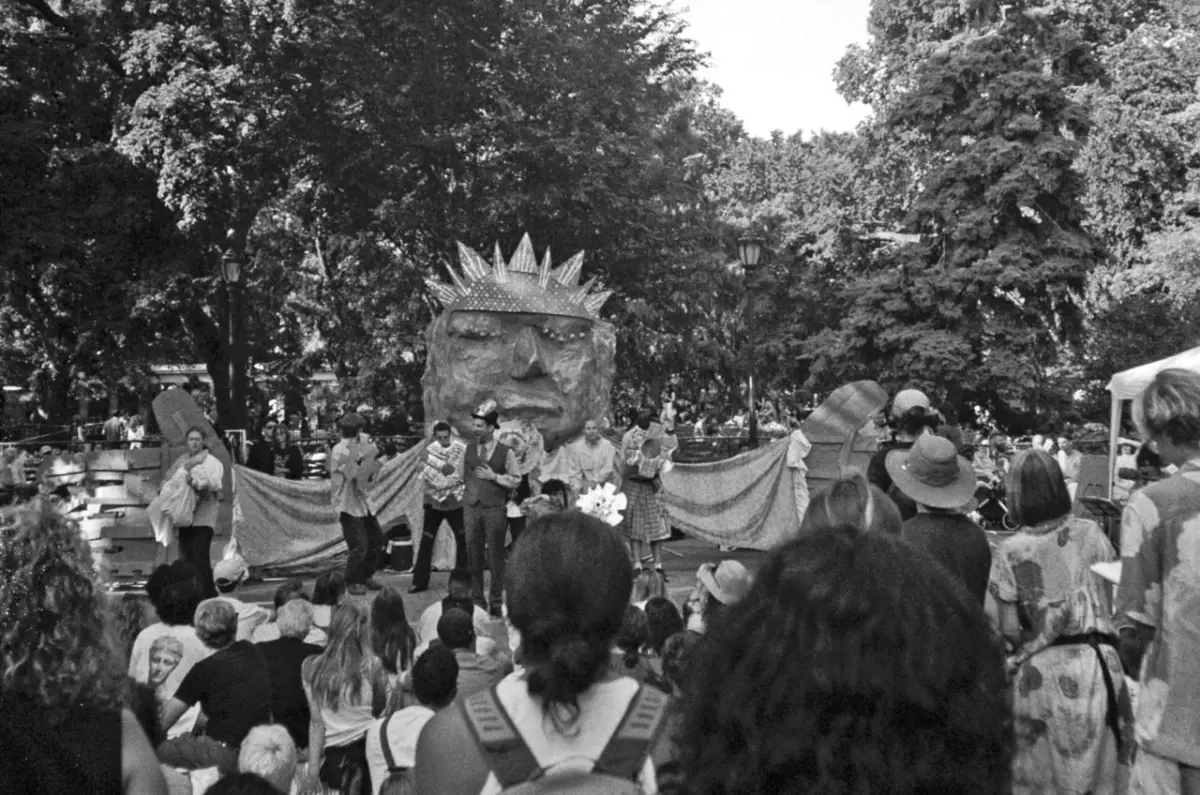
By June 2026, the movement graduated from localized guerrilla happenings to a sustained cultural festival. Dubbed the "Summer of Ludd," the initiative launched in Tompkins Square Park with a weeklong festival featuring over 120 free, public events. Rejecting social media advertising entirely, the organizers relied on wheatpasting, flyering, and an informational hotline.
The keynote presentation—a play by filmmaker Amanda Hanna-McLeer depicting the history of the original 19th-century English Luddites alongside modern tech oligarchs—drew hundreds of participants into the park. It served as a living archive, bridging the historical struggle of textile workers against industrial looms with contemporary resistance against algorithmic data extraction.
Supporting Context & Metrics: The Scale of the Digital Enclosure
To understand the urgency of the neo-Luddite movement, one must examine the staggering metrics of modern screen dependency and data harvesting:
- Screen Time Statistics: The average American spends approximately 50 hours a week looking at screens, with 16 of those hours dedicated strictly to social media platforms.
- Generational Projections: Current demographic projections indicate that an American born in 2025 will spend an estimated 21 cumulative years of their lifetime staring at digital displays.
- The TikTok Economy: Global statistics reveal that the average user of platforms like TikTok consumes upwards of 100,000 short-form videos annually.
- Public Pushback on Data Infrastructure: According to a 2026 Gallup poll, public resistance to the physical footprint of digital capitalism has reached new highs, with seven in ten Americans actively opposing the construction of AI data centers in their local neighborhoods.
This physical footprint—spanning undersea communication cables, server farms consuming vast quantities of water and electricity, and militarized supply chains—demonstrates that the "online" world is far from spectral. It is one of the most aggressive terraforming projects in human history.
Official Statements and Movement Philosophy
The Architects of the Luddiverse
Interviews with key figures within New York’s artist-activist wing—including anonymous organizers operating under moniker titles such as Captain Ludd, General Ludd, Skeleton Ludd, and Lighthouse Ludd, alongside their spokes-puppet, Gowanus—clarify the movement’s foundational principles:
"We are standing still and they’re pushing shit onto us," remarked Skeleton Ludd, highlighting the passive role forced upon consumers by corporate tech developers.
Captain Ludd emphasized that the movement’s name links them to a historic lineage of resistance against exploitation, rather than a blanket rejection of innovation:
"The idea was to be connected to a historic tradition, a lineage of people who took a stand against technological exploitation… We oppose the social costs and fascist alignment of Big Tech, not technology qua technology."
Nick Plante and the NYC Off Tech Network
Nick Plante, a 25-year-old organizer and founder of the NYC Off Tech newsletter, views the movement as a fundamental renegotiation of urban social life. Having studied the developmental effects of digital saturation at the University of Pennsylvania, Plante points out that individuals severely underestimate the power of cultural norms and groupthink in driving device dependency:
"People overestimate their own willpower… What’s happening is a much wider-scale renegotiation of what it means to be with each other in this city. It is kind of this shared project in being re-enchanted with each other, the time we spend with each other, and the rest of nature that we share."
Damian Thomas on Producer-Led Organizing
Damian Thomas, a technologist and writer who developed Unplatform—an interactive guide to help users exit social media ecosystems—argues that the problem of digital entrapment is structural rather than purely psychological:
"People aren’t on Instagram because they loved it as a social media platform. They were there because their friends, shows, events, political updates, artists, and creative communities had all been pushed there… That is not a consumer problem, that is a producer problem. And that’s why I’m trying to organize those producers."
Future Outlook: Can a Grassroots Movement Tilt the Paradigm?
As the neo-Luddite movement matures, its long-term viability and strategic trajectory remain subjects of intense debate. Unlike traditional political lobbying groups that focus on antitrust legislation or congressional regulation (such as policies championed by figures like Lina Khan or researchers monitoring adolescent smartphone use), the contemporary Luddites focus primarily on prefigurative politics.
Their theory of change—encapsulated in the zine The Event Is The Medium—posits that by engineering free, public, participatory, and unpredictable events, they can systematically undo decades of digital conditioning.
Challenges Ahead
- Accessibility: Critics and sympathetic observers alike question how the movement will account for accessibility issues, ensuring that the time-poor, socially anxious, or disabled are not inadvertently marginalized by physical-only organizing models.
- Big-Tent Tensions: While the movement’s broad-tent approach successfully attracts a multipartisan coalition of anti-tech sentiment (bridging left-wing community organizers with conservative critics of corporate monopolization), maintaining ideological coherence will become increasingly difficult as the movement scales.
- The Omnipresent Screen: As demonstrated when an organizer gently chastised the author for capturing video footage of the Tompkins Square Park play, the line between absolute divestment and practical navigation of modern life remains razor-thin.
Conclusion
The neo-Luddites of New York City are not attempting to turn back the clock to a pre-industrial fantasy. Instead, they are issuing an existential clarion call: to reclaim collective agency from attention-fracking algorithms, to re-enchant public life through shared physical presence, and to prove that human beings are capable of designing tools that serve human dignity rather than corporate exploitation.
Whether this decentralized network of gnomes, puppeteers, and independent thinkers can successfully alter the trajectory of global technology remains to be seen. But in a world increasingly dominated by synthetic intimacy and algorithmic isolation, the simple act of touching grass—together—feels nothing short of revolutionary.




Comments
Facebook App ID not configured. Please add it in the Customizer.