The Hawaiian archipelago has long captivated global travelers with its dramatic sea cliffs, pristine coastlines, and lush tropical canopies. Among these ecological treasures, the island of Kauai—affectionately known as the "Garden Isle"—holds a reputation for unmatched botanical diversity. A crown jewel of this natural heritage is found along the island’s southern coastline, where two distinct yet intimately connected horticultural sanctuaries sit side by side: the Allerton Garden and the McBryde Botanical Garden. Administered under the umbrella of the National Tropical Botanical Garden (NTBG), these dual sanctuaries represent a fascinating convergence of philanthropic vision, scientific preservation, and artistic landscape architecture.
Recent observational accounts from visitors and conservation enthusiasts highlight these living museums not merely as passive tourist attractions, but as dynamic, evolving ecosystems that capture the complex history of human intervention in paradise. The Allerton Garden, often described whimsically as a "rich man’s folly," stands as a monumental testament to the eccentric, deeply creative mind of industrialist Robert Allerton and his partner, John Gregg Allerton. Conversely, the adjacent McBryde Botanical Garden serves as a vital genetic repository, functioning as a sprawling horticultural haven dedicated to the conservation, study, and display of the native flora of the Hawaiian Islands and the broader tropics.
Beyond their immediate visual splendor, these gardens serve as a microcosm for broader discussions surrounding ecological preservation, sustainable land stewardship, and experiential tourism. This investigative report provides a comprehensive analysis of the Allerton and McBryde Botanical Gardens, exploring their historical roots, architectural distinctiveness, unexpected connections to local geography, and expanding educational initiatives that invite visitors to engage with the natural world on a deeper, more artistic level.
The Genesis of a Horticultural Dream: Pre-Contact to the Early 20th Century
Long before the arrival of landscape architects and wealthy industrialists, the Lawai Valley—where the Allerton and McBryde gardens now reside—held immense cultural significance for Native Hawaiians. The sheltered valley, watered by the Lawai Stream and kissed by gentle Pacific trades, was historically utilized for agricultural cultivation, including extensive taro patches (lo‘i) and traditional fishponds along the coast.
The modern history of the estate began to take shape in the late 19th and early 20th centuries as the land transitioned into commercial sugar cane production under the McBryde Sugar Company. Recognizing the unique microclimate of the lower valley, early entrepreneurs and estate owners began planting non-native ornamentals, laying the groundwork for what would eventually become a botanical utopia.
The Allerton Era: 1938–Present
The definitive transformation of the western portion of the valley occurred in 1938, when Robert Allerton—a successful businessman, architect, and self-described failed artist—alongside his adopted son and partner, John Gregg Allerton, purchased the property from the McBryde family. Moving away from the industrial focus of the valley, the Allertons embarked on a decades-long labor of love.
Pumping a sizable portion of his personal fortune into the project, Robert Allerton poured his frustrated artistic energies into the landscape. Rather than painting on canvas, he sculpted the jungle, carving out dramatic garden "rooms," integrating classical European architectural elements, and framing natural vistas with towering trees. Following Robert’s passing in 1964 and John’s in 1986, the estate transitioned into the Pacific Tropical Botanical Garden (later renamed the National Tropical Botanical Garden) by congressional charter, ensuring the preservation of their eccentric, master-planned vision for generations to come.
Expansion and Scientific Integration: The McBryde Legacy
While the Allerton Garden developed as an intimate, art-infused landscape, the adjacent acreage evolved along a parallel, more scientifically rigorous track. The McBryde Botanical Garden was established to fulfill a broader conservation mandate. Over the latter half of the 20th century, NTBG botanists mounted expeditions across the Pacific, collecting rare, endangered, and extinct-in-the-wild plant species.
Today, McBryde functions as a living laboratory. The integration of McBryde and Allerton under a single operational umbrella allows visitors to experience two starkly contrasting philosophies of land use: one driven by romantic, architectural whimsy, and the other driven by urgent botanical conservation.
Supporting Context & Metrics
Architectural Distinctiveness: Allerton vs. McBryde
To fully appreciate a visit to the Lawai Valley, one must understand the distinct personalities of the two gardens. Though managed together, their approaches to landscape design diverge significantly:
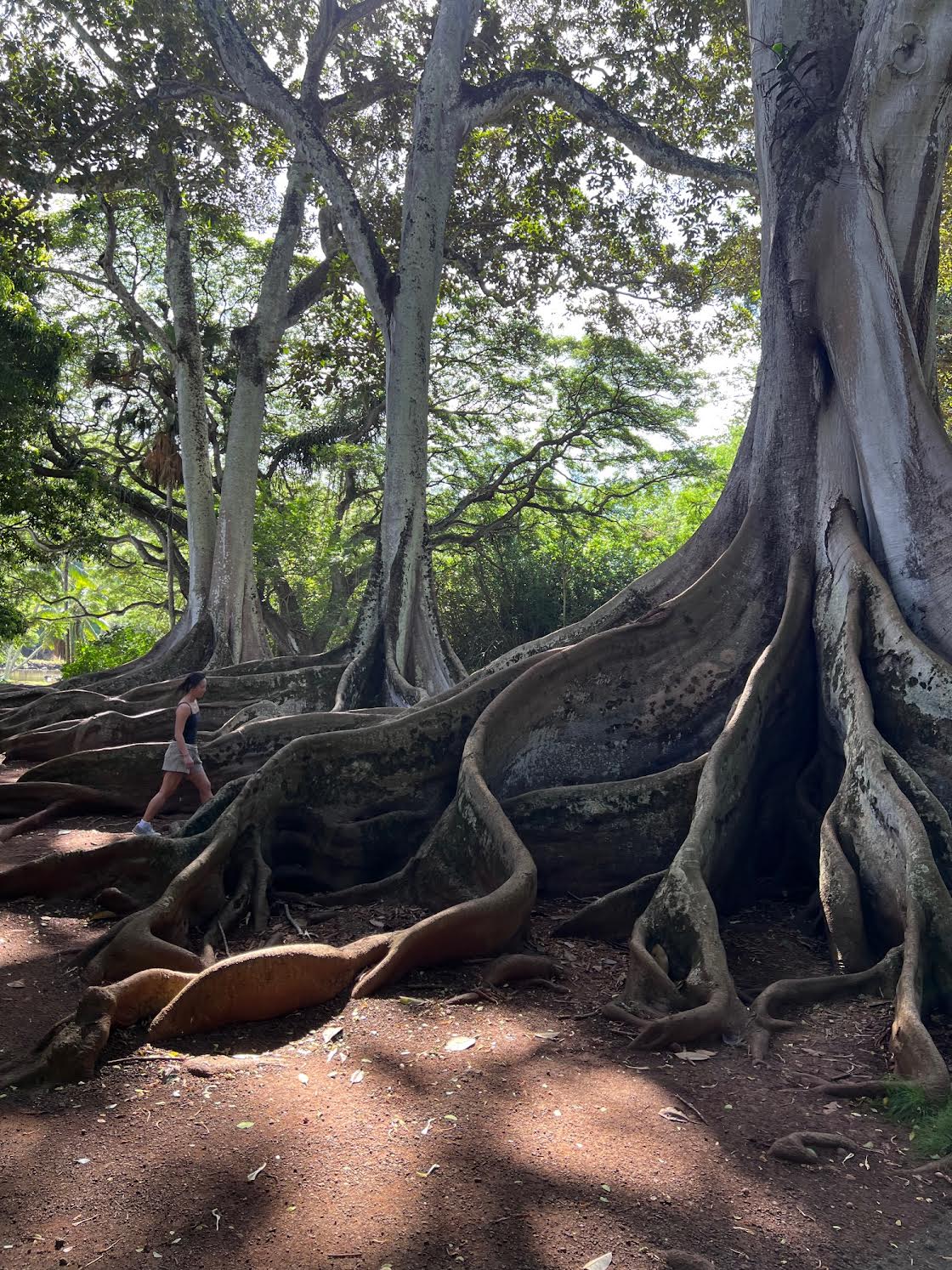
The Allerton Garden (The Artistic Sanctuary): Spanning roughly 80 acres of the valley floor and lower slopes, Allerton is structured much like an outdoor mansion. The property is divided into distinct "rooms," each evoking a different mood or aesthetic. Visitors encounter dramatic water features, classical statuary, and monumental trees—most famously the massive Moreton Bay fig trees (Ficus macrophylla) with their gargantuan, cascading buttress roots, which have served as backdrops for major Hollywood motion pictures like Jurassic Park.
The McBryde Botanical Garden (The Scientific Repository): Encompassing over 250 acres, McBryde is the administrative and scientific heart of the NTBG operations on Kauai. It houses the world’s largest ex-situ collection of native Hawaiian flora, alongside extensive holdings of palms, heliconias, rubiaceae, and Zingiberales. The layout emphasizes ecological grouping, winding paths, and immersive canopy views, making it a critical asset for global biodiversity conservation.
Operational Logistics and Visitor Metrics
Navigating the dual gardens requires advance planning. Visitors can choose from several touring modalities, primarily traditional guided bus tours that provide historical narratives and vehicular access across the sprawling terrain, or more independent, self-guided explorations designed for deeper, unhurried observation.
Metric / Feature
Allerton Garden
McBryde Botanical Garden
Primary Focus
Landscape Architecture, Art, History
Botanical Science, Native Conservation
Acreage
~80 acres
~250+ acres
Key Highlights
Moreton Bay Fig Trees, Mermaid Fountain
Native Hawaiian Flora, Palm Valley
Tour Formats
Guided Bus, Walking Tours
Self-Guided, Research Tours
Unexpected Geography and Local Lore
An intriguing dimension of the Lawai Valley’s geography is its porous boundary with the rugged Kauai coastline. Local lore and anecdotal travel accounts frequently highlight hidden access points, including secluded pocket beaches nestled near the garden boundaries. Seasoned travelers occasionally recount stumbling upon these coastal fringes from adjacent coastal trails—a reminder of the fluid boundary between manicured estate grounds and the untamed Pacific Ocean. While formal tours do not typically traverse these coastal fringes, the physical proximity of the gardens to secret surf spots and dramatic tide pools adds an adventurous undertone to any excursion into the region.
Official Statements
The National Tropical Botanical Garden maintains a strict policy regarding conservation, education, and public engagement. In official communications regarding visitor programs and educational outreach, NTBG representatives emphasize the necessity of moving beyond traditional sight-seeing:
"Our mission is to enrich life through discovery, scientific research, and conservation of tropical plants. By opening our doors through curated tours, educational workshops, and immersive artistic classes, we invite the public to become active participants in the preservation of our planet’s fragile botanical heritage."
Furthermore, educational coordinators highlight the synergy between art and science within the garden parameters:
"The legacy left by Robert and John Allerton proves that nature can be a canvas. When we offer botanical illustration and watercolor workshops on-site, we are honoring that exact intersection where human creativity meets botanical wonder. We want visitors to not only look at a rare flower or a towering fig, but to slow down, study its morphology, and capture its essence through creative expression."
Future Outlook
As global biodiversity faces unprecedented threats from climate change, invasive species, and habitat destruction, the role of institutions like the Allerton and McBryde Botanical Gardens becomes increasingly critical. Looking toward the horizon, the NTBG is expanding its educational and conservation frameworks to meet modern demands.
The Rise of Experiential and Educational Tourism
Modern travelers increasingly seek purpose-driven vacations that offer personal enrichment. The NTBG has responded to this shift by diversifying its programming. Beyond standard walking tours, the integration of specialized adult education courses—such as watercolor painting and botanical illustration workshops—positions the gardens as premier destinations for creative retreats. These programs tap into a growing demographic of tourists who wish to slow down, immerse themselves in the natural environment, and cultivate tangible skills inspired by their surroundings.
Conservation Challenges and Innovations
Operationally, the gardens face ongoing challenges associated with tropical land management, including invasive species eradication, storm resilience, and the propagation of critically endangered endemic Hawaiian plants. Future initiatives will likely see an expansion of ex-situ conservation efforts, utilizing advanced tissue culture and seed banking to safeguard species that may soon vanish from their native upland habitats.
Ultimately, a journey through the Allerton and McBryde Botanical Gardens is much more than a pleasant afternoon stroll. It is an exploration of legacy, a masterclass in landscape design, and a frontline defense for the preservation of tropical biodiversity. Whether viewed through the lens of an artist sketching beneath the canopy of a Moreton Bay fig or a scientist cataloging an endangered Hawaiian fern, these gardens remain an indispensable treasure of the Garden Isle—one destined to inspire awe, education, and stewardship for generations to come.











Comments
Facebook App ID not configured. Please add it in the Customizer.