
Executive Overview
In the rapidly evolving landscape of contemporary art and digital media, the intersection of advanced technology and creative expression has become a frequent flashpoint for public debate. This tension reached a head in August 2026 at the renowned Walker Art Center in Minneapolis, Minnesota. The institution, alongside internationally acclaimed Nigerian-born artist, architect, and designer Olalekan Jeyifous, found itself compelled to forcefully refute growing accusations from museum visitors claiming that his solo exhibition was constructed using generative artificial intelligence.
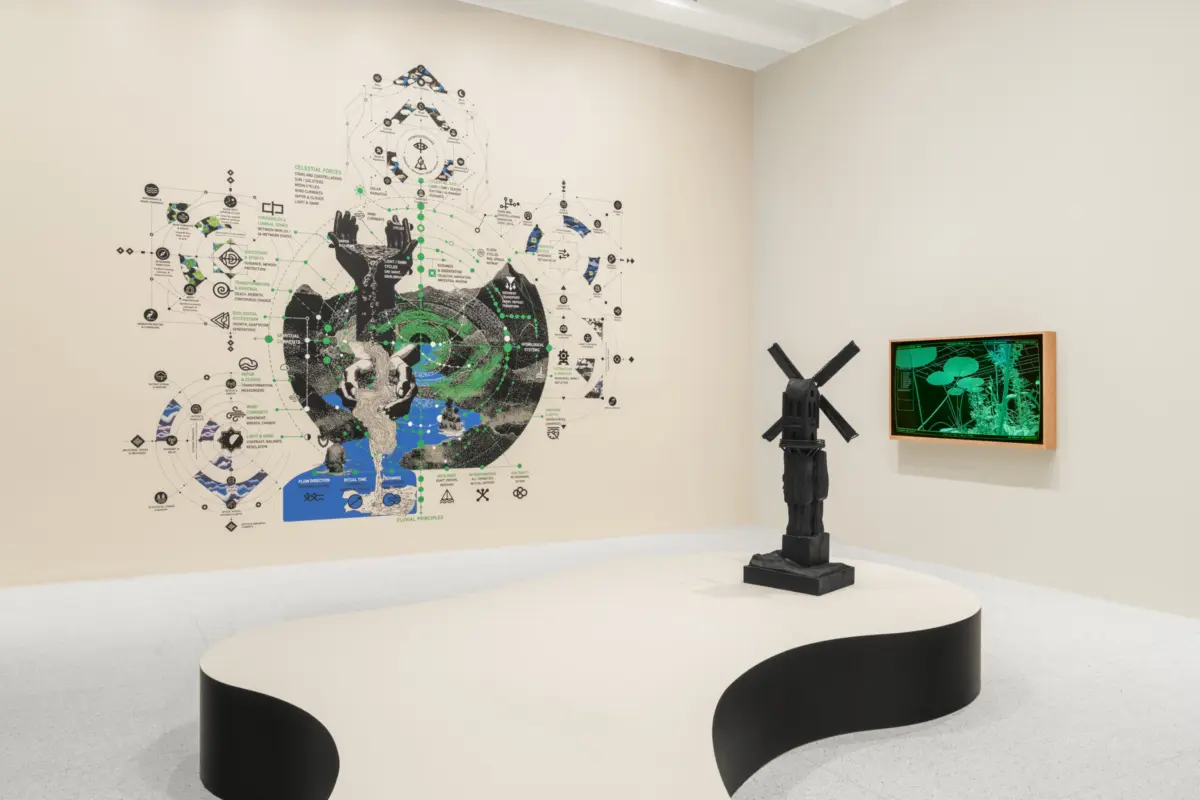
The controversy centers on Jeyifous’s landmark solo museum exhibition, Hydricosmic Litanies, organized by the Walker’s associate curator for visual arts, Taylor Jasper. Featuring an immersive blend of video, sculpture, and elaborate soundscapes, the exhibition draws deeply from African diasporic cosmologies, Ben Okri’s Booker Prize–winning 1991 novel The Famished Road, and speculative architectural futures centered on the Mississippi River. However, due to the hyper-detailed, speculative, and digitally constructed aesthetic of Jeyifous’s practice—a style he has refined over two decades using architectural software—some gallery-goers mistook his meticulous digital craft for instantaneous, prompt-based "AI slop."
What began as a viral critique on Reddit rapidly snowballed into a public relations challenge for one of the country’s most respected contemporary art museums. The incident underscores a broader cultural anxiety: as generative AI tools proliferate across every creative sector, audiences are increasingly primed to view digital art with deep skepticism. This case study examines the friction between traditional artistic methodologies and modern digital tools, the nuances of Jeyifous’s artistic process, the museum’s response, and the broader implications for the contemporary art world as it navigates the murky waters of technological transparency.
Read Also
Detailed Chronology of the Controversy
The unfolding of the controversy surrounding Hydricosmic Litanies highlights the velocity at which local museum grievances can transform into viral digital debates, forcing swift institutional action.
August 6, 2026: The Exhibition Opens
The Walker Art Center officially opens Olalekan Jeyifous: Hydricosmic Litanies in Gallery C of the Burnet building. Occupying a prominent space in the Minneapolis institution, the exhibition is designed to envelop visitors in a speculative aquatic environment. Echoing the physical topology of a riverbed, the gallery features platforms resembling islands, surrounded by video projections, intricate physical sculptures machined from complex digital models, and evocative soundscapes. Reviews and initial visitor responses praise its ambitious conceptual scope, engaging with themes of environmental degradation, industrialization, and colonial legacies.
August 15, 2026: The Reddit Catalyst
Nine days after the exhibition’s opening, the conversation shifts dramatically online. A Reddit user operating under the handle stvincentstreet publishes a post on the popular regional subreddit r/Minneapolis titled "AI slop alert: The new Olalekan Jeyifous exhibit."
The user expresses profound disappointment, writing that they were disheartened to see what they perceived as "so much AI garbage" featured prominently in the galleries. The post gains further traction due to a damaging claim: the user alleges that an unnamed Walker staff member, speaking off the record, agreed that generative AI was utilized, explicitly telling the visitor that even the physical sculptures in the show were machined from AI-generated 3D models. The user lambasts the institution, calling it "sickening" that a museum of the Walker’s caliber would display such work without explicitly notifying the public about the integration of generative technology.
Mid-August 2026: Media Inquiry and Institutional Silence
As the Reddit post garners upvotes, comments, and cross-platform shares, local and national arts journalists take notice. Outlets like MPR News begin investigating the claims, prompting inquiries to the Walker Art Center. Initially, the museum declines to comment extensively on the specific miscommunication or the viral allegations, leaving a vacuum that allows speculation to mount across architectural and digital art communities.
Late August 2026: Official Clarifications and Retractions
Facing mounting public pressure and mischaracterizations of his life’s work, Olalekan Jeyifous steps forward to set the record straight in interviews with MPR News and ARTnews. Supported by statements from the Walker’s leadership—including Chief Curator and Director of Curatorial Affairs Henriette Huldisch and Associate Curator Taylor Jasper—the artist clarifies the precise nature of his digital workflow.
Recognizing that the rapid evolution of generative AI has conditioned audiences to view speculative digital design with suspicion, museum leadership announces a proactive measure: the Walker commits to updating its gallery wall texts to explicitly outline the sophisticated, iterative software tools Jeyifous employs, aiming to bridge the educational gap between specialized architectural design practices and general gallery visitors.
Supporting Context & Metrics: Understanding Jeyifous’s Practice and Provenance
To understand the roots of the misunderstanding, one must examine Olalekan Jeyifous’s distinguished career, his artistic pedigree, and the technical realities of contemporary architectural visualization.
A Proven Pedigree in Contemporary Art and Architecture
Olalekan Jeyifous is not an overnight internet creator dabbling in prompt-based AI image generators; he is an established, internationally recognized artist, designer, and trained architect whose career spans more than twenty years. Born in Nigeria and currently based in New York City, Jeyifous has built a robust institutional resume that places his work far outside the realm of casual digital experimentation:
- Global Exhibitions: His works have been exhibited at elite international venues, including the Studio Museum in Harlem, the Vitra Design Museum in Weil am Rhein (Germany), and the prestigious Guggenheim Bilbao.
- Permanent Collections: His pieces are housed in the permanent collections of world-class institutions, such as the Museum of Modern Art (MoMA) in New York, the Art Institute of Chicago, and the San Francisco Museum of Modern Art (SFMOMA).
- Critical Acclaim: In 2023, Jeyifous achieved monumental international recognition by winning the prestigious Silver Lion for a promising young participant at the 18th International Architecture Exhibition of the Venice Biennale.
The Mechanics of "Hydricosmic Litanies"
Hydricosmic Litanies is a multi-disciplinary masterclass in speculative world-building. The exhibition engages with African diasporic cosmologies, treating historical and contemporary traumas—such as colonization, industrial exploitation, and environmental collapse—through a lens of speculative futures. Taking direct literary inspiration from Ben Okri’s Booker Prize–winning 1991 novel The Famished Road, which famously opens with the line, "In the beginning there was a river," the exhibition centers on the Mississippi River, a vital geographic and cultural artery flowing directly through Minneapolis.
The installation transforms Gallery C into a hybridized river ecosystem. Visitors navigate through physical architectural platforms resembling river islands while being immersed in multi-channel video art and soundscapes. The physical sculptures within the space are not random algorithmic outputs; they are the result of rigorous, high-level computer-aided design (CAD) and advanced 3D modeling translated into physical objects through precision machining—a standard pipeline in modern architectural fabrication.
The Fine Line Between Digital Tools and Generative AI
The crux of the controversy lies in the fundamental misunderstanding of how contemporary digital artists, architects, and designers operate. As Henriette Huldisch noted, Jeyifous utilizes a sophisticated suite of professional software tools—ranging from advanced rendering programs to standard industry mainstays like Adobe Photoshop and complex 3D modeling packages—many of which have incorporated AI-assisted features in recent years to streamline repetitive tasks like texture mapping, lighting calculations, and mesh optimization.
However, there is a vast qualitative chasm between utilizing software with embedded machine-learning algorithms to execute a deeply considered artistic vision and typing a prompt into a text-to-image generator to produce superficial "art." Jeyifous works iteratively, spending weeks or months on individual components, continuously rendering, re-rendering, conceptualizing, and refining.
As Jeyifous noted in his interviews, the speculative, futuristic, and science-fiction-adjacent aesthetic of his work—which he has pioneered for over two decades—coincidentally mirrors the visual lexicon popularized by early consumer-facing generative AI tools. Consequently, casual observers viewing his retrospective and new works through a contemporary lens retroactively applied the pejorative label of "AI slop" to a deeply rigorous, labor-intensive artistic practice.
Official Statements and Institutional Responses
The statements released by the artist and the Walker Art Center illuminate the challenges cultural institutions face in maintaining transparency while defending the integrity of complex artistic processes.

Olalekan Jeyifous on the Burden of Misinterpretation
Reflecting on the controversy, Jeyifous expressed frustration—though not entirely without understanding—regarding how general audiences consume digital art in the age of generative algorithms:
"For more than two decades, people have asked some version of, ‘How did you make this?’ Those methods are commonplace within the discipline I emerge from, but less familiar to a general museum audience, so there has always been some uncertainty around how my images and objects are produced and that has followed me from the beginning."
He further addressed the retroactive vilification of his portfolio, noting:
"As AI imagery increasingly entered the broader visual culture, I anticipated that people might begin viewing my work through that lens, and even retroactively framing my earlier work as ‘AI slop,’ which has actually happened. Simply prompting images and presenting the results as my artwork is fundamentally at odds with how I’ve always worked."
Curatorial Defense: Iteration Versus Prompting
The Walker’s curatorial team stepped up to defend the meticulous nature of Jeyifous’s labor, emphasizing that the artist’s methodology is rooted in intense human agency and artistic decision-making.
Henriette Huldisch, Chief Curator and Director of Curatorial Affairs, addressed the nuance of software integration:
"He uses a range of sophisticated software and tools, many of which have AI embedded within them, but the artworks are never created from simple prompts."
Taylor Jasper, associate curator for visual arts and the organizer of the exhibition, elaborated on the multi-stage evolution of the physical and digital pieces:
"He works extremely iteratively. Everything goes through multiple stages of reconceptualization, of rendering, of visualization and revisualizing and visualizing again."
Institutional Accountability and Remediation
Rather than digging in its heels or dismissing visitor feedback, leadership at the Walker Art Center demonstrated a willingness to listen and adapt. Recognizing that the museum-going public possesses heightened sensitivity toward technological transparency, Huldisch announced that the institution would update its gallery materials:
"We’re listening and we’re learning with our visitors, and we are adding language."
True to this promise, the Walker initiated plans to update exhibition wall texts, providing clearer didactic explanations of Jeyifous’s architectural background, his digital software pipeline, and the distinction between professional design tools and generative artificial intelligence.
Future Outlook: The New Era of Digital Art Transparency
The controversy surrounding Olalekan Jeyifous: Hydricosmic Litanies at the Walker Art Center is unlikely to be an isolated incident. As artificial intelligence continues to permeate commercial design, cinema, architecture, and fine art, cultural institutions face a new set of interpretive challenges.
1. The Burden of Didactic Transparency
Museums and galleries will likely need to adapt their wall texts and interpretive materials for exhibitions that rely heavily on digital fabrication, 3D modeling, and advanced software tools. Just as museums historically learned to contextualize photography, video art, and net art, contemporary curators must now proactively demystify digital workflows to prevent public miscommunication. When visitors lack insight into how digital tools function, suspicion can easily overshadow artistic intent.
2. Protecting Digital Artists from Unfair Stigmatization
Artists who have spent decades mastering digital rendering, computer-aided design, and speculative world-building face an unfair collateral penalty from the backlash against generative AI. Creators like Jeyifous—whose aesthetic vocabulary pre-dates the current wave of consumer generative AI by many years—must now constantly defend the sweat, skill, and human conceptualization embedded in their portfolios. The arts community must develop a more nuanced critical vocabulary that distinguishes between human-led digital mastery and algorithmic generation.
3. Evolving Visitor Literacy
As audiences become more digitally literate, museum-goers are increasingly demanding transparency regarding the tools used to create the art they consume. While this can sometimes lead to premature witch hunts—as seen in the viral Reddit thread targeting Jeyifous—it also signals a healthy, engaged public interest in the ethics of creation.
Ultimately, the Walker Art Center’s willingness to listen, clarify, and update its exhibition texts marks a constructive path forward. By addressing visitor concerns head-on rather than ignoring them, the museum and Olalekan Jeyifous have turned a localized online misunderstanding into a valuable educational dialogue about the evolving definition of craftsmanship in the twenty-first century.


Comments
Facebook App ID not configured. Please add it in the Customizer.