Deep within the murky, silt-choked waters of an ancient harbor off the coast of Menorca lies a fragile, time-capsuled window into the medieval Mediterranean. Known locally as Cala en Busquets—and poetically dubbed the "Cove of Mysteries"—this unassuming Spanish harbor has yielded an archaeological treasure: a trio of intertwined 13th-century trading vessels. Sunk simultaneously by a violent, freak meteorological anomaly more than 750 years ago, these ships—designated Busquets I, II, and III—have escaped the devastating pillaging that has historically plagued Mediterranean maritime excavations.
The significance of this discovery extends far beyond the preservation of medieval timber and hull structures. The composite cargo recovered from the overlapping wrecks tells a complex story of a contested frontier. Containing artifacts originating from both Christian kingdoms and Moorish communities on the Iberian Peninsula, the site challenges long-held dichotomies of an entirely partitioned medieval world. Spearheaded by the Menorca Shipwreck Project—a collaborative venture between the New York City-based Explorers Club and local archaeological experts—this ongoing underwater excavation is rewriting our understanding of Balearic history, pre-conquest commerce, and the sheer destructive power of ancient meteotsunamis.
Detailed Chronology: From First Glimpse to Definitive Dating
The narrative of the Cove of Mysteries is one of persistent intuition meeting cutting-edge scientific validation. The timeline of this extraordinary discovery highlights the challenges and triumphs intrinsic to modern underwater archaeology.
2009: Catalan archaeologist Xavier Aguelo Mas, working alongside local heritage teams, conducts preliminary surveys of the floor of Cala en Busquets, an ancient harbor located off the historic city of Ciutadella. Recognizing anomalies in the seabed, Aguelo Mas theorizes that significant medieval remains lie beneath the sediment, though his early hypotheses are met with widespread skepticism from the broader archaeological community.
Late 1240s (The Disaster): Based on carbon-dating data secured centuries later, a sudden and catastrophic meteorological event—a meteotsunami, locally referred to as a rissaga—sweeps into the harbor. The violent, rapid sea-level fluctuations overwhelm three trading vessels anchored or moored in close proximity, causing them to founder and settle together in a tangled underwater grave.
1287 (The Conquista): King Alfonso III of Aragon conquers Menorca, integrating the island into the Crown of Aragon and effectively scrubbing or altering many of the island’s prior Moorish administrative and maritime records. The original names of the Busquets vessels are lost to history.
October 2023: Armed with funding and formal organization via the newly minted Menorca Shipwreck Project—a partnership featuring the Explorers Club—systematic, deep-water excavations officially begin in the cove. Initial visual assessments suggest the wrecks may date to the 18th century.
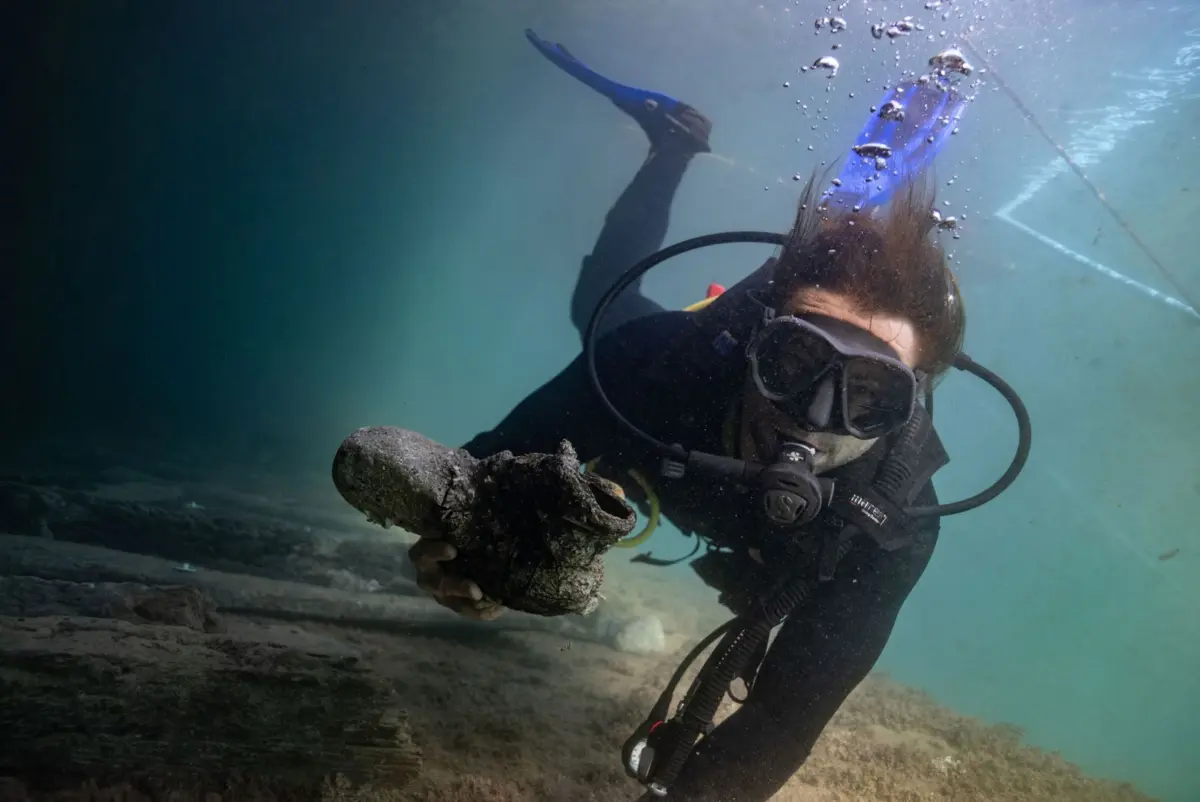
October 2025: Diving conditions degrade severely, resulting in near-zero visibility described by researchers as "like chocolate." Despite the adverse environment, expedition divers, led by founder Trevor J. Wallace and veteran researchers like Aguelo Mas, press forward under the guiding maritime ethos: "We dive anyway!"
Late 2025: Rigorous wood-dating and dendrochronological analyses shatter previous assumptions. The results definitively place the shipwrecks in the 13th century, making them the first confirmed 13th-century vessels ever discovered in Menornca’s waters.
2025–2026 Field Seasons: Utilizing an innovative excavation technique dubbed the "Queen Elizabeth" wave, divers systematically clear sediment to reveal high-status artifacts, including an exceptionally rare 13th-century Christian encolpium (reliquary) and pristine Islamic ceramics.
Spring 2027 (Projected): The Menorca Shipwreck Project plans to publish a comprehensive academic paper detailing the structural analysis, environmental impacts, and historical implications of the Busquets excavations.
Supporting Context & Metrics: Meteotsunamis, Medieval Trade, and Preservation
To fully appreciate the uniqueness of the Busquets shipwrecks, one must examine the confluence of environmental geography and geopolitical history that preserved them for three quarters of a millennium.
The Menace of the Rissaga
Menorca is uniquely vulnerable to meteorological tsunamis, known locally as rissagas. Unlike seismic tsunamis caused by tectonic shifts under the ocean floor, meteotsunamis are atmospheric phenomena. Sudden shifts in barometric pressure, often triggered by severe weather systems moving rapidly across the Mediterranean, can generate towering, cyclical surges in sea level that funnel into narrow, shallow bays like Ciutadella’s harbor.
Manifesting unpredictably within minutes, these towering waves can violently crash ashore or drag entire fleets down into the muck within hours. The Busquets vessels stand as a stark, preserved testament to the sheer destructive capacity of a 13th-century rissaga.
Why the Busquets Wrecks Are an Anomaly
In the broader theater of Mediterranean archaeology, ancient Roman shipwrecks are comparatively common. Roman merchant vessels frequently transported goods in durable ceramic jars known as amphorae. While these containers served as a boon for modern historians, they also acted as beacons for ancient and modern looters. Piles of broken amphorae on the seafloor frequently signaled the presence of valuable cargo, leading to widespread pillaging over the centuries.
Furthermore, by the second century C.E., Mediterranean merchants began transitioning from heavy amphorae to degradable wooden barrels, which were far more efficient to pack and transport. As marine geoarchaeologist Beverly Goodman-Tchernov notes, "In underwater archaeology, what we say is that the barrel killed the amphora." Wooden barrels left fewer visual traces on the seafloor, shielding subsequent generations of wrecks from casual scavengers.
Compounding this preservation dynamic is the unique urban development of Menorca. While many Mediterranean ports were heavily dredged and excavated during the 19th century to accommodate expanding, modern shipping infrastructure—destroying countless underwater archaeological sites in the process—Menorca’s modern harbor was built on the opposite side of the island. This stroke of geographic fortune left the Cove of Mysteries largely undisturbed, sparing the Busquets fleet from industrial destruction.
Interconnected Geopolitics of the Balearic Islands
During the mid-13th century, the Balearic Islands were a crucible of competing civilizations. Menorca remained under Moorish rule while surrounding islands fell rapidly to the expanding Christian kingdoms of the Iberian Peninsula—King James I of Aragon conquered Majorca in 1229 and Ibiza in 1235, setting the stage for Alfonso III’s eventual conquest of Menorca in 1287.
Rather than representing a hermetically sealed frontier between warring factions, the cargo recovered from the Busquets vessels indicates fluid, cross-cultural commercial networks. The presence of both unbroken Islamic ceramics and high-status Christian liturgical objects within the same maritime assembly underscores that Christian traders and Muslim Moors maintained complex economic and cultural ties, operating in deep, pragmatic proximity even on the precipice of regional war.
Official Statements & Expert Perspectives
The excavation of the Cove of Mysteries has drawn intense interest from international academic communities, underscoring the collaborative and multidisciplinary nature of the project.
Reflecting on the decades-long journey to prove his initial hypothesis, Catalan archaeologist Xavier Aguelo Mas captured the sentiment of vindication common among pioneering field researchers:
"We have a rough phrase in Spanish: After the bulls pass [by], everybody knows. Once the evidence became undeniable, his fellow archaeologists quickly echoed the view that he had held since 2009."
Dr. Beverly Goodman-Tchernov, a marine geoarchaeologist at the University of Haifa who was not directly involved in the excavation, contextualized the rarity of the find within the wider Mediterranean basin:
"Shipwrecks from this period are relatively rare in the Mediterranean archaeological record, particularly outside the eastern part of the region, because of widespread excavations conducted in the 19th century to clear the way for larger harbors. While nearly all discovered shipwrecks warrant some research and capture our attention, not all are equally important. These hulls offer a rare, pristine glimpse into a turbulent chapter of maritime history."
Describing the methodological innovations required to clear heavy silt from delicate artifacts under poor visibility, expedition founder and leader Trevor J. Wallace highlighted the precision of his dive team:
"Diver Kevin Carrigan has dubbed the team’s preferred excavation method the ‘Queen Elizabeth’ because it mimics the late British monarch’s signature wave, a firm palm smoothly swiveling from side to side. Underwater, this motion stirs the sediment blanketing the Busquets without damaging the fragile structures beneath."
Describing his surreal encounter with the crown jewel of the excavation—a 13th-century encolpium found next to a medieval millstone—Wallace recalled:
"I was working next to a millstone, and I saw a black corner of something that I thought was contemporary trash. As I uncovered it, I saw a king with a scepter."
Commenting on the broader historical implications of these recovered artifacts, medieval shipbuilding and trade expert Marcel Pujol Hamelink noted that the finds provide definitive proof that Christian merchants and Islamic Moors "were not two worlds apart" during this volatile transitional era in Balearic history.
Future Outlook
As the sun sets over the rugged coastline of Menorca, the work at the Cove of Mysteries is far from finished. While archaeologists have successfully mapped, documented, and excavated the hulls of Busquets I and II, preservation and recovery efforts for Busquets III remain active and ongoing.
The crown jewel of the excavation thus far—the exquisite 13th-century encolpium—is undergoing delicate, professional desalination at the local Museum of Menorca. Once this painstaking conservation process is finalized, historians and conservators will unlock the reliquary to reveal its hidden contents. Whether it houses sacred parchment, bone fragments, or other organic mementos remains an open question that has electrified the archaeological community.
Looking ahead, the Menorca Shipwreck Project is preparing to release a comprehensive peer-reviewed research paper in spring 2027, which will establish a new academic baseline for medieval trade routes, ship construction, and paleo-environmental disasters in the western Mediterranean.
With more of the seabed left to explore, project participants remain buoyant about what else might be lurking beneath the murky waters of the cove. As Aguelo Mas wryly observes regarding the potential for future discoveries, "We [could] have Busquets IV, V." Expedition leader Trevor J. Wallace echoes this sentiment with an eye toward the broader legacy of the site: "It’s an unraveling story still. This tiny little cove, this underwater museum… still has a lot to tell."

/https://tf-cmsv2-smithsonianmag-media.s3.amazonaws.com/filer_public/96/18/96189b3d-e04b-4d00-8996-245f89801b5f/dsc04914.jpg)
/https://tf-cmsv2-smithsonianmag-media.s3.amazonaws.com/accounts/headshot/katie-hitchcock-smith.png)
:focal(2120x1413:2121x1414)/https://tf-cmsv2-smithsonianmag-media.s3.amazonaws.com/filer_public/96/18/96189b3d-e04b-4d00-8996-245f89801b5f/dsc04914.jpg)
/https://tf-cmsv2-smithsonianmag-media.s3.amazonaws.com/filer_public/51/0b/510bde82-912f-49ee-baf3-b38070d885f7/dsc02626.jpg)

/https://tf-cmsv2-smithsonianmag-media.s3.amazonaws.com/filer_public/72/19/7219c825-464f-4663-8bc6-e3e138249f0c/three_shipwrecks_bruno_2.jpg)
/https://tf-cmsv2-smithsonianmag-media.s3.amazonaws.com/filer_public/ab/e0/abe0f3e5-84d6-4e1d-8f6a-7f5c154eb5df/shipwreck-12-dh.jpg)
/https://tf-cmsv2-smithsonianmag-media.s3.amazonaws.com/filer_public/6e/21/6e21315d-1412-4a29-960b-cb991acb4f27/encolpium.jpg)


Comments
Facebook App ID not configured. Please add it in the Customizer.