

Executive Overview
In contemporary American poetry, few subjects demand as much emotional bravery, restraint, and linguistic precision as the exploration of familial mental health crises. When a child descends into the labyrinth of psychological distress, addiction, and self-harm, the domestic sphere is irrevocably altered. Parents are cast into an unfamiliar, terrifying theater where traditional boundaries of care, authority, and protection dissolve.
It is within this harrowing landscape that acclaimed poet Michael Broek has positioned his latest work, "Stem," which has been officially selected as the Poem of the Week.
Broek, celebrated for his deeply resonant collections—including the Kinereth Gensler Award-winning volume Refuge/es (Alice James Books)—brings his trademark lyrical vulnerability to the agonizing realities of modern parenting under the shadow of self-harm and alienation. "Stem" is not merely a confessional piece; it is a masterclass in modern elegiac verse that examines the collateral damage of psychological trauma within a family unit. Through searing imagery that juxtaposes the visceral violence of self-inflicted wounds with the indifferent beauty of the natural world—epitomized by the gray waters of New Jersey’s Navesink River—Broek captures the paradoxical paralysis of loving someone who simultaneously pushes you away.
Read Also
This report provides a comprehensive examination of Broek’s award-winning poem, contextualizing its literary lineage, exploring its thematic weight through the author’s own critical reflections, and analyzing the broader cultural resonance of poetry that confronts the unspoken epidemics of familial trauma and mental illness.
Detailed Chronology and Literary Context
To fully understand the weight of "Stem," one must trace the trajectory of Michael Broek’s literary career, which has consistently circled the peripheries of displacement, psychological endurance, and human fragility.
From Chapbooks to Critical Acclaim
Over the past decade, Broek has established himself as a vital voice in contemporary American poetry. His publishing history reflects an artist deeply attuned to the fractures of modern existence:
- The Chapbook Foundations: Early works such as The Logic of Yoo (published by the Beloit Poetry Journal) and The Amputation Artist (ELJ Publications) showcased a poet willing to dissect identity, loss, and the physical manifestations of emotional pain.
- The Breakthrough: His full-length collection, Refuge/es, secured the prestigious Kinereth Gensler Award from Alice James Books, cementing his reputation for blending narrative urgency with lyric sophistication.
- Recent Developments: With the release of his latest collection, The Window Light, and subsequent fellowships at the MacDowell Colony and the Marble House Project—alongside a scholarship to the Bread Loaf Writers Conference and three Individual Artist Fellowships from the New Jersey State Council on the Arts—Broek’s creative output has reached a new zenith of maturity and introspection.
The Genesis of "Stem"
The publication of "Stem" as the Poem of the Week marks a pivotal moment in Broek’s ongoing poetic investigation into the domestic impacts of mental illness. While much of his recent writing has confronted these themes head-on, "Stem" introduces a profound synthesis of personal helplessness and literary heritage.
The poem’s journey from conception to publication is rooted in the quiet, devastating routines of caregiving: the morning walk into a son’s bedroom, the confrontation with physical scars that mimic "war wounds," the exhausting cycles of therapy refusals, and the domestic detritus of a fractured household. By anchoring these hyper-specific, agonizing domestic details to a broader philosophical tradition—specifically drawing from the existential architecture of Samuel Beckett—Broek elevates private grief into universal art.
Supporting Context and Thematic Metrics
"Stem" operates on multiple emotional and literary frequencies. To dissect the poem is to examine the anatomy of a parent’s grief—one characterized by simultaneous surrender and tenacity.
The Anatomy of the Poem
The poem opens with a confrontation that no parent should ever have to face:
There must be a name
for the trauma of walking
into my son’s bedroom
when shirtless he rises from sleep
and the cuts on his arms
his shoulders
resemble war wounds
or the red gashes
of a lash.
The imagery is unflinching. Broek avoids euphemism, choosing instead to render the self-harm visible, stark, and terrifying. The comparison to "war wounds" or the "gashes of a lash" forces the reader to confront the internal war being waged within the young man’s psyche—a war whose collateral damage is etched directly onto his skin.
As the poem unfolds, the speaker acknowledges the crushing weight of daily exhaustion:
Maybe it’s just another name for tired—
stealing his sister’s cash & stash.
Endless walks
to the therapist’s door & him saying
no—not today.
Here, Broek captures the mundane indignities and frustrations of addiction and mental illness: the petty thefts within the home, the rejected interventions, the unwashed dishes caked with waste. The tragedy is shown to live not only in grand, operatic moments of crisis, but in the grinding, monotonous erosion of hope.
The Metaphor of the Glass and the Gulls
In the poem’s central stanzas, Broek introduces two striking metaphors that define the emotional core of the work:
- The Glass: The speaker reflects on giving up while still grasping, comparing the situation to holding a fragile glass whose “thin stem, mouth opened / upward like a gull’s beak / swallowing everything, even dark.” This haunting image illustrates an insatiable consumption of despair—a vessel that takes in pain endlessly without filling up or breaking.
- The Navesink River and the Gulls: In the concluding lines, Broek turns outward to the landscape of New Jersey’s Navesink River:
Gulls refuse reason
and fly above the millionaire’s yacht
and fly above the rusted dredge
dawdling in the gray Navesink
not caring that one is a lie—
the other a hurt.
The gulls embody a cold, indifferent nature that stands in stark contrast to human suffering. Whether soaring above obscene wealth ("the millionaire’s yacht") or industrial decay ("the rusted dredge"), nature remains unbothered by human constructs of success, failure, truth, or pain. The speaker, recognizing this, finds a strange liberation in accepting that some things cannot be fixed, reasoned with, or healed by parental love alone.
Official Statements and Author’s Reflections
In an exclusive Author’s Note accompanying the publication, Michael Broek shed light on the unexpected literary catalyst behind the poem’s title and emotional resonance. Contrary to what readers might assume, the title was not derived directly from a botanical metaphor, but from the theatrical and philosophical depths of Samuel Beckett.
The Beckett Connection
Broek reveals that the title "Stem" was inspired by a specific, poignant line from Beckett’s iconic play Krapp’s Last Tape. While the play is ostensibly about an aging man listening to audio diaries of his youth and confronting the bitter realization of a wasted life, a particular memory haunts the protagonist: a moment of fleeting intimacy in a small boat with a former lover.
Quoting Beckett, Broek reflects on the passage:
“We drifted in among the flags and stuck. The way they went down, sighing, before the stem! (Pause.) […] We lay there without moving. But under us all moved, and moved us, gently, up and down, and from side to side.”
For Broek, this literary echo serves as a profound meditation on human connection and isolation. As the author notes:
“What he remembers is both the insularity and the necessity of human intimacy, the way that what is experienced together is also experienced alone.”
This duality—being bound together in a shared domestic space while experiencing profound, unbridgeable isolation—forms the beating heart of "Stem." The parent and the son are drifting in the same boat, yet each is locked within their own private suffering, moved by forces beneath them that they cannot control.
Visual Dialogue: Art and Grief
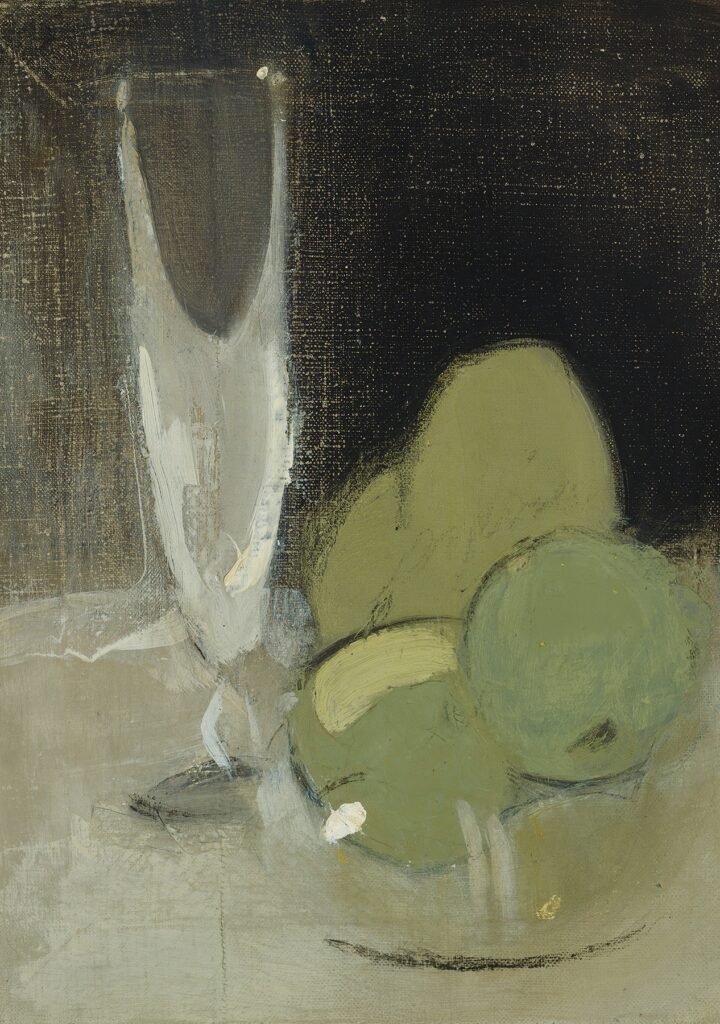
The publication of the poem is further enriched by its visual accompaniment. The featured title image—Green Apples And Champagne Glass (1934) by Finnish modernist painter Helene Schjerfbeck—provides a modernist dialogue with Broek’s themes. Schjerfbeck’s minimalist, spare aesthetic mirrors the stripped-down, emotionally raw language of Broek’s verse, where every line feels pared down to its absolute structural necessity.
Future Outlook: The Role of Vulnerable Art in Healing
As discussions surrounding mental health, adolescent trauma, and the systemic pressures on caregiving families continue to dominate public discourse, works like Michael Broek’s "Stem" serve an essential cultural and therapeutic function.
Breaking the Silence
For decades, familial struggles with severe mental illness, self-harm, and addiction were relegated to the shadows of shame and secrecy. Families bore their grief in isolation, fearing social judgment or institutional failure. By bringing these raw experiences into the light of literary art, poets like Broek dismantle the stigma surrounding mental health crises.
The Future of Broek’s Work
With "Stem" receiving widespread acclaim as Poem of the Week, readers and literary critics alike are eagerly looking toward Broek’s future projects. His ability to fuse rigorous literary craftsmanship—informed by masters like Beckett—with unflinching autobiographical honesty ensures that his work will remain a touchstone for contemporary verse.
Ultimately, "Stem" offers no facile resolutions or comforting platitudes. There is no miraculous recovery neatly tied up in the final stanza, no sudden epiphany that erases the scars. Instead, the poem offers something far more valuable: a mirror for the exhausted, the grieving, and the fiercely devoted. It reminds us that even when love fails to cure, and even when the child wishes for the parent to disappear, the act of bearing witness—of simply staying in the room, looking at the scars, and acknowledging the hurt—is an act of profound, enduring grace.





Comments
Facebook App ID not configured. Please add it in the Customizer.