
EXECUTIVE OVERVIEW
Decades after its landmark publication in 1969, Kurt Vonnegut’s Slaughterhouse-Five; or, The Children’s Crusade: A Duty-Dance with Death remains a towering monument of 20th-century American literature. Blending dark humor, science fiction, historical trauma, and fragmented nonlinear narratives, the novel crystallized the disillusionment of a generation scarred by global conflict. Yet, the genesis of Billy Pilgrim’s cosmic odyssey—and the complex, multifaceted life of its creator—extends far beyond the traditional boundaries of literary criticism.
Recently, literary scholar Susan Farrell, author of the definitive critical study Vonnegut’s War: The Making of Slaughterhouse-Five, compiled an exhaustive profile of ten lesser-known realities regarding Vonnegut’s life, his wartime trauma, his academic pursuits, and the surprising cultural catalysts that shaped his masterwork. Drawing from archival discoveries, newly unearthed love letters, and biographical milestones, this analysis presents an authoritative examination of the man behind the typewriter. From his harrowing incarceration in a subterranean Dresden slaughterhouse to his unexpected cameos in Hollywood cinema, the narrative of Kurt Vonnegut is one of profound resilience, artistic reinvention, and an enduring crusade for human empathy.
Read Also
DETAILED CHRONOLOGY
1. Crucible of the Battle of the Bulge: The Shared Realities of Creator and Character
To understand the psychological architecture of Slaughterhouse-Five, one must retrace Kurt Vonnegut’s steps through the freezing, chaotic landscape of the European Theater during World War II. Serving as an intelligence scout with the 106th Infantry Division, Vonnegut found himself cut off and captured behind enemy lines during the brutal winter offensive known as the Battle of the Bulge.
Much like his fictional alter-ego, Billy Pilgrim, Vonnegut experienced the indignities of war firsthand. He was packed tightly into crowded, unheated boxcars alongside hundreds of starving, shell-shocked American prisoners of war. Transported deep into Germany, he was eventually incarcerated in a former slaughterhouse—Slaughterhouse Five (Schlachthof fünf)—in the historic city of Dresden.
It was within this subterranean brick fortress that Vonnegut, reduced to a state of emaciation and filth, survived the catastrophic Allied firebombing of February 1945. In the aftermath of the phosphorus-fueled firestorm that obliterated the cultural hub of Dresden, Vonnegut and his fellow prisoners were forced onto grim labor details: unearthing decaying human corpses from the suffocating rubble.
The emotional resonance of the novel was heavily anchored by real comrades Vonnegut encountered in captivity:
- Edward R. Crone, Jr.: A gentle, passive young man whose physical and psychological collapse culminated in his tragic death from despair and malnutrition. Crone served as the direct biological and psychological blueprint for Billy Pilgrim.
- Michael Palia: A fiercely patriotic high school teacher who was summarily executed by his German captors after being caught looting a simple jar of string beans. Palia’s rigid ideals and unjust fate were immortalized through the character of Edgar Derby.
2. The Labyrinth of Historical Record: Uncovering the Dresden Firebombing
Securing accurate, verified historical data regarding the destruction of Dresden proved to be a formidable, nearly impossible bureaucratic hurdle for Vonnegut in the post-war decades. When the author formally petitioned the United States government for official documentation and casualty figures concerning the firebombing, he was routinely rebuffed. Government officials informed him that the catastrophic event remained classified under "top secret" clearance.
Denied access to official state archives, Vonnegut turned to alternative historical literature, heavily relying on British historian David Irving’s 1963 monograph, The Destruction of Dresden. At the time of its release, Irving’s work was widely praised as a critically acclaimed, authoritative account of the raid.
However, history would reveal a bizarre, Kafkaesque twist. Decades after Vonnegut utilized the text, Irving’s scholarly reputation collapsed spectacularly. Embroiled in controversies involving forged Nazi documents, Irving faced a British court of law that formally ruled his historical writings had deliberately manipulated and misrepresented empirical evidence. Irving was later sentenced to three years in prison in Austria for gross Holocaust denial. This ongoing historical controversy underscored the elusiveness of truth regarding Dresden—a city whose actual death toll has been intensely debated by historians for over half a century.
3. Cold War Paranoia and the Genesis of Alien Abduction
While Slaughterhouse-Five is universally recognized as an anti-war masterpiece, its structural integration of science fiction elements was a relatively late development. Archival research demonstrates that the concept of alien abduction did not enter Vonnegut’s initial drafts until 1967, long after he had begun structural work on the manuscript.
During the mid-to-late 1960s, American popular culture was saturated with sensationalized accounts of extraterrestrial encounters, most notably the highly publicized 1961 Betty and Barney Hill abduction case. Fueled by prevailing Cold War anxieties surrounding rapid advancements in space exploration, rocketry, and reproductive technologies, these post-war cultural myths provided Vonnegut with a brilliant narrative framework.
For Billy Pilgrim—a man psychologically fractured by trauma—the fantasy of being kidnapped by the Tralfamadorians serves as a vital coping mechanism. The aliens teach Billy a deterministic philosophy of time where past, present, and future occur simultaneously, and where death is merely an illusion. By framing his wartime horror through the lens of science fiction, Billy constructs a psychological sanctuary against unbearable memories.
4. The Journalistic Apprenticeship
Long before he achieved international literary renown, Vonnegut honed his precise, conversational, and deceptively simple prose style within the demanding ecosystem of daily journalism. Following in the illustrious footsteps of American literary giants such as Mark Twain, Walt Whitman, and Ernest Hemingway, Vonnegut learned the disciplines of brevity, clarity, and narrative hook through the press.
His formal training began at Shortridge High School in Indianapolis, a progressive public institution that boasted its own daily student-run newspaper. Vonnegut served with distinction as both a reporter and editor for the Shortridge Echo. He continued this journalistic trajectory at the collegiate level as a staff contributor for The Cornell Daily Sun.
Upon returning from the European theater of war, Vonnegut worked briefly as a reporter for the Chicago City News Bureau. While he seriously weighed a permanent career in journalism, his growing obsession with speculative fiction eventually led him to abandon the newsroom for the solitary life of a fiction writer.
SUPPORTING CONTEXT & METRICS
The Epistolary Romance: Letters to Jane Cox Vonnegut
Beyond his published works, recent archival discoveries—curated and published by his daughter, Edith Vonnegut—have shed light on the author’s romantic inner life. A vast collection of wartime and early post-war letters written to his first wife, Jane Cox Vonnegut (affectionately nicknamed "Woofy"), reveals a young man consumed by artistic ambition and deep emotional devotion.
Illustrated frequently with charming hand-drawn sketches and original poems, these letters reflect Vonnegut’s early intellectual influences, including his admiration for Henry David Thoreau, his respect for the scientific method, and his grappling with complex existential philosophy. Yet, the emotional core of the correspondence remained his absolute adoration for Jane. In a letter dated May 3, 1944, he wrote:
"Darling, at this moment, as I write, you are being loved so much that my heart is nearly bursting."
Following their marriage, when military obligations forced them apart, Vonnegut expressed profound gratitude for what he described as "the cool, the sweet, the gentle and deep, the brilliant, exquisitely melodic, rhapsodic, rolling, rumbling, thundering, hell-fire burning, throbbing, bursting, trembling, sighing, crying, dying, smiling, sleeping love" that Jane provided him amidst a world at war.
The Anthropological Turn: The University of Chicago
When asked by his son Mark to identify the happiest moment of his life, Vonnegut pointed directly to the autumn of 1945. Freshly discharged from the U.S. Army, he was admitted as a graduate student to the University of Chicago. Recalling that day, he remarked with relief: "At last! I was going to study man!"
At Chicago, Vonnegut became deeply influenced by the lectures of cultural anthropologist Dr. Robert Redfield. Redfield focused on small-scale folk societies—communities compact enough that every individual was personally known and valued for their intrinsic humanity rather than their utility as economic cogs. For Vonnegut, Redfield’s theories provided a sociological lens through which to critique modern American civilization, explaining why human beings struggle so profoundly with the crowded anonymity, isolation, and alienation of urban life.
Navigating Domestic Chaos: The Integration of Six Children
The domestic equilibrium of the Vonnegut household was radically disrupted in 1958 by a horrific dual tragedy. In a span of 48 hours, Kurt’s beloved sister Alice died of cancer, while her husband, James Adams, was killed instantly in a catastrophic commuter train crash.
Displaying extraordinary compassion, Kurt and Jane Vonnegut stepped forward to take in the four orphaned Adams children. While the youngest toddler was eventually adopted by relatives in Alabama, the three older boys (aged 14, 11, and 9) integrated permanently into the Vonnegut home, joining the couple’s three biological children.
The sudden expansion to a household of six children transformed the family dynamic into a whirlwind of controlled chaos. The home was loud, disorganized, and notoriously freewheeling, yet rich in artistic imagination. For Kurt, the loss of Alice left a permanent psychological scar; she had been fiercely cherished and served as the primary, idealized imaginary audience for his early writing.
Kilgore Trout and Theodore Sturgeon
One of Vonnegut’s most enduring literary creations is the recurring fictional character Kilgore Trout: a brilliant, prolific science-fiction author whose revolutionary ideas are perpetually hamstrung by atrocious prose, leading to his work being relegated to the dusty back pages of pornography pulp magazines. Trout makes his most profound thematic appearance in the 1973 novel Breakfast of Champions, where Vonnegut himself steps directly into the narrative to confront Trout, informing him of his fictional status and granting him literary emancipation.
While Trout clearly functions as a satirical self-portrait of Vonnegut’s own anxieties regarding the literary establishment, the character was directly modeled after a real-life contemporary: science-fiction pioneer Theodore Sturgeon. During the height of the genre’s mid-century golden age, Sturgeon was one of the most widely anthologized authors alive. Vonnegut befriended Sturgeon while both men were living on Cape Cod, immortalizing Sturgeon’s eccentric brilliance through Trout’s tragicomic persona.
OFFICIAL STATEMENTS & PUBLIC INTELLECTUALISM
The Commencement Orator: Dismantling the Myth of the "Good War"
In his later decades, Vonnegut evolved into one of America’s most sought-after and unconventional graduation speakers. Eschewing the conventional platitudes of academic success, he delivered biting, darkly humorous, and deeply philosophical commencement addresses that left indelible impressions on graduating classes.
During the height of the Vietnam War in the early 1970s—a conflict widely condemned by university students—Vonnegut utilized his personal combat experiences to dismantle the romanticized cultural narrative of righteous militarism. In one memorable address, he noted:
"For all the sublimity of the cause for which we fought, we surely created a Belsen of our own."
He argued before generations of young scholars that military science inherently views human beings as contemptible commodities—and that the institution is likely correct in its cynical assessment. However, he urged students to actively refute that inherent contemptibility through the creation of art. According to Vonnegut, art places human beings at the absolute center of the moral universe, empowering individuals to imagine and construct a kinder, saner, and vastly more just society.
FUTURE OUTLOOK: THE ENDURING LEGACY OF KURT VONNEGUT
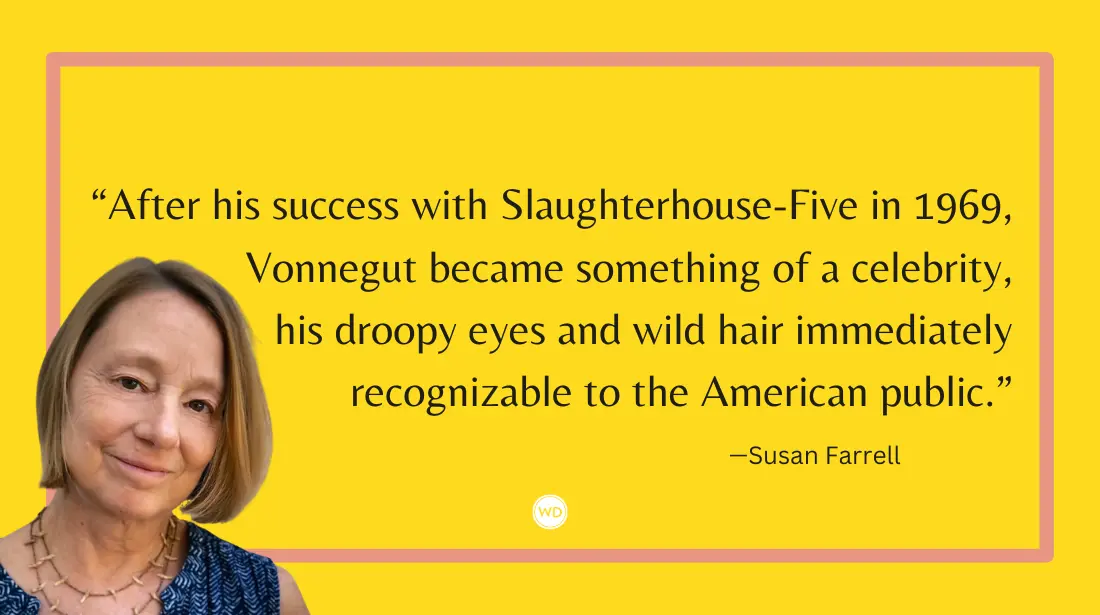
By the time Slaughterhouse-Five cemented his cultural ubiquity in 1969, Vonnegut had transitioned from a struggling pulp writer into a bona fide American literary celebrity. Instantly recognizable by his unruly mop of hair and permanently drooping, melancholy eyes, he became a fixture of American cultural life. He hosted television adaptations of his short stories, fronted national advertising campaigns for Discover credit cards and the National Coffee Association, and provided voice work for Ken Burns’s landmark PBS documentary series, The Civil War.
Among his many pop-culture crossovers, perhaps none was more delightfully self-aware than his cameo in the 1986 Rodney Dangerfield comedy Back to School. In the film, Dangerfield’s lovable-slacker character hires the famous author to write a college term paper analyzing Vonnegut’s own literary canon—only to receive a failing grade from an oblivious professor who insists the essay proves the student knows nothing whatsoever about Vonnegut’s work.
As academic analyses like Susan Farrell’s Vonnegut’s War continue to unpack the deep historical and biographical roots of his bibliography, Kurt Vonnegut’s legacy remains profoundly secure. Far from being relegated to the dusty shelves of mid-century counterculture history, his warnings against unchecked technology, political polarization, institutional cruelty, and the horrors of mechanized warfare resonate with urgent, chilling relevance in the 21st century. Through Billy Pilgrim, Kilgore Trout, and his own unflinching memories of the Dresden ash, Vonnegut taught generations of readers that while human cruelty may be inevitable, the human imperative to create art, demand justice, and insist upon radical empathy remains our most powerful defense against the dark.




Comments
Facebook App ID not configured. Please add it in the Customizer.