
On a balmy Wednesday evening in North London, against the backdrop of a shifting political landscape and the suffocating weight of post-imperial decline, a nation’s collective consciousness fractures along two very distinct fault lines: the semi-finals of the World Cup and the dizzying, perpetual motion machine of British governance.
This report chronicles the intersection of football mania and national politics during a tumultuous week marked by England’s heartbreaking semi-final exit against Argentina, the sudden rise of Andy Burnham to the premiership, and the quiet, deeply human undercurrents of anticipation experienced by those on the sidelines—specifically, a heavily pregnant partner watching the theater of national self-delusion unfold from the comfort of a Guinness 0.0.
Through the lens of cultural critique, philosophical inquiry into the nature of "hope" versus "optimism," and first-hand accounts from a packed North London pub, we examine how a weary populace continuously oscillates between cynical detachment and a desperate, cyclical longing for national redemption.
Read Also
Detailed Chronology: The Week That Was
Wednesday Evening: The Semi-Final Grudge Match
The atmosphere inside The Winchester on Archway Road is suffocatingly dense fifteen minutes before kickoff. The pub is standing-room only, pulsating with the raw, volatile energy of fifteen years of political exhaustion channeled entirely into a ninety-minute football match.
Outside, a sudden drop in temperature has given way to an uncharacteristically perfect, balmy summer evening. Inside, however, the air is thick with anticipation and low-grade dread. The author’s heavily pregnant partner has stayed home, opting out of the "tiresome and dispiriting" exercise of sitting marooned with a non-alcoholic beverage while patrons toss out lazy conversational tropes.
As the television screens flash with familiar celebrity faces—Mick Jagger, David and Victoria Beckham—the national myth-making machine hits overdrive. Why else would royalty and rockstars assemble if not for an ordained victory?
The match itself proves to be a grueling spectacle. The first half is a nervy, foul-laden slog—nineteen fouls in total, characterized by a lack of attacking fluency and an abundance of defensive caution. John Stones manages a header wide in the 33rd minute, while Argentina’s Lionel Messi and Enzo Fernández probe defensively resilient English lines. The half ends scoreless, leaving patrons to mill about in bored, restless chatter.
The second half explodes into life. Following a chaotic sequence involving Declan Rice and Morgan Rogers, Anthony Gordon crashes the ball past the Argentine keeper in a moment that sends the Winchester into absolute pandemonium. For four fleeting minutes, England appears ascendant.
Yet, the historical ghosts of English football soon materialize. Dropping into a defensive shell with a meager 12 percent possession, England absorbs wave after wave of attack. In the 85th minute, Fernández converts a Messi corner, and in stoppage time, Lautaro Martínez delivers a fatal header. Final score: Argentina 2, England 1.
As the crowd shuffles out into the night, the familiar national malaise sets in. A drunk patron hurls xenophobic abuse near a fan-made banner reading LAS MALVINAS SON ARGENTINAS, highlighting the toxic underbelly of football tribalism. The author’s Canadian partner diagnoses the national affliction with surgical precision: an endless pathology of decline, a bottomless narcissistic obsession rooted in unresolved postwar trauma.
Saturday Night: The Surreal Third-Place Playoff
Days later, the absurdity of the international tournament concludes with the third-place playoff between England and France. Arriving at a surprisingly empty Winchester, the author and his brother brace for a game devoid of stakes.
What follows is an utterly chaotic, high-scoring masterclass. By halftime, England leads 4–0, only to plunge the pub back into familiar, nail-biting anxiety as France claws the score back to 4–3. A penalty extends England’s lead, France counters again, and finally, Jude Bellingham seals a 6–4 victory with a brilliant solo run in stoppage time.
The match ends in an atmosphere of bizarre levity—Kylian Mbappé smiling, players hugging, and the neighborhood echoing with the muffled cheers of residents tracking the goalfest from afar.
Supporting Context & Metrics: Politics, Power, and the Rhetoric of Hope
While the nation fixated on the pitch, the political machinery of Westminster underwent a structural earthquake.
The Fall of Starmer and the Rise of Burnham
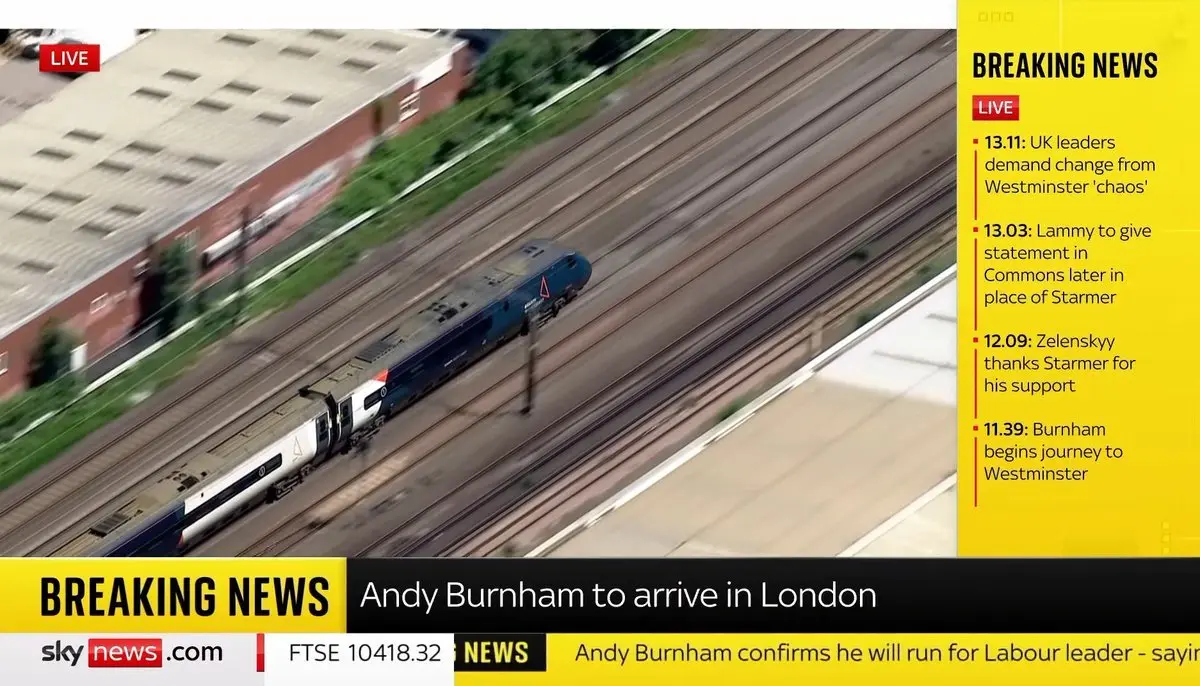
Just weeks prior, Labour MP Josh Simons stepped down from his Makerfield seat to trigger a by-election, paving the way for former Manchester Mayor Andy Burnham to re-enter parliament. Operating against the backdrop of a deeply unpopular incumbent government led by Sir Keir Starmer—whose personal approval ratings languished underwater for years—Burnham secured a resounding local victory, declaring that his constituents had "voted for hope."
On June 29, at the People’s History Museum in Manchester, Burnham formally launched his leadership bid, invoking the word "hope" no fewer than eight times across a soaring address. This political pivot stood in stark contrast to the technocratic, managerial austerity that defined Starmer’s brief, highly contentious tenure—a tenure that ultimately collapsed not due to ideological grand failure, but because of a catastrophic mismanagement of public "vibes," culminating in widespread alienation across both the political left and right.
The Philosophical Divide: Hope vs. Optimism
Drawing on Terry Eagleton’s seminal text Hope Without Optimism, the political and cultural posturing of the week invites a rigorous philosophical distinction:
- Optimism is bovine, unreflective, and primordial. It assumes a positive outcome without deep study, frequently collapsing into its corrupt corollary: self-delusion and institutional disappointment (paradigmatically captured by Shepard Fairey’s iconic Obama "HOPE" poster, which eventually curdled into a symbol of the "disappointment industrial complex").
- Hope, by contrast, is an active, reasoned commitment to the open possibilities of the future. It is the enemy of both idle utopianism and paralyzing despair.
In British politics, where fifty years of diminishing returns and rolling austerity have baked systemic decline into the state apparatus, hope has become an endangered import. Every electoral cycle since the 2006 financial crash and the 2016 Brexit referendum has represented a desperate "twist"—a visceral rejection of whoever held power last, driven less by ideological alignment and more by a collective longing to escape national numbness.
Official Statements & Public Discourse
The rhetorical reliance on "hope" by incoming Prime Minister Andy Burnham signaled an intentional break from the bloodless managerialism of the Starmer era. In his inaugural address to the Trades Union Congress in London, Burnham explicitly renounced the neoliberal consensus that has dominated British economic policy since the 1980s:
"Four decades of the neoliberalism that began in the 1980s have not been kind to the places that built our Party. Political power was centralised and economic power was privatised… We are going to give them hope back."
Yet, skepticism remains the default setting of the British electorate. As Burnham himself rhetorically queried during his launch speech:
"What hope can we have that it will be different this time?"
Given that the United Kingdom has cycled through seven prime ministers in a decade—Cameron, May, Johnson, Truss, Sunak, Starmer, and now Burnham—the certainty of change is matched only by the deep uncertainty of competence.
Future Outlook: Expecting the Unexpected
As the dust settles on both the World Cup tournament and the latest iteration of Westminster musical chairs, the broader cultural horizon remains charged with a quiet, domestic uncertainty.
The experience of the tournament—and the parallel reality of navigating impending parenthood—forces a reconciliation between institutional timelines and personal agency. Medical frameworks of pregnancy, much like political manifestos, are inherently optimistic: they impose schedules, due dates, and statistically likely trajectories. Yet, lived experience remains stubbornly hopeful, defined by lingering doubts, open-ended potential, and the courage to face unknowns without prophetic guarantees.
Looking ahead to the 2030 World Cup, a new generation will enter the fold. Whether England can finally shatter its cycle of near-misses on the pitch—and whether a reorganized British state can transcend its fifty-year narrative of managed decline—remains entirely unwritten.
For now, the nation returns to its default setting: bruised, slightly cynical, but perpetually, stubbornly open to the possibility that the next time, just maybe, things will be different.



Comments
Facebook App ID not configured. Please add it in the Customizer.