
Executive Overview
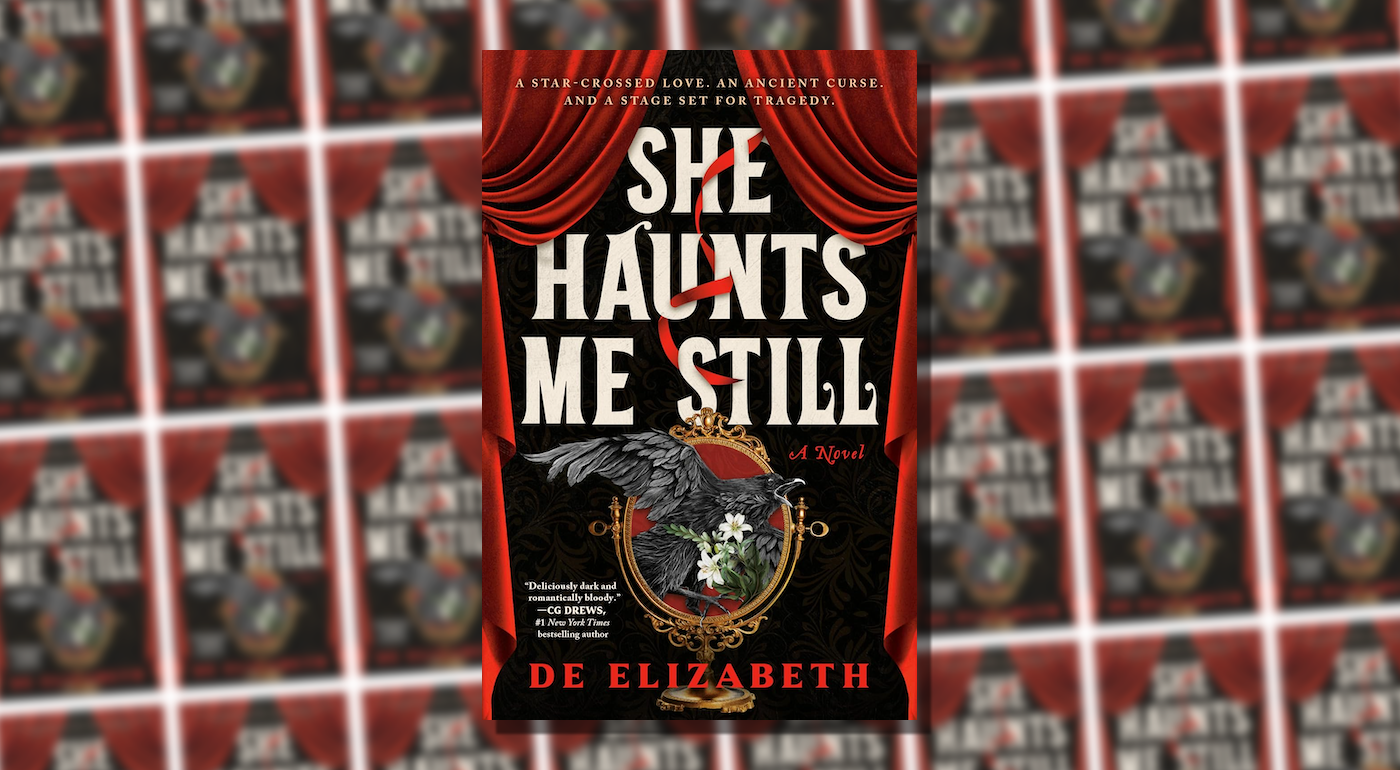
Literary history is replete with works that position the theater as a liminal space—a threshold where identities dissolve, boundaries blur, and the living briefly inhabit the ghosts of fictional personae. Yet, few contemporary Gothic novels merge the visceral, bodily transformation of the dramatic arts with historical supernaturalism quite as distinctively as De Elizabeth’s debut novel, She Haunts Me Still, published by Dutton.
Set against the atmospheric backdrop of an elite New England institution steeped in institutional dread, Elizabeth’s narrative weaves together the 19th-century New England vampire panic, the rigid structures of William Shakespeare’s Romeo and Juliet, and a slow-burning modern-Gothic mystery. The novel follows Mallory, a college freshman arriving at Shore College under mysterious and preordained circumstances, accompanied by her longtime friend Arden. Burdened by a generations-spanning family curse that claimed her mother’s life, Mallory finds herself thrust into the lead role of Juliet, triggering a cascade of uncanny visions, dangerous romantic fixations, and unsettling physical manifestations.
This review and literary analysis examine She Haunts Me Still through an investigative and authoritative lens, charting its narrative chronology, exploring its historical touchstones, analyzing its bodily motifs, and positioning it within the broader landscape of contemporary Gothic and campus-horror fiction.
Read Also
Detailed Chronology & Narrative Arc
The Threshold of Shore College: 1999
She Haunts Me Still opens in the autumn of 1999, a deliberately chosen temporal anchor. By setting the narrative at the cusp of the new millennium, Elizabeth captures a specific technological and social milieu: cellphones exist and provide a baseline tether to the outside world, yet social media does not yet dominate the consciousness of young adults. This isolation allows the hothouse environment of Shore College to exert maximum psychological pressure on its students.
Shore College itself is an institution pregnant with institutional secrets. Most notably, the campus occupies the grounds of a former 19th-century sanitarium—a structural legacy that forms the literal and metaphorical foundation for the haunting secrets unearthed by the protagonists. Furthermore, the novel kicks off with an immediate, arresting premise encapsulated by its opening line: "Secrets are a kind of sickness."
The Audition and the Awakening
Upon arrival, Mallory discovers she has been accepted into Shore College’s prestigious drama program despite having never actually applied—the first in a series of disquieting anomalies. Seeking normalcy or perhaps drawn by an inescapable gravitational pull, Mallory auditions for the campus production of William Shakespeare’s Romeo and Juliet and promptly wins the coveted title role.
It is through rehearsals that Mallory’s world expands and fractures. She becomes deeply entangled with two pivotal figures:
- Saskia Garin: A fiercely magnetic castmate whose own body tells a story of survival, having triumphed over childhood cancer. Saskia begins experiencing her own spectral flashes and visual anomalies that mirror Mallory’s waking nightmares.
- Erasmus "Ezra" Pierce: An older student with an ambiguous and controversial past, whose sudden arrival at Shore mirrors Mallory’s own unverified enrollment. Ezra’s very wealthy father hints at deep, proprietary ties to the college that predate the students’ arrival.
The Slow Burn and the Escalation
In its first half, She Haunts Me Still operates as a meticulous, slow-burning psychological mystery. The supernatural elements do not announce themselves with cinematic bombast; rather, they seep into the text through quiet portents, fleeting visions of the dead, and the oppressive weight of Mallory’s family history.
Mallory is haunted not only by literal ghosts but by the legacy of her mother’s premature, curse-driven demise. As rehearsals for Romeo and Juliet progress, the lines between performance and possession begin to fray. The physical demands of the stage bleed into the characters’ waking lives, manifesting as explicit, highly charged romantic encounters marked by the visceral intimacy of biting—a motif that edges the narrative firmly into vampire-adjacent territory.
As the mysteries multiply—why Mallory sees the dead, why Saskia shares these spectral visions, why Ezra fled his former school, and what dark pact connects Ezra’s father to Shore College—the novel sheds its slow-burn pacing. In its latter half, the narrative explodes into over-the-top, ecstatic Gothic excess, most notably during a hallucinatory sequence where a character undergoes birdlike, avian transformations.
Supporting Context & Thematic Metrics
To fully appreciate the architecture of She Haunts Me Still, one must examine the socio-historical and literary mechanics that Elizabeth employs. The novel functions at the intersection of three distinct frameworks: theatrical embodiment, historical folklore, and bodily vulnerability.
1. The Theater as Possession
Elizabeth posits that the theater is the ultimate setting for stories of haunting because acting itself is a form of spiritual occupation. Embodying a character—stepping into the skin of another life, surrendering one’s voice and physical form to an external blueprint written centuries prior—is structurally indistinguishable from demonic or spectral possession.

When an actor takes on a role like Stanley Kowalski in A Streetcar Named Desire or Juliet Capulet, they invite an entity to hijack their instrument. In She Haunts Me Still, this metaphor becomes literal. The theatrical framework of Romeo and Juliet dictates the structural trajectory of the characters’ doomed entanglements, transforming dramatic irony into literal fate.
2. Historical Roots: The New England Vampire Panic
At the heart of Mallory’s family curse lies a deep connection to regional 19th-century history: the documented New England vampire panic. During this era, fearful communities in rural New England exhumed the bodies of deceased relatives, searching for physical signs of continued vitality—such as fresh blood in the heart—convinced that the dead were rising from their graves to consume the living.
Elizabeth’s integration of this folklore places She Haunts Me Still in a fascinating conversation with other contemporary works exploring the same historical trauma, such as Paul Tremblay’s The Pallbearers Club. While Tremblay approaches the material through a framework of memoir and ambiguous supernaturalism, Elizabeth leans into the visceral, bodily horror of bloodlines, consumption, and inherited contagion.
3. The Body as Archive
Bodies in She Haunts Me Still are never merely aesthetic vessels; they are archives of trauma, illness, and hereditary destiny. The novel relentlessly centers physical vulnerability:
- Mallory’s lineage: Burdened by a maternal curse that manifests as physical decline and early death.
- Saskia’s survival: Marked indelibly by childhood cancer, leaving physical reminders of mortality that inform her fierce presence on stage.
- The eroticization of violence: The prevalence of biting and bodily trauma during intimate encounters, connecting sexual awakening with predatory mythologies.
Comparative Literary Analysis
In contemporary Gothic fiction, She Haunts Me Still shares DNA with several notable predecessors while carving out a distinct aesthetic niche.
Critics and readers will find compelling parallels to Emily M. Danforth’s Plain Bad Heroines. Both novels successfully merge supernatural hauntings with the rigorous, obsessive craft of acting, anchoring their narratives in atmospheric, historically weighty New England settings.
Furthermore, the novel’s stylistic descent from controlled psychological realism into delirious, operatic excess evokes cinematic touchstones like Dario Argento’s masterpiece Opera. Like Argento’s film, Elizabeth’s novel traps an ingénue in a theatrical pressure cooker where conspiracies abound, culminating in an ecstatic, uninhibited third act that refuses to underplay its hand.
Future Outlook & Critical Reception
Published by Dutton to considerable anticipation, She Haunts Me Still establishes De Elizabeth as a formidable new voice in literary Gothic fiction and psychological horror.
+-------------------------------------------------------------------------+
                    CRITICAL RECEPTION & TRAJECTORY
+-----------------------------+-------------------------------------------+
| Metric / Milestone          | Status / Outlook                          |
+-----------------------------+-------------------------------------------+
| Publisher                   | Dutton (Penguin Random House)             |
| Primary Genre               | Gothic / Psychological Horror             |
| Thematic Focus              | Theatrical Possession, Historical Panic   |
| Literary Comparisons        | Emily M. Danforth, Paul Tremblay          |
| Reader Engagement           | High (Driven by slow-burn mystery & excess)|
+-----------------------------+-------------------------------------------+
As horror and dark literary fiction continue to reclaim tropes traditionally sidelined as genre fiction—such as campus mysteries and theatrical melodramas—Elizabeth’s work points toward a healthy future for the "academic Gothic." While the novel prioritizes high-stakes supernatural investigation over the granular mechanics of theatrical training in its latter half, it hints at a versatile authorial register capable of balancing intellectual precision with unbridled, over-the-top terror.
For readers seeking a novel that treats the stage not merely as a platform for drama, but as an altar for ghosts, She Haunts Me Still stands out as an essential, blood-infused triumph.
De Elizabeth’s She Haunts Me Still is available now through Dutton and major booksellers. Readers interested in sampling the atmosphere can access official novel excerpts online.




Comments
Facebook App ID not configured. Please add it in the Customizer.