
Executive Overview
In an industry long dominated by corporate conglomerates and sprawling distribution pipelines, the landscape of independent literature is undergoing a quiet, determined renaissance. Ten years after its conceptualization on the floor of the American Booksellers Association’s Winter Institute in Denver, the Independent Publishers Caucus (IPC) has matured into an indispensable anchor for the country’s mid-sized and boutique literary houses. Boasting 107 member publishers—up from 69 at its five-year milestone—the organization has transitioned from an informal collective of entrepreneurial risk-takers into a structured, proactive powerhouse complete with a dedicated steering committee and a full-time executive director.
Today, the IPC stands as a vital counterweight to the "Big Five" publishing houses, championing a distinct ethos that places cultural resonance, artistic risk, and ideological diversity well above corporate profit margins. By tackling structural isolation head-on, the IPC provides its members with a unified voice, collective bargaining strength, and shared institutional knowledge.
The launch of the IPC Top 40 bestseller lists earlier this year marks a watershed moment for the organization. Tabulated directly from independent bookstore sales data via the American Booksellers Association (ABA), these dedicated adult fiction and nonfiction rankings tear down the obscurity that has historically plagued mid-list and indie titles. By bridging the gap between creators, sellers, and readers, the IPC is not merely surviving the modern publishing climate—it is actively redesigning it.
Read Also
Detailed Chronology: From Denver Incubator to Industry Force
The Genesis: 2016 Winter Institute
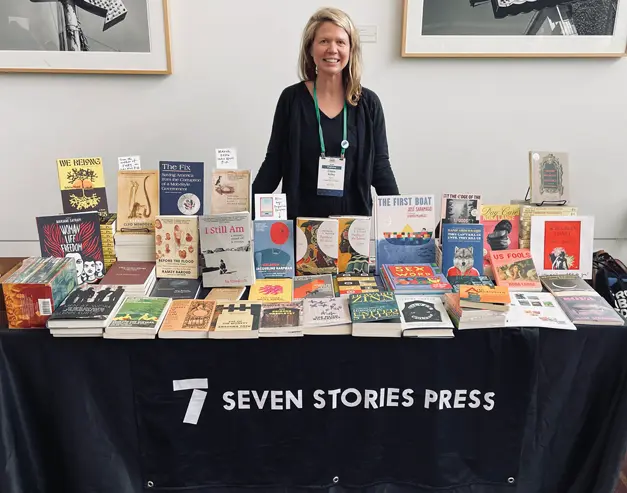
The roots of the IPC trace back to a shared frustration among independent publishers who found themselves navigating a fractured, high-stress industry devoid of centralized support. At the 2016 ABA Winter Institute in Denver, Seven Stories Press publisher Dan Simon and former Beacon Press associate publisher Tom Halleck sat down to map out an ambitious blueprint: a professional organization specifically designed to unify, advocate for, and economically empower independent presses.
They recognized that while independent bookstores had a powerful advocate in the ABA, and literary agents had the Association of American Literary Agents (AALA), mid-sized independent publishers operated in a professional vacuum. They lacked a centralized trade body to address shared concerns regarding distribution visibility, economies of scale, marketing infrastructure, and institutional advocacy.
The Growth Trajectory and Institutionalization
In the years following its founding, the IPC experienced steady, deliberate expansion. By its five-year mark, the caucus had grown to 69 member houses. Rather than pursuing explosive, unmanageable growth, the organization focused on building internal structures: establishing a formal steering committee, codifying membership requirements, and securing professional leadership.
Currently, the organization is spearheaded by Executive Director Daniel O’Brien—who concurrently serves in a similar leadership capacity for the AALA—bringing institutional rigor and deep literary industry expertise to the caucus.
Reaching a Milestone: The IPC Top 40 Bestseller Lists
In early 2026, the IPC achieved one of its most ambitious strategic goals to date: the rollout of the IPC Top 40 bestseller lists. Comprising separate weekly rankings for adult fiction and nonfiction, and with a children’s book list currently in development, these charts are tabulated by the ABA using real-time sales data from independent bookstores across the United States.
For a decade, indie publishers struggled against mainstream algorithms and commercial lists that favor massive marketing budgets over literary merit. The IPC Top 40 has changed that dynamic, offering a transparent, culturally vibrant metric of what readers are actually buying when they walk into their local neighborhood bookshops.
Supporting Context & Metrics: Defining "Independence" in Modern Publishing
Membership Criteria and Structural Boundaries
In an era where corporate imprints frequently market themselves as "indie" to capture the authenticity-driven consumer base, the IPC maintains strict, uncompromising definitions. To qualify for membership, a publishing house must meet clear operational parameters:
- Catalog Depth: Must have at least 10 books currently in print.
- Author Diversity: Must feature works by at least three distinct authors.
- Staff Limitations: Must employ no more than 60 full-time staff members.
These carefully calibrated boundaries intentionally exclude massive independent conglomerates such as W.W. Norton or Grove Atlantic. While these larger independent entities wield considerable market power, the IPC was explicitly built to serve the unique operational vulnerabilities of smaller, mission-driven presses that lack massive corporate safety nets.
The Post-Pandemic Retail Boom
The timing of the IPC’s recent expansions coincides with a remarkable resurgence in physical retail. According to data from the American Booksellers Association, approximately 600 new independent bookstores have opened across the United States since the onset of the COVID-19 pandemic.
This retail renaissance presents both an opportunity and a hazard for indie publishers. While more storefronts mean more potential shelf space, new booksellers—often unfamiliar with the complex mechanics of book distribution—can easily default to ordering exclusively from major conglomerates simply out of habit or convenience. Recognizing this, the IPC has begun structuring targeted outreach programs designed to put frontlist and backlist titles from independent presses directly onto the radar of newly established shop owners before corporate defaults become institutionalized.
Official Statements & Member Perspectives: Purpose Before Profit
The heartbeat of the IPC is its fiercely protective community ethos. To understand the organization is to understand the psychological and operational toll of running an independent publishing house.
Escaping "The Darkness" of Isolation
Emily Saer Cook, founder of Cursor Literary and a dedicated member of the IPC’s education committee, describes the pre-IPC era for independent publishers as "the darkness"—a state of profound professional isolation.
"The IPC has given us language for how strong independent publishing is," Cook observes. In an industry where publishers are perpetually overextended, she notes that “the work is endless, and it’s hard to come up for air.”
Without the caucus, small publishers are left to solve systemic distribution, marketing, and legal challenges entirely on their own, often duplicating administrative efforts while drowning in overhead.
The Philosophy of Purpose Over Profit
Christie Henry, director of Princeton University Press—the caucus’s largest member publisher, which joined the fold three years ago—captures the ideological core that binds the 107 member houses together:
"I think you can summarize it as publishers who put purpose before profit."
Henry points to the caucus’s collaborative educational initiatives as concrete proof of this philosophy in action. Recently, the IPC developed a shared virtual training program for interns across various member presses. Rather than forcing each small, resource-strapped publishing house to design an internship curriculum from scratch, the caucus pooled its institutional knowledge.
"Our interns loved it," Henry says, hailing the program as one of the "clearest cases of the caucus creating value that smaller members couldn’t produce alone."
Cutting Through the Noise
Dan Simon, publisher of Seven Stories Press and co-founder of the IPC, draws a sharp contrast between mainstream commercial charts and the vitality of independent literary curation:
"Go look at the New York Times bestseller list—mostly it’s things that are selling but aren’t really changing hearts and minds. Now, go look at the IPC Top 40 fiction or nonfiction list, and there’s all this dynamism."
Sanj Kharbanda, associate publisher and director of sales and marketing at Beacon Press and a member of the IPC steering committee, emphasizes that the list solves a critical information asymmetry for booksellers.
"Booksellers, especially new ones, often can’t tell which titles come from independent presses, since so many are distributed through the same channels as the Big Five," Kharbanda explains. The IPC Top 40 strips away the corporate fog, allowing booksellers to curate their shelves with intention.
Future Outlook: Strategic Horizons and Controlled Growth
As the Independent Publishers Caucus looks toward its second decade, its leadership is deliberately charting a course defined by sustainable impact rather than unchecked expansion.
Cautious, Intentional Growth
Unlike many trade organizations obsessed with maximizing membership numbers and collecting dues, the IPC’s leadership maintains a strict philosophy of quality over quantity.
"There is no goal to grow to 150 or 200 members," notes Sanj Kharbanda. "We’re happy where we are. We just want to make sure that everybody who’s in it is in it for the right reasons. And the right reasons include putting in sweat equity alongside everybody else."
This requirement of active participation ensures that the caucus remains an agile, problem-solving collective rather than a bloated, bureaucratic trade association.
Expanding Institutional Bridges: Libraries and Digital Infrastructure
Looking ahead, the IPC is aggressively scaling its outreach beyond retail storefronts and into public institutions. Through its biennial in-person IndieLib Forum, held in conjunction with the Public Library Association’s annual conference, the caucus facilitates direct dialogues between independent presses and library procurement officers. Executive Director Daniel O’Brien notes that future iterations of the forum may pivot to hybrid or fully virtual formats to ensure broad librarian attendance at a time when municipal and public library budgets face severe tightening.
On the technological front, the caucus continues to leverage digital connectivity. Through bi-weekly virtual town halls, a dedicated members-only newsletter, and shared educational programming, the organization maintains a continuous feedback loop among its members.
Furthermore, current strategic initiatives are exploring pathways for direct-to-consumer (D2C) sales integration and advanced point-of-sale (POS) data synchronization with independent bookstores. These technological upgrades will allow independent presses to track regional reading trends with surgical precision, optimizing print runs and reducing unsold inventory waste.
Conclusion: A Resilient Literary Ecosystem
Ten years after its humble inception in a Denver conference room, the Independent Publishers Caucus has proven that collective solidarity is the ultimate antidote to corporate consolidation. By safeguarding the operational independence of its members while forging powerful new data channels like the IPC Top 40, the caucus has secured a permanent, vibrant space for literature that challenges, provokes, and inspires. In a publishing world perpetually pulled toward the lowest common denominator, the IPC ensures that purpose-driven books continue to find their way into the hands of readers who need them most.





Comments
Facebook App ID not configured. Please add it in the Customizer.