
Executive Overview
For generations of readers worldwide, Eiko Kadono has been synonymous with enchantment, imagination, and the soaring freedom of flight. Best known as the creative visionary behind the beloved 1985 children’s fantasy novel Kiki’s Delivery Service—which subsequently inspired Hayao Miyazaki’s iconic, critically acclaimed 1989 animated masterpiece of the same name—Kadono continues to shape the landscape of global children’s literature well into her tenth decade of life.
Earlier this month, the literary world eagerly anticipated a historic appearance by the 91-year-old author at Anime NYC. Kadono had planned to travel to New York City to personally unveil the forthcoming English translation of Kiki and the Other Witch, the eagerly awaited third installment in her enduring magical series. Although sudden, unforeseen health complications grounded her travel plans, preventing her from crossing the Pacific, the announcement proceeded as scheduled, generating massive excitement among fans, publishers, and industry insiders alike.
Rather than letting her absence dampen the momentous occasion, Kadono shared an exclusive, deeply personal letter with Publishers Weekly. In this poignant missive, the nonagenarian author reflects not only on her long-standing, romantic fascination with New York City—dating back to her postwar youth—but also offers a sharp, philosophical critique of the modern technological era. Amid rapid advancements in artificial intelligence and automation, Kadono issues a passionate defense of human agency, bodily language, and the irreplaceable power of the imagination.
Read Also
This article explores the trajectory of Kadono’s career, the background of her newest book release, the intricate details of her recent health-related absence from Anime NYC, and her broader reflections on the future of human creativity in a mechanized world.
Detailed Chronology
The Genesis of a Literary Phenomenon (1985–1989)
Eiko Kadono’s journey into the literary pantheon began over three decades ago. In 1985, she published Kiki’s Delivery Service (Majo no Takkyūbin), introducing readers to Kiki, a resourceful young witch navigating the trials of independence, adolescence, and self-doubt alongside her talking black cat, Jiji. The novel captured the imaginations of young readers across Japan with its tender depiction of growing up, finding one’s place in the world, and embracing the unique gifts one possesses.
The story reached an unprecedented global audience four years later when Studio Ghibli adapted the novel into an animated feature film directed by Hayao Miyazaki. Released in 1989, Miyazaki’s Kiki’s Delivery Service became a commercial and critical triumph, cementing its status as a cornerstone of modern animation. The film introduced Kadono’s charming magical universe to millions of international viewers who might not otherwise have encountered her written work, turning Kiki into an enduring cultural icon of resilience, youthful ambition, and gentle autonomy.
Expanding the Canon: Kiki and the Other Witch
Though the film adaptation firmly established Kiki’s place in pop culture history, Kadono’s literary universe continued to expand on the page. She penned subsequent adventures for the young protagonist, steadily deepening the lore of Kiki’s magical world.
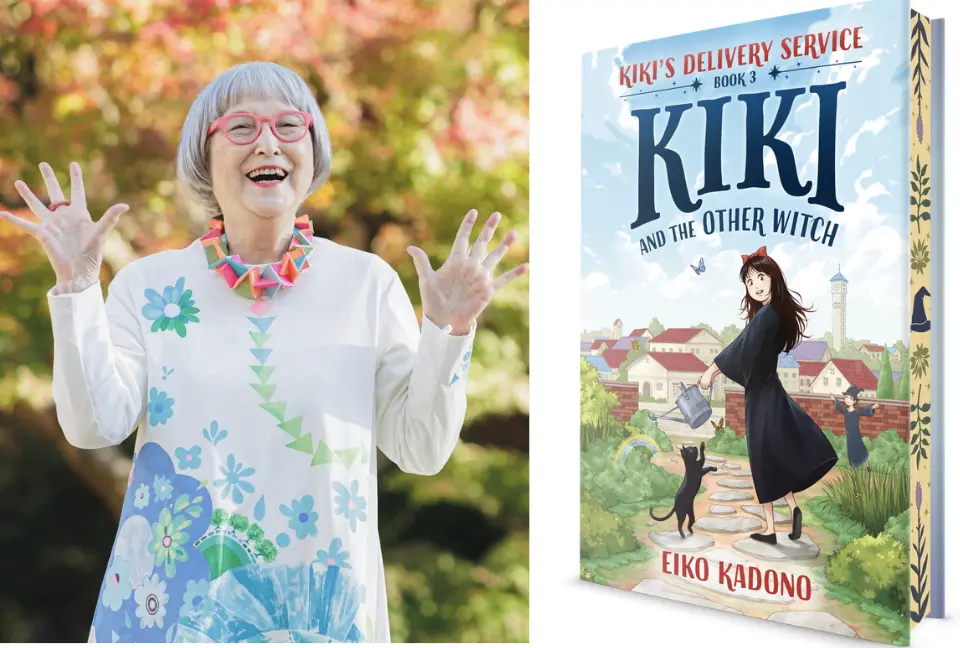
The latest milestone in this literary evolution is Kiki and the Other Witch, slated for publication by Delacorte Press in February. Translated with linguistic grace by Emily Balistrieri and brought to vibrant visual life through illustrations by Yuta Onoda, this third book in the core series presents a more mature, contemplative protagonist.
In Kiki and the Other Witch, readers encounter a 16-year-old Kiki whose settled reality is suddenly upended by the arrival of 12-year-old Keke. Described as a free-spirited girl possessing unconventional and unpredictable magical abilities, Keke throws Kiki’s structured world into complete chaos. More importantly, Keke acts as a psychological and magical mirror, challenging Kiki’s firmly established identity as a witch. This dynamic forces the older protagonist to embark on a profound, introspective journey of self-discovery, exploring what it means to grow older while retaining a sense of wonder.
The Anime NYC Disruption and Global Anticipation
The official English-language announcement for Kiki and the Other Witch was slated as the premier highlight of Kadono’s appearance at Anime NYC earlier this month. The convention, a massive annual celebration of Japanese pop culture held in the heart of Manhattan, offered the ideal stage for the nonagenarian author to connect directly with her Western fanbase.
However, life intervened. In the days leading up to the event, Kadono experienced sudden health issues that made intercontinental travel medically impossible. Forced to cancel her long-awaited flight, the author remained in Japan. Despite her physical absence, the announcement was met with thunderous applause and widespread media coverage, demonstrating that Kiki’s enduring appeal remains completely undiminished nearly forty years after her literary debut.
Supporting Context & Metrics
A Lifelong Love Affair with New York City
To understand the emotional weight of Kadono’s canceled trip, one must examine her lifelong, deeply romanticized relationship with the United States, and New York City in particular. Born in Tokyo, Kadono was ten years old when World War II ended in 1945. Navigating the immediate postwar landscape in Japan was fraught with complex geopolitical and emotional realities, particularly regarding the nation’s former adversary, the United States.
Yet, as Kadono recalls in her personal letter, cultural diplomacy and art transcended the bitterness of conflict. "I probably should have had complicated feelings about our then ‘enemy,’ the United States, but in no time, I was charmed by the American music playing on the radio—followed by films and translated literature," she writes.
Her fascination quickly blossomed into an obsession. The very first English song she mastered was the American standard "You Are My Sunshine," which she gleefully sang over and over again. This budding cultural affection eventually materialized into academic pursuits; Kadono dedicated her graduation thesis to Carson McCullers’s classic American novel, The Heart Is a Lonely Hunter.
When Kadono finally visited New York City for the first time in 1961, she arrived with very little money. She stayed in a modest hotel where the sole view outside her window was a metal fire escape ladder. Despite her financial constraints, the city captivated her. "Still, I was happy. Even without money, I found New York fascinating," she noted. Her planned trip to Anime NYC would have marked a triumphant, full-circle return to a metropolis that had sparked her creative imagination decades prior.
The Landscape of Contemporary Publishing and Translation
The publication of Kiki and the Other Witch by Delacorte Press highlights a broader, highly positive trend in the modern literary publishing industry: the increasing accessibility of translated international children’s and young adult literature to English-speaking audiences.
Translating children’s fantasy—especially works deeply embedded in Japanese folkloric sensibilities and linguistic nuances—presents unique challenges. Emily Balistrieri’s translation work, paired with Yuta Onoda’s striking contemporary illustrations, bridges a critical cultural gap. It ensures that modern readers experience the warmth, wit, and philosophical depth of Kadono’s original Japanese prose without losing the whimsical cadence that defines the series.
Furthermore, the longevity of the Kiki franchise serves as an inspiring metric within an industry often obsessed with fleeting trends. Few literary characters transition successfully from a 1980s middle-grade novel to a globally recognized cinematic masterpiece, and finally into a multi-generational book series exploring teenage identity. Kadono’s ability to age her protagonist alongside her readership—from a young girl finding her footing in the original book to a 16-year-old grappling with existential and identity shifts in the upcoming translation—demonstrates a rare, enduring narrative elasticity.
Official Statements
In lieu of her physical presence at Anime NYC, Eiko Kadono shared an exclusive, heartfelt letter and an original illustration with Publishers Weekly. Her words offer a rare, unfiltered glimpse into the mind of a legendary creator confronting the twilight of her life while maintaining a sharp, inquisitive eye on the future of humanity.
Excerpts from Eiko Kadono’s Letter to Readers
Reflecting on her canceled journey, Kadono writes with characteristic grace and gentle humor:
"This summer I was supposed to hop on a broom and fly to New York City. I was really looking forward to it. Due to sudden health issues, I was unable to go."
Transitioning from personal disappointment to a sweeping philosophical critique of the modern digital landscape, Kadono addresses the rise of artificial intelligence and the technological anxieties defining the 21st century:
"Our world is at a complicated juncture. The voice of AI is loud and seems liable to suck us in. New technologies are sure to evolve at rapidly accelerating paces. I don’t know what the future will bring—it’s all a bit much for an elderly woman of 91."
Crucially, Kadono mounts a passionate defense of human physicality, language, and the irreplaceable nature of biological thought:
"But I have thoughts. Since the dawn of history, people have turned sounds into words and moved our bodies to acquire language. Bodies and language. The language packed inside a person. I think there’s power in that; I want to cherish it. Is it really okay to entrust everything to machines and abandon our rich culture of language so readily? If we do, humanity will probably lose the capacity to think, stop using our bodies, stop enjoying our imaginations, lose the power to create, and end up bored. Or will we instead aim to scale higher peaks? At 91 years old, I am interested, and I intend to observe from close up as long as I’m alive."
Concluding her message, Kadono reconciles her inability to visit New York with the boundless power of human imagination—the very cornerstone of her life’s work:
"It’s terribly unfortunate that I won’t be able to meet you all. But I can imagine. My final journey couldn’t take shape, but New York has become a city I can imagine each time I think of it, like opening a door. I’ll just decide that I have even more to look forward to. For all of your kindness, you have my heartfelt gratitude. Thank you."
Future Outlook
As the literary and pop culture communities look ahead to February, the release of Kiki and the Other Witch stands out as a major cultural event. Delacorte Press’s upcoming publication guarantees that new generations of readers will fall under the spell of Kiki’s universe, while long-time fans will relish the opportunity to see how their favorite protagonist has matured over the decades.
Beyond the immediate book release, Eiko Kadono’s reflections at age 91 leave an indelible mark on ongoing cultural conversations about the intersection of art, humanity, and artificial intelligence. At a time when algorithms increasingly threaten to commodify and automate creative output, Kadono’s resolute defense of "the language packed inside a person" serves as an essential rallying cry for artists, writers, and thinkers everywhere.
She reminds us that true creation is intrinsically tied to the physical human body, lived experience, and the boundless architecture of the imagination—things no machine can ever truly replicate. Though her broomstick journey to New York City was grounded by reality, Eiko Kadono continues to soar effortlessly across the globe through her words, proving that true magic never grows old.





Comments
Facebook App ID not configured. Please add it in the Customizer.