
Executive Overview
Recent archaeological excavations at the strategic frontier site of Tell Al-Abqain in Egypt’s Beheira Governorate have yielded profound insights into the architectural sophistication, military logistics, and daily domestic existence within a New Kingdom fortress. Announced by Egypt’s Ministry of Tourism and Antiquities, these discoveries significantly elevate our historical understanding of Egypt’s Western Military Road—a network of fortifications established during the imperial height of the New Kingdom (circa 1570–1069 BCE) to safeguard the nation’s borders against persistent incursions by Libyan tribes.
Spearheaded by an indigenous team of Egyptian archaeologists, the recent campaign has peeled back millennia of sand and sediment to expose a remarkably preserved landscape of power, piety, and pragmatism. Among the most compelling finds are a sprawling, meticulously planned mud-brick residential and administrative complex, royal stelae bearing the names of legendary Nineteenth Dynasty sovereigns such as Ramesses II and Merneptah, and an exceptionally rare, possibly ceremonial burial of a high-performance military horse equipped with an intact decorative harness.
This body of evidence shifts the academic narrative surrounding Tell Al-Abqain. Once viewed strictly as a cold, austere military outpost, the site is now recognized as a vibrant, self-sustaining community where soldiers, administrators, and civilian support staff lived, worked, worshiped, and died. By illuminating the intersection of state-sponsored defense and domestic routines, the findings provide an unprecedented window into the socioeconomic machinery that protected the Egyptian frontier during an era of profound geopolitical tension.
Read Also
Detailed Chronology of Excavations and Findings
The systematic unearthing of Tell Al-Abqain represents a crowning achievement in modern Egyptian field archaeology. Over successive seasons of meticulous excavation, the mission has systematically mapped the complex architectural stratigraphy of the fortress, revealing a chronological evolution that aligns closely with the shifting military doctrines of the New Kingdom.
The Architectural Blueprint: Urban Planning on the Frontier
The most prominent structural addition to the archaeological record is a massive mud-brick housing complex linked directly to the southern entrance of the fortification. Unlike the haphazard settlements that often characterize frontier outposts, this complex demonstrates an advanced level of urban planning and centralized engineering.
Excavators tracing the northern section of the complex uncovered a primary thoroughfare running east-to-west, cleanly intersected by a secondary road running north-to-south. This grid-like organization highlights the administrative efficiency enforced within the fortress walls. The complex was heavily integrated with logistical infrastructure, featuring large-scale grain storage silos designed to stockpile provisions for prolonged sieges or troop mobilizations. Adjacent to these silos, archaeologists recovered cylindrical pottery ovens dedicated to bread baking—the foundational staple of the ancient Egyptian diet and economy.
These culinary and storage zones were positioned alongside residential chambers that connected directly to previously discovered deep-water wells in the southeastern corner of the fortress. This proximity underscores an organized approach to resource management, ensuring that water, food supplies, and troop quarters functioned as a cohesive, self-contained ecosystem capable of enduring isolation during times of military crisis.
The Equine Interment: A Symbolic and Strategic Milestone
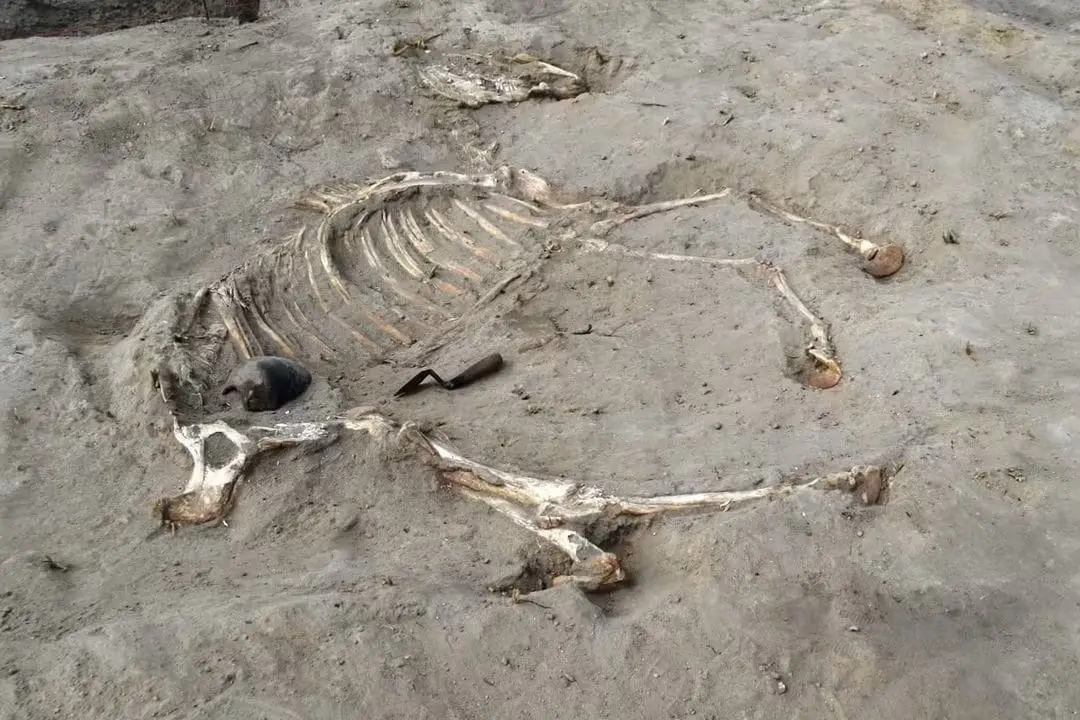
Perhaps the most visually arresting and archaeologically unusual discovery of the campaign is the intact burial of a young male horse. Animal burials, while occasionally documented in elite dynastic contexts, are exceedingly rare within military frontier installations, making this find a subject of intense academic scrutiny.
Osteological analysis indicates that the animal belonged to a specialized lineage selectively bred for speed, endurance, and agility. In the context of New Kingdom warfare, such equines were invaluable assets, utilized primarily for scouting missions or as the dynamic engine pulling light horse-drawn chariots—the ultimate tactical weapon of the era. The horse’s body was recovered in an undisturbed state alongside fragments of an ornate, decorative harness. The deliberate nature of the interment, paired with the preservation of equestrian finery, points toward a ceremonial or honorific burial. Whether the horse was sacrificed to accompany a fallen master, honored for exceptional service in combat, or treated as a cherished military companion, the burial offers a poignant glimpse into the emotional and cultural dimensions of life on the Egyptian war-front.
Epigraphic Treasures: Stelae of the Ramesside Kings
The excavation trenches also yielded a wealth of epigraphic material that firmly anchors the fortress within the political landscape of the Nineteenth Dynasty. Chief among these textual artifacts is a fragmentary limestone stela associated with King Merneptah, the son and successor of Ramesses II.
The stela bears an intricate inscription carved in classic hieratic script. The text lauds Merneptah’s martial prowess, explicitly comparing his terrifying might on the battlefield to that of Seth, the turbulent and powerful god of storms, chaos, and desert frontiers. This ideological framing was crucial for a ruler who faced massive coalitions of Libyan tribes and Sea Peoples during his reign; aligning the pharaoh’s military campaigns with divine cosmic order legitimized state violence and bolstered frontier morale.
Complementing the Merneptah inscription, excavators recovered a second stela fragment bearing the full titulature—birth name, throne name, and Horus name—of Ramesses II, universally known as Ramesses the Great. The presence of artifacts bearing the cartouches of both Ramesses II and his son indicates prolonged royal patronage and sustained administrative investment in Tell Al-Abqain across generations.
A third stela fragment offers stark visual testimony to the geopolitical conflicts that necessitated the fortress’s construction. This piece depicts a bound prisoner captured in a rigid posture of submission. The prisoner’s distinctive clothing and sidelock hairstyle clearly identify him as a Libyan from the Meshwesh tribe, one of the primary tribal confederations that threatened Egypt’s western Delta borders throughout the New Kingdom.
Material Culture: Faith, Fashion, and Daily Sustenance
Beyond monumental architecture and royal stelae, the excavations recovered a vast array of small finds that flesh out the daily reality of the fortress’s inhabitants.
Among these are numerous scarabs inscribed with the names of reigning monarchs and major deities, serving simultaneously as administrative seals, personal signatures, and protective amulets. Alongside the scarabs, archaeologists found a diverse assemblage of protective amulets dedicated to fertility, health, and spiritual strength. These objects reveal the deep-seated anxieties and religious devotions of soldiers and civilians living far from the traditional cult centers of the Nile Valley.
Everyday artifacts—including utilitarian pottery vessels, loom weights indicative of textile production, and personal jewelry such as beads and copper rings—demonstrate that Tell Al-Abqain was not populated solely by detached garrisons of soldiers. The presence of women and children within the community is strongly suggested by the domestic objects and industrial tools recovered from the residential quarters, painting a picture of a permanent, civilianized military settlement.
Supporting Context & Metrics
To fully grasp the significance of the Tell Al-Abqain discoveries, one must examine the broader geopolitical framework of the New Kingdom, particularly the perennial security challenge posed by Egypt’s western neighbors.
The Western Frontier: The Libyan Threat
During the Eighteenth and Nineteenth Dynasties, Egypt reached the zenith of its imperial power, dominating the Levant and Nubia. However, while its eastern and southern borders were largely secure, the expansive Western Desert presented a persistent vulnerability.
Semi-nomadic Libyan tribes—most notably the Libu, Meshwesh, and Kahka—frequently cast covetous eyes on the fertile, water-rich lands of the western Nile Delta. Driven by severe environmental pressures, shifting climate patterns, and population movements in North Africa, these tribes launched sporadic raids against Egyptian farming communities. By the reign of Seti I and Ramesses II, these incursions escalated from opportunistic cattle-rustling into organized, large-scale migrations aimed at settling the Delta.
In response, the pharaonic administration initiated a massive public works program, constructing a heavily fortified chain of coastal fortresses stretching from the western Delta across the Mediterranean coast. Tell Al-Abqain was a vital node in this defensive grid, acting as an early-warning system, a staging ground for counter-offensive operations, and a logistical depot that controlled access routes into the Egyptian heartland.
Quantitative and Chronological Metrics
- Historical Period: New Kingdom (specifically the Ramesside Period, Nineteenth Dynasty), dating approximately from 1570 to 1069 BCE.
- Geographical Location: Tell Al-Abqain archaeological site, Beheira Governorate, situated in the western Nile Delta region of Egypt.
- Key Structural Elements: Mud-brick fortifications, orthogonal street grids (east-west main street intersected by north-south roads), grain silos, cylindrical baking ovens, and integrated well systems.
- Primary Epigraphic Findings: Limestone stelae fragment of King Merneptah (inscribed in hieratic script), royal name fragments of Ramesses II, and a relief stela depicting a captive Meshwesh Libyan prisoner.
- Unique Zoological Discovery: Intact burial of a prime-condition, speed-bred young male military horse accompanied by a preserved decorative harness.
Official Statements and Academic Implications
The announcement of these discoveries has drawn international acclaim, with senior Egyptian officials highlighting their importance for both national heritage preservation and academic research.
In an official ministerial statement, Egypt’s Minister of Tourism and Antiquities, Sherif Fathy, emphasized that the finds transcend mere aesthetic or treasure-hunting value. Minister Fathy noted that the discoveries fundamentally reshape our understanding of New Kingdom military architecture by illuminating the intimate relationship between state-level defense policy and the domestic realities of the people who inhabited these remote installations. He underscored that the ministry remains fully committed to supporting archaeological missions that employ cutting-edge scientific methodologies to uncover Egypt’s hidden past.
Dr. Mohamed Ismail Khaled, Secretary-General of the Supreme Council of Antiquities, expanded on these remarks, pointing out that the architectural layout of the residential complex—with its sophisticated water management systems, grain storage silos, and bakeries—proves that Tell Al-Abqain was engineered for long-term sustainability. Dr. Khaled noted that the discovery of the horse burial, alongside administrative seals and religious amulets, provides a holistic socio-cultural profile of the fortress garrison, bridging the gap between high royal politics and the lived experiences of ordinary soldiers and auxiliary workers.
Leading independent Egyptologists and military historians have echoed these sentiments, noting that the epigraphic recovery of Merneptah’s hieratic stela offers crucial philological data for understanding how royal propaganda was disseminated to the farthest edges of the empire. The explicit comparison of the pharaoh to the god Seth reinforces how ideological warfare was leveraged to maintain morale and justify border security in times of extreme external stress.
Future Outlook and Conservation Strategy
As the excavation season draws to a close, the focus of the archaeological mission at Tell Al-Abqain is shifting from active field recovery to comprehensive laboratory analysis, artifact conservation, and site preservation.
Immediate Conservation Challenges
Mud-brick architecture, while highly effective for rapid construction in arid environments, is notoriously fragile when exposed to modern environmental conditions, fluctuating humidity, and rising water tables in the Delta region. Conservators from the Ministry of Tourism and Antiquities are currently applying consolidation treatments to the newly uncovered residential walls, silos, and street layouts to prevent structural collapse.
Similarly, organic materials recovered from the site—most notably the remains of the military horse and its decorative leather and textile harness—require immediate, climate-controlled stabilization. Osteological and veterinary specialists are conducting detailed DNA and isotopic analyses on the horse bones to determine its exact diet, geographic origin, and pathological history, which will shed further light on ancient Egyptian equine husbandry and military supply chains.
Long-term Research Objectives
Looking ahead, future excavation seasons at Tell Al-Abqain will target the unexcavated northern and western quadrants of the fortress. Archaeologists hope to locate the main command headquarters, armories, and additional administrative archives that may shed light on the garrison’s communication networks with Memphis and Pi-Ramesses.
Furthermore, digital epigraphers are utilizing photogrammetry and 3D laser scanning to create high-resolution digital twins of the stelae fragments and architectural complexes. These digital archives will not only ensure the permanent preservation of fragile texts like the Merneptah hieratic stela but will also facilitate collaborative international research without risking physical damage to the originals.
Ultimately, the discoveries at Tell Al-Abqain promise to rewrite the history of Egypt’s western frontier. By transforming our understanding of how ancient fortresses were built, provisioned, and lived in, the site stands as a testament to the resilience, organizational genius, and cultural complexity of New Kingdom Egypt—a civilization that successfully defended its borders while maintaining a vibrant, sophisticated internal society.




Comments
Facebook App ID not configured. Please add it in the Customizer.