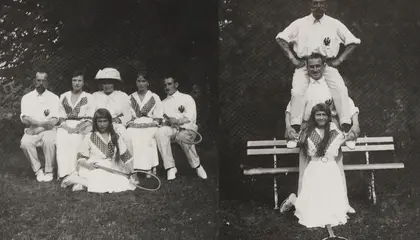
One hundred and eight years after the brutal midnight execution of Czar Nicholas II and his family in a damp Yekaterinburg basement, the private lives of Russia’s final imperial dynasty continue to exert a powerful, haunting grip on the global imagination. Long before the era of digital saturation and smartphone snapshots, the children of the last emperor carried box-shaped Kodak Brownie cameras everywhere they went. They captured thousands of intimate, unguarded photographs of each other, their parents, their pets, and their privileged yet deeply isolated world.
Preserved in state archives, university libraries like Yale’s Beinecke Rare Book & Manuscript Library, and international museums, these surviving photo albums dismantle the cold, severe myth of the Romanovs. Far from the rigid, unsmiling autocrats depicted in official state portraits, the family’s private collections reveal ordinary domestic rhythms: pillow fights, clumsy attempts at hand-colorizing prints, playful bicycle rides, and humorous self-portraits. Yet, this striking humanity exists in agonizing juxtaposition with their historical fate. The domestic warmth captured on film serves as a poignant prelude to a catastrophic fall, offering a voyeuristic portal into an empire rushing blindly toward a violent revolution.
Detailed Chronology: From Absolute Autocracy to the House of Special Purpose
1894–1904: The Burden of the Crown and the Arrival of an Heir
When Nicholas II ascended the throne in November 1894 following the death of his father, Alexander III, the 26-year-old monarch confessed his deep inadequacies to a cousin: "I am not prepared to be a czar. I never wanted to become one. I know nothing of the business of ruling." Inheriting an empire teetering on the edge of modernity, Nicholas stubbornly rejected political reform, choosing instead to lean on the archaic divine right of autocracy.
His marriage to Alix of Hesse—who took the name Alexandra Fyodorovna upon converting to Russian Orthodoxy—brought a favorite granddaughter of Britain’s Queen Victoria into the imperial fold. Victoria’s early embrace of photography quickly filtered down to her royal descendants, establishing a family habit of documenting their lineages. However, Alexandra’s frigid public demeanor and intense shyness alienated the Russian aristocracy and peasantry alike.
For the first decade of their marriage, the pressure to produce a male heir weighed heavily. Alexandra gave birth to four daughters in rapid succession: Olga (1895), Tatiana (1897), Maria (1899), and Anastasia (1901). The birth of each girl was met with palpable disappointment from the Russian public and the imperial court. Finally, in 1904, the long-awaited tsarevich, Alexei, was born. As historian Robert K. Massie famously observed, this "blessed birth" proved to be the mortal blow to the dynasty: Alexei inherited hemophilia, a genetic curse passed down through his mother that transformed the young heir into a fragile, closely guarded secret and opened the door to the infamous faith healer Grigori Rasputin.
1905–1914: The Cocoon of Privilege and the Rise of "OTMA"
The outbreak of the 1905 Revolution forced Nicholas to concede to a parliamentary State Duma, establishing a fragile constitutional framework that Alexandra fiercely opposed. Shielding Alexei from the constant, life-threatening danger of minor bruises and bleeding episodes, the imperial family retreated into greater isolation at the Alexander Palace in Tsarskoye Selo.
It was within this protective cocoon that the children—collectively known by the acronym OTMA for the four grand duchesses—cultivated their own distinct personalities, captured vividly in their personal photographs:
Olga: The eldest, dreamy, introspective, and heavily burdened by the responsibilities of her royal status.
Tatiana: Practical, elegant, and acting as her mother’s primary emotional and physical support.
Maria: The most conventionally beautiful, naturally maternal, and dreaming of a large family.
Anastasia: Mercurial, irreverent, and mischievous, famous for her early "selfies" and pranks, such as sneaking cigarettes or wearing false teeth while her sister slept.
Despite their immense wealth, the girls grew up under surprisingly austere conditions dictated by their Victorian-minded mother: they slept on simple folding cots, wore hand-me-down clothing, and were largely sheltered from the socio-political realities of the Russian populace.
1914–1917: World War I, Rasputin, and the Collapse
The onset of World War I in 1914 shattered the family’s domestic bubble. Olga and Tatiana trained as Red Cross nurses, working tirelessly alongside their mother in military hospitals, while Nicholas and Alexei departed for the military headquarters (Stavka) in Belarus. In the czar’s absence, Alexandra’s political interference—heavily guided by Rasputin—accelerated the regime’s collapse.
As wartime casualties mounted and food shortages crippled Russian cities, public fury crystallized around the czarina’s German origins and her reliance on Rasputin. Desperate to save the monarchy, aristocratic conspirators murdered Rasputin in December 1916. Yet, it was too late. In February 1917, a full-scale revolution erupted in Petrograd. Pressured by his generals and lacking the stomach for a civil war, Nicholas abdicated on March 15, 1917, relinquishing the throne for both himself and his sickly son.
1917–1918: Captivity, Siberia, and the Midnight Execution
Initially placed under house arrest at Tsarskoye Selo, the family contracted measles, forcing the grand duchesses to shave their heads. Tutors captured poignant photographs of the children posing playfully with bare heads—images Alexandra prophetically likened to prisoners awaiting execution.
In August 1917, the provisional government transferred the Romanovs to Tobolsk in remote Siberia. Following the Bolshevik seizure of power in October 1917 under Vladimir Lenin, the family was moved one final time to the "House of Special Purpose" in Yekaterinburg.
On the night of July 16–17, 1918, eleven executioners led by Yakov Yurovsky descended upon the basement. Nicholas and Alexandra died instantly. However, the execution descended into a chaotic, horrific twenty-minute ordeal for the children. Protected by jewel-studded corsets sewn into their clothing that deflected initial bullets and bayonet thrusts, the grand duchesses and Alexei were systematically shot at close range. Anastasia, the final survivor among the children, was silenced by a pistol shot after sitting up on the bloody truck bed.
Supporting Context & Metrics
Imperial Scale: Nicholas II ruled over approximately one-sixth of the Earth’s total landmass, presiding over an empire of over 125 million subjects, yet remained ideologically bound to absolute autocracy.
The Photographic Archive: Preserved primarily through the efforts of close friend Anna Vyrubova and tutor Pierre Gilliard, six original family albums safely evacuated from Russia are housed at Yale University’s Beinecke Library.
The Hemophilia Factor: Alexei’s genetic disorder crippled the dynasty’s political stability, directly driving the reliance on Grigori Rasputin, whose influence became a primary catalyst for the downfall of public trust in the Romanov regime.
Execution Duration: What was planned as a swift 30-second execution in the Ipatyev House basement stretched into a 20-minute struggle due to the hidden diamond-lined corsets worn by the grand duchesses.
Official Statements & Historical Perspectives
Historian and biographer Helen Rappaport, author of The Romanov Sisters and The Last Days of the Romanovs, emphasizes the psychological power of the visual record in framing our understanding of the tragedy:
"There’s something so very haunting about seeing those four lovely girls whose lives were cut short and that handsome and engaging little boy… The Romanovs really used photography to publicize and promote an image of the family as this beautiful domestic unit. But their private albums humanize a family that fiercely protected their privacy at the cost of intense criticism over their perceived insularity."
Reflecting on the discovery of the family photo albums for a major London exhibition, curator Natalia Sidlina noted to The Guardian:
"What amazed me was how alike those albums were to any other family albums we have. The Romanovs looked just like any middle-class family."
Biographer Robert K. Massie captured the fundamental tragedy of Nicholas II’s historical position, writing that the czar was a man utterly unsuited to the modern era:
"Events were moving too swiftly, ideas were changing too radically… Imperial Russia was toppled by a tiny defect in the body of a little boy."
Future Outlook & Historical Legacy
More than a century after the volleys of gunfire echoed through the Yekaterinburg basement, the legacy of the Romanov family continues to undergo intense academic re-evaluation and public fascination. Modern historiography has successfully shifted away from the polarized caricatures—either bloodthirsty tyrants or purely saintly martyrs—promoted by Soviet propaganda and early monarchist sympathizers.
Instead, the recovery and digital archiving of thousands of personal photographs, diaries, and home movies allow researchers to examine the dynasty through a nuanced, humanized lens. Institutions worldwide continue to digitize fragile glass-plate negatives and faded Kodak prints, ensuring that the everyday humanity of Olga, Tatiana, Maria, Anastasia, Alexei, and their parents remains permanently accessible. As new generations explore these archives, the snapshot albums act as an enduring historical warning: a poignant, immutable reminder of the fragile domestic lives hidden behind the monumental, unstoppable wheels of global revolution.

/https://tf-cmsv2-smithsonianmag-media.s3.amazonaws.com/filer_public/8d/ad/8dad55dd-6089-4211-a179-dc51f45ad2b5/anastasia-tennis.png)
/https://tf-cmsv2-smithsonianmag-media.s3.amazonaws.com/accounts/headshot/meilan_headshot2.png)
:focal(750x500:751x501)/https://tf-cmsv2-smithsonianmag-media.s3.amazonaws.com/filer_public/8d/ad/8dad55dd-6089-4211-a179-dc51f45ad2b5/anastasia-tennis.png)
/https://tf-cmsv2-smithsonianmag-media.s3.amazonaws.com/filer_public/7f/d1/7fd1ff35-08f9-4b88-a2a5-8093673a2cdf/anastasia_nikolaevna_of_russia_fooling_around_original.jpg)
/https://tf-cmsv2-smithsonianmag-media.s3.amazonaws.com/filer_public/23/18/23186e2a-54a3-495b-a7f5-2aa50bdb453c/inside_anastasia_smoking.jpg)
/https://tf-cmsv2-smithsonianmag-media.s3.amazonaws.com/filer_public/30/bf/30bf0f74-b6f2-4950-839e-c4ba627ad751/romanov_cycling_on_bikes_5_of_10.jpg)
/https://tf-cmsv2-smithsonianmag-media.s3.amazonaws.com/filer_public/80/10/8010618b-b792-4a82-accc-a18190e7632b/anastasia_nikolaevna_romanova_in_a_selfie_1915.png)
/https://tf-cmsv2-smithsonianmag-media.s3.amazonaws.com/filer_public/91/8d/918daa7d-bb79-4982-8eae-1a2f78580529/mirror-selfie.png)
/https://tf-cmsv2-smithsonianmag-media.s3.amazonaws.com/filer_public/07/dc/07dcdb3f-e14f-406f-bd57-6a9ffee17e1c/3840px-family_nicholas_ii_of_russia_ca_1914.jpg)
/https://tf-cmsv2-smithsonianmag-media.s3.amazonaws.com/filer_public/35/0c/350c569a-b87e-4b0e-8f74-cdf74eabac7d/royal_family_group.jpg)
/https://tf-cmsv2-smithsonianmag-media.s3.amazonaws.com/filer_public/bb/c5/bbc55b38-df69-4bb9-af94-2e148612ebab/screenshot_2026-07-15_at_123625pm.png)
/https://tf-cmsv2-smithsonianmag-media.s3.amazonaws.com/filer_public/e9/8c/e98c51fb-f4e3-428d-9519-15783945c5a1/nicholas_ii_and_alexei_in_reval_1908.jpg)
/https://tf-cmsv2-smithsonianmag-media.s3.amazonaws.com/filer_public/f5/64/f564102b-b1d9-4459-866a-b190d4101739/empress_alexandra_fyodorovna_of_russia_and_her_children.jpg)
/https://tf-cmsv2-smithsonianmag-media.s3.amazonaws.com/filer_public/21/aa/21aae4ab-fe2a-4c73-a227-df826e8af206/olgatatianamariaanastasia1916.jpg)
/https://tf-cmsv2-smithsonianmag-media.s3.amazonaws.com/filer_public/7c/f0/7cf0dee6-b8eb-4a92-9dd0-76634fe1fdfb/olgabeachreading.jpg)
/https://tf-cmsv2-smithsonianmag-media.s3.amazonaws.com/filer_public/86/2d/862d7775-4ec5-459c-86b3-5929cb8b48d0/tatianaalexandra.jpg)
/https://tf-cmsv2-smithsonianmag-media.s3.amazonaws.com/filer_public/56/7a/567a553a-3708-4793-867c-5c2cbaf64c0e/maria_nikolaevna_aboard_the_imperial_yacht_polar_star.jpg)
/https://tf-cmsv2-smithsonianmag-media.s3.amazonaws.com/filer_public/9b/79/9b795fe5-de6a-4f55-a583-b51045cd32eb/mariaanastasiamugging.jpg)
/https://tf-cmsv2-smithsonianmag-media.s3.amazonaws.com/filer_public/bb/38/bb387afe-ee95-4efe-acb8-2602345b1dc5/anastasia_romanova_-_gym_at_the_alexander_palace_1913.jpg)
/https://tf-cmsv2-smithsonianmag-media.s3.amazonaws.com/filer_public/98/24/98240e07-a031-4e26-9098-d558295d68ed/screenshot_2026-07-15_at_123910pm.png)




Comments
Facebook App ID not configured. Please add it in the Customizer.