
Executive Overview
Are we on the precipice of a white Christian nationalist takeover? For religion scholar and author Robert P. Jones, the answer is an alarming and resounding yes. In his compelling new book, Backslide: Reclaiming a Faith and a Nation After the Christian Turn Against Democracy, Jones draws a stark, urgent historical parallel to the fall of Weimar Germany. “This is our 1933,” he warns, invoking the fateful year that Adolf Hitler and the Nazi party consolidated absolute power.
Panicked allusions to Nazi Germany have become a frequent fixture of political discourse during the turbulent Trump era. However, Jones approaches these comparisons from a uniquely authoritative perspective. Having spent decades studying the sociology of American religion and growing up deeply embedded in the Southern Baptist tradition in the Deep South, Jones understands the internal mechanics of white evangelical spaces. His concern is not merely political; it is deeply theological. He argues that the unyielding, monolithic support of white Christian evangelicals for the second Trump administration—coupled with rising authoritarian rhetoric from administration officials like Defense Secretary Pete Hegseth—is accelerating a dangerous backslide into religious authoritarianism.
Yet, Backslide is far from a counsel of despair. Rather, it functions as a clarion call to action. Jones argues that the greatest danger to American democracy is not merely the vocal extremism of the MAGA movement, but the profound apathy of moderate and progressive white Christians who have watched this radicalization unfold in silence. Drawing lessons from the resistance efforts of historical figures like German pastor Martin Niemöller, Jones contends that a window of opportunity remains for religious moderates to find their voice, out-organize extremist factions, and reclaim a pluralistic vision of faith and democracy before it is too late.
Read Also
Detailed Chronology: From Weimar Germany to Modern America
To understand the gravity of Jones’s thesis, one must examine the historical framework he utilizes. In his book, Jones spends significant time analyzing the trajectory of German Lutheran pastor Martin Niemöller. During the rise of the Nazi party in the 1920s and early 1930s, Niemöller was an active supporter, even casting ballots for them across three separate elections. It was not until 1933—the year the Nazi regime fully seized control and opened Dachau—that Niemöller began to experience a profound moral awakening, ultimately leading to his arrest in 1937 and imprisonment in concentration camps until 1945.
Reflecting on his experiences after World War II, Niemöller did not view 1933 merely as the year his imprisonment began; he viewed it as a bitter marker of the years he had wasted abetting a totalitarian regime. Every day of his post-war freedom was shadowed by the agonizing realization that he had missed critical opportunities to avert a catastrophic tragedy.
Jones maps this historical tragedy onto the contemporary United States. He points to a deeply ingrained, destructive national myth: the inherited narrative that the United States was uniquely intended to be a nation "of, by, and for Christians of European descent." When this ethno-nationalist mythology intersects with modern political polarization, the results are devastating.
Throughout the Trump era, Jones argues, there has been virtually no daylight between the hardline, often draconian policies of the administration and the moral tolerances of white evangelical voters. Whether examining extreme immigration policies—such as the widespread evangelical tolerance for razor wire barriers designed to cause drowning or the establishment of internment camps—or the normalization of aggressive Christian nationalist rhetoric within the upper echelons of government, Jones charts a clear trajectory of democratic erosion. "We are now living in a democratically back-slidden nation," he writes, "abetted by an apostate white Christianity."
Supporting Context & Metrics: Data, Demographics, and the Myth of Monoliths
As the president and founder of the Public Religion Research Institute (PRRI)—the leading independent research and polling think tank focusing on the intersection of politics, religion, and American identity—Jones backs his historical warnings with rigorous sociological data.
When questioned about whether he realistically expects hardened supporters of the MAGA movement to alter their worldviews, Jones is pragmatic. "I’m not writing for the people who have completely given themselves over to this MAGA worldview," he notes. PRRI polling consistently demonstrates that roughly 85 percent of white evangelicals are deeply embedded in this political ecosystem, manifesting extreme attitudes toward undocumented immigrants, systemic racism, and pluralism that directly contradict biblical teachings concerning care for the widow, orphan, and stranger.
However, Jones’s data reveals a crucial silver lining that subverts the narrative of an invincible Christian nationalist majority:
- Shifting Demographics: According to recent PRRI religious censuses, white evangelicals now comprise a mere 13 percent of the total U.S. population.
- Rejecting Extremism: Even when aggregating every American who subscribes to a Christian nationalist worldview, they account for only about 30 percent of the national population.
- The Two-Thirds Majority: While Christian nationalism commands a majority among Republicans and roughly two-thirds of white evangelicals, the broader American public rejects this ideological framework by a commanding margin of two to one.
- Internal Divisions: Unlike the near-monolithic alignment found among white evangelicals, other religious demographics—including white Catholics, white mainline Protestants, and Latino evangelicals—exhibit significant internal division and active ideological debate.
"The biggest challenge has been apathy among many white Christians who have watched this extremism take hold, have watched it grow, and have really been uncomfortable speaking out," Jones explains. By targeting the millions of Christians who are quietly disturbed by the weaponization of their faith, Jones hopes to galvanize a sleeping demographic.
Official Statements and Grassroots Resistance
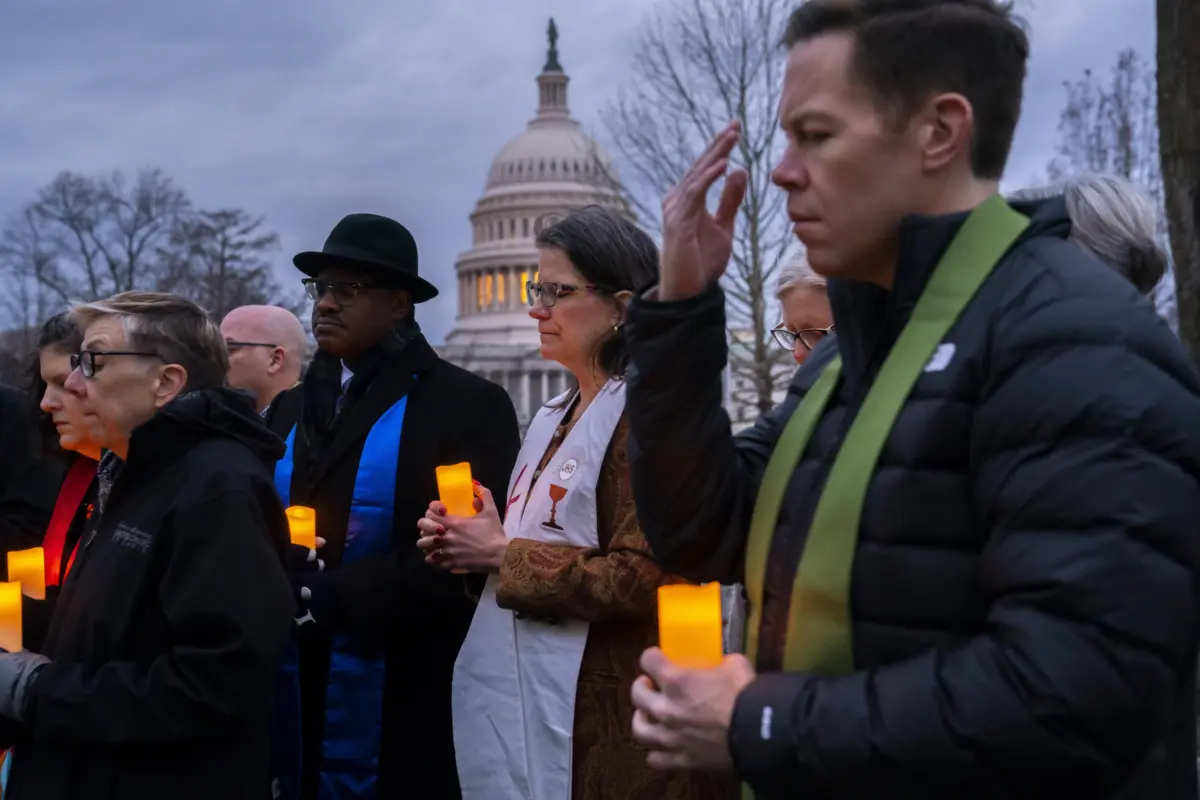
While national headlines often focus on the figures driving Christian nationalism, a quiet counter-revolution is taking shape at the grassroots level. Across the United States, alternative white Christian spaces, mainline Protestant denominations, and Catholic communities are actively pushing back against the encroachment of religious authoritarianism.
Mainline Protestant bodies—including Presbyterian, Lutheran, and United Church of Christ denominations—have increasingly adopted official resolutions and statements explicitly condemning Christian nationalism. These institutional guardrails provide local pastors and congregations with the theological vocabulary necessary to draw bright, unambiguous lines against extremism.
Furthermore, direct action is springing up in local communities:
- Immigration Advocacy in the Midwest: In cities like Minneapolis and St. Paul, active religious coalitions—spanning Lutheran, mainline Protestant, and Catholic parishes—have organized to protest Immigration and Customs Enforcement (ICE) operations, provide sanctuary, and monitor federal enforcement actions.
- Border Communities: In regions surrounding El Paso, Texas, Catholic bishops and local parishes have successfully organized to halt the construction of large-scale detention facilities, proving that institutional religious power can effectively challenge authoritarian state apparatuses.
- A New Generation of Faith-Driven Leaders: While African American faith leaders such as the late Representative John Lewis, Representative Jim Clyburn, and Senator Raphael Warnock have long articulated progressive political visions rooted in deep religious conviction, a new wave of white leaders from the Midwest and mainline traditions is emerging. Figures like Texas Senate candidate James Talarico and various Midwestern politicians are increasingly willing to articulate a faith centered on love, inclusion, and pluralistic democracy.
Future Outlook: A Critical Juncture for Faith and Democracy
As Jones’s work underscores, the path forward requires a clear-eyed strategy. Attempting to persuade individuals who have spent a decade deeply entrenched in the MAGA movement is, in Jones’s estimation, a "fool’s errand." The pragmatic solution is not conversion, but out-organizing: building a robust, highly visible alternative that champions human dignity, racial equity, and democratic integrity.
Crucially, Jones is careful to clarify that Backslide is not an apologetic defense of the institutional church. He expresses deep empathy and understanding for the millions of Americans who have disaffiliated from Christianity over the past two decades in response to the church’s moral compromises. Rather than calling for a blind return to religious institutions, Jones issues a call to reclaim a historically grounded, compassionate expression of faith that is entirely compatible with a pluralistic constitutional republic.
"If you want a different version of Christianity to exist in this country, it’s time to stand one up and make it a very publicly visible thing," Jones urges. For those navigating the turbulent intersection of American religion and politics, the message is stark: the parallels to 1933 serve not as a fatalistic prophecy, but as an urgent wake-up call to act before the window of democratic resistance closes entirely.





Comments
Facebook App ID not configured. Please add it in the Customizer.