
Executive Overview
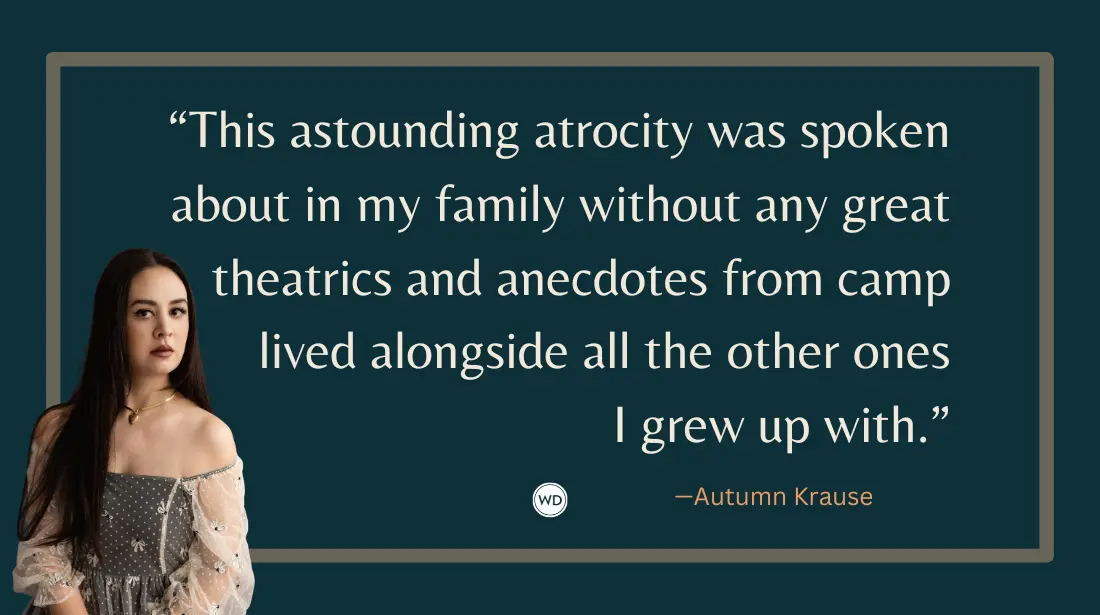
For author Autumn Krause, identity was never a simple binary, nor was it defined by the boundaries of a single culture. Growing up in Southern California with a multicultural heritage that spans Japan, Mexico, Lithuania, and Hawaii, Krause lived inside a vibrant, hyper-connected family ecosystem. Yet, beneath the warmth of high-tea rituals, Kikkoman soy sauce, and Spanglish-laced neighborhood banter lay a solemn, generational shadow: the forced mass incarceration of her Japanese American relatives during World War II.
This duality—the sun-drenched vibrancy of a tight-knit Los Angeles upbringing juxtaposed against the grim, barbed-wire reality of American concentration camps—forms the bedrock of Krause’s deeply anticipated novel, The Gods Will Sing Our Song. Blending historical trauma, the intricate magic of Japanese folklore, and a passionate romance born behind prison fences, the book is both a deeply personal tribute and a vital act of historical reclamation.
Despite encountering online backlash and viral vitriol leading up to its release, Krause’s work stands as a testament to the resilience of her ancestors. It challenges sanitized textbook narratives and asserts that stories of state-sponsored injustice, love, and defiance must be told on the terms of those who lived them.
Read Also
Detailed Chronology: From Southern California Roots to the Barbed Wire of Manzanar
To understand the emotional geography of The Gods Will Sing Our Song, one must trace the winding branches of Krause’s family tree. Descending from a rich mixture of cultures, Krause’s worldview was fundamentally shaped by the proximity of her extended family. Raised in a homeschooling household where relatives lived mere blocks away, her life was soundtracked by the familiar jingle of her grandparents’ keys turning in the side door.
However, woven into this idyllic Southern California tapestry was a darker historical thread. Krause recalls childhood family trips returning from Mammoth, where the caravan would routinely pull off the highway at a specific, somber location: the Manzanar War Relocation Center. Alongside standard family photo albums and mementos sat a paperback copy of Jeanne Wakatsuki Houston’s Farewell to Manzanar, a permanent fixture on the family bookshelf.
The history was never hidden, nor was it delivered with grand theatricality. Krause grew up knowing that her grandfather, several members of her grandmother’s family, and countless other Japanese Americans were unconstitutionally stripped of their homes and possessions by the U.S. government following the outbreak of World War II. Her relatives were funneled through makeshift holding facilities—such as the horse stalls at the Santa Anita racetrack—before being dispatched to bleak, isolated concentration camps like Gila River in Arizona and Rohwer in Arkansas.
As a young reader devouring World War II fiction, Krause noticed a glaring omission. While bookstores abounded with historical novels featuring women in vintage dresses standing beneath warplanes, none reflected the desert dust, the armed guards, and the psychological weight of the American concentration camps that populated her family’s lore. The seed for a novel was planted early, driven by a determination to one day document this specific mass displacement.
Supporting Context & Metrics: The Historical Architecture of Incarceration
The historical backdrop informing Krause’s novel is rooted in one of the most severe civil rights violations in modern American history. Following the bombing of Pearl Harbor on December 7, 1941, hysteria and institutionalized anti-Japanese racism culminated in President Franklin D. Roosevelt signing Executive Order 9066 on February 19, 1942.
Key Historical Metrics:
- The Displaced Population: Approximately 120,000 men, women, and children of Japanese ancestry—the majority of whom were American citizens by birth—were forcibly removed from their homes on the West Coast.
- The Incarceration Infrastructure: The evacuees were housed in ten permanent concentration camps run by the War Relocation Authority (WRA), spanning desolate regions across California, Arizona, Wyoming, Idaho, Utah, Colorado, and Arkansas.
- Military Service Amid Incarceration: Even as their families were held behind barbed wire by their own government, thousands of young Japanese American men volunteered to fight for the United States. Among them was Krause’s great-grandfather, Shigemi, who fought valiantly with the legendary 442nd Regimental Combat Team—a unit composed almost entirely of second-generation Japanese Americans (Nisei) that became the most decorated unit for its size and length of service in U.S. military history.
While her great-grandfather fought in Europe, Krause’s great-grandmother Toshi navigated the harrowing reality of raising four young children inside the camps. These dual perspectives—the soldier on the front lines and the mother inside the perimeter—imbue The Gods Will Sing Our Song with authenticity and emotional gravity.
Creative Vision and Literary Anatomy
Crafting The Gods Will Sing Our Song required a delicate synthesis of lived ancestral memory, exhaustive historical research, and imaginative myth-making. Krause knew she wanted the narrative to capture not only the grim structural realities of camp life—the dust storms, the lack of privacy, the armed guard towers—but also the enduring human spirit and the rich tapestry of Japanese folklore.
The Protagonists and the Power of Romance
At the heart of the novel are two young lovers:
- Ren: A lone wolf hailing from an abusive family background, learning to navigate survival in a hostile environment.
- Violet: An imaginative, creative artist rooted in a deeply connected, supportive family network.
Krause chose to center the narrative on romance as an extension of her own family’s legacy. Descended from generations who fell in love young and forged intense marriages defined by passion, devotion, and steadfast companionship, Krause viewed romance as an act of resistance.
"Love occurring despite being surrounded by such hate is an important theme of The Gods Will Sing Our Song," Krause notes. This theme mirrors the real-life correspondence of her great-grandparents, Shigemi and Toshi, who maintained an unyielding bond through hundreds of letters exchanged while Shigemi fought overseas and his family remained incarcerated.
Weaving Folklore and Research
To ensure the novel resonated both emotionally and educationally, Krause balanced magical realism rooted in Japanese folklore with meticulous historical research. She recognized that many contemporary readers might encounter this chapter of history for the first time outside of a brief textbook footnote. By anchoring the narrative in sensory details—the sound of footsteps on wooden barracks, the taste of dust, the comfort of whispered folklore—she built a bridge between past atrocities and modern empathy.
Official Statements and Industry Reception
The journey to publication for The Gods Will Sing Our Song has been marked by both profound validation and unexpected adversity. As an author who describes herself as sensitive, Krause has faced waves of online harassment and trolls attempting to suppress the book’s visibility following viral social media posts.
Despite coordinated efforts to drown out the novel’s reach, industry response and grassroots support have positioned the book as a vital contribution to contemporary historical fiction.
"While I struggle with that as a sensitive author, I’m grateful it is getting reach and that this history lives again despite the online trolls trying to drown it out," Krause reflects on the digital vitriol. "I hope that if the premise of this book at all interests you that you will pick it up and hear my family’s song and that you will find in it the same mysterious lyrics of love that fears no hate, hope as defiance, and magic."
Literary critics have lauded the novel for its unflinching portrayal of American internment camps, noting that works of historical fiction written by direct descendants carry an urgent, irreplaceable authority. By prioritizing marginalized narratives, Krause’s work joins a crucial canon of literature that refuses to let state-sanctioned human rights abuses fade into historical obscurity.
Future Outlook: The Enduring Resonance of Ancestral Song
As The Gods Will Sing Our Song makes its way into the hands of readers worldwide, its broader cultural impact points toward a shifting landscape in historical publishing. The appetite for authentic, descendant-led narratives is growing, signaling a departure from sanitized historical accounts toward stories that embrace complexity, trauma, and resilience.
For Krause, the book represents one of the greatest accomplishments of her life—not merely as a milestone in her writing career, but as a living monument to her ancestors. The branches of her family tree, stretching from the Pacific Ocean to the sun-bleached streets of Los Angeles, now share their story with a global audience.
In an era where discussions surrounding systemic injustice, government overreach, and civil liberties remain fiercely relevant, The Gods Will Sing Our Song serves as both a warning and a beacon. It reminds us that even within the bleakest confines of barbed wire and institutional hatred, the human spirit retains the capacity to create art, preserve culture, and sing songs of enduring love.




Comments
Facebook App ID not configured. Please add it in the Customizer.