
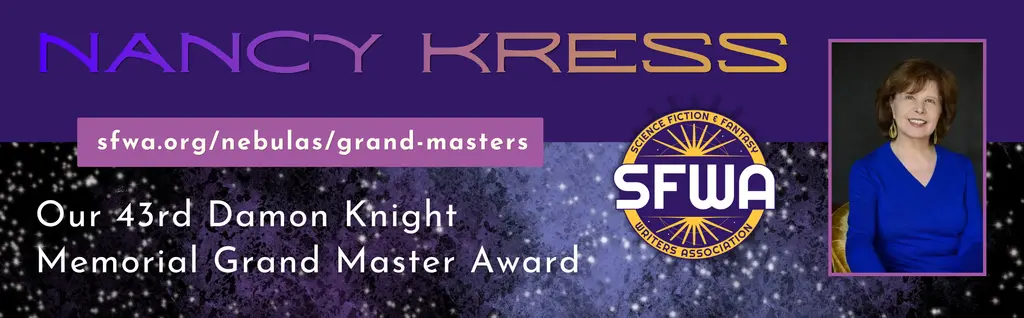
Executive Overview: A Lifetime of Speculative Brilliance
The Science Fiction & Fantasy Writers Association (SFWA) has officially announced Nancy Kress as the 43rd recipient of the prestigious Damon Knight Memorial Grand Master Award. This designation represents the pinnacle of recognition within the speculative fiction community, awarded to writers who have made monumental, career-spanning contributions to the genres of science fiction and fantasy.
Kress, an author whose career spans nearly five decades, is internationally celebrated for her intellectually rigorous and deeply empathetic exploration of biotechnology, genetic engineering, and the societal ramifications of scientific advancement. Her selection highlights her dual legacy as both a pioneering literary voice and a dedicated educator who has mentored generations of emerging writers across the globe.
The formal presentation of the Grand Master Award will take place during the 2027 Nebula Awards Conference, scheduled to run from June 3 to June 7, 2027. By receiving this honor, Kress joins an elite pantheon of speculative fiction legends, including Ursula K. Le Guin, Isaac Asimov, Samuel R. Delany, Ray Bradbury, and N.K. Jemisin.
Read Also
At a time when the creative industries are grappling with the rapid integration of artificial intelligence and shifting definitions of artistic labor, the SFWA’s choice of Kress is both a celebration of her historical impact and a timely acknowledgment of her work’s ongoing relevance. Her fiction has consistently interrogated what it means to remain human in the face of radical technological transformation—a theme that resonates profoundly with contemporary global anxieties.
Detailed Chronology: The Evolution of a Hard Science Fiction Pioneer
To understand Nancy Kress’s ascent to the rank of Grand Master is to trace the modern evolution of "hard" science fiction—a subgenre often characterized by scientific accuracy, which Kress uniquely synthesized with intense psychological and sociological depth.
[1976] Published first short story ("The Earth Dwellers" in Galaxy)
  │
  ├── [1981] Released debut novel (The Golden Grove)
  │
  ├── [1991] Published "Beggars in Spain" novella (Won Hugo & Nebula)
  │
  ├── [1993] Expanded "Beggars in Spain" into a landmark novel
  │
  ├── [2000s] Authored the critically acclaimed Probability Series
  │
  ├── [2014] Published Yesterday's Kin (Won Nebula & Locus Awards)
  │
  └── [2027] Scheduled to receive the 43rd SFWA Grand Master Award
The Early Years and Genre Foundations
Kress began her publishing career in 1976 with the short story "The Earth Dwellers," featured in Galaxy Science Fiction. Her early novels, such as The Golden Grove (1981) and The White Pipes (1985), leaned toward high fantasy. However, by the late 1980s, Kress began pivoting toward hard science fiction, finding her true artistic home at the intersection of biological science and human character study. This transition culminated in her groundbreaking work of the early 1990s, which redefined how the genre approached biotechnology.
The Breakthrough: Beggars in Spain and Genetic Class Warfare
In 1991, Kress published the novella Beggars in Spain in Asimov’s Science Fiction. The story was an immediate critical sensation, winning both the Hugo and Nebula Awards. Kress subsequently expanded the novella into a full-length novel in 1993, establishing a foundational text for modern "biopunk" and genetic science fiction.
Beggars in Spain introduced the concept of the "Sleepless"—genetically modified humans engineered to require no sleep. This modification grants them not only extra hours in the day but also heightened intelligence, emotional stability, and cognitive processing power.
Kress used this premise to conduct a brilliant, multi-layered critique of Ayn Rand’s Objectivism and social Darwinism. The novel explores the inevitable societal chasm that opens between the hyper-productive "Sleepless" elite and the unmodified "Sleepers" who find themselves economically and socially obsolete.
Decades before the development of real-world gene-editing tools like CRISPR-Cas9, Kress accurately predicted the ethical, legal, and class-based anxieties that would accompany human genetic enhancement.
Mid-Career Mastery: Expanding the Horizons of Biopunk
Throughout the late 1990s and 2000s, Kress expanded the Beggars universe into a celebrated trilogy (Beggars and Choosers and Beggars Ride), solidifying her reputation as science fiction’s premier voice on genetic ethics. She continued to push the boundaries of hard SF with the Probability series (Probability Moon, Probability Sun, and Probability Space), which combined hard physics with alien anthropology and interstellar politics.
In 2014, Kress published Yesterday’s Kin, a novella that explored the biological and ecological consequences of first contact with an alien species sharing a genetic lineage with humanity. The work won both the Nebula and Locus Awards, proving that her ability to craft compelling, scientifically grounded narratives remained entirely undiminished.
Supporting Context & Metrics: The Scale of Kress’s Legacy
The Damon Knight Memorial Grand Master Award is not merely a reflection of popularity; it is a metric of sustained excellence, structural influence, and peer respect. Kress’s career metrics demonstrate why her selection was met with universal acclaim across the industry.
Awards, Publications, and Peer Recognition
Kress’s competitive award record is one of the most distinguished in the history of speculative fiction. She has secured:
- Six Nebula Awards (from over a dozen nominations), representing the highest level of peer recognition from her fellow writers.
- Two Hugo Awards, voted on by the global science fiction fan community.
- One John W. Campbell Memorial Award for Best Science Fiction Novel.
- One Theodore Sturgeon Memorial Award for outstanding short fiction.
Her bibliography includes over thirty novels, numerous short story collections, and hundreds of short stories published in major genre venues such as Asimov’s, Analog, and Tor.com. Her fiction has been translated into dozens of languages, ensuring her place as a global ambassador for English-language speculative fiction.
| Metric / Attribute | Nancy Kress Career Profile |
|---|---|
| Active Years | 1976–Present (Over 45 Years) |
| Novels Published | 30+ |
| Nebula Awards Won | 6 |
| Hugo Awards Won | 2 |
| Key Teaching Tenures | Clarion, Clarion West, Taos Toolbox |
| Primary Thematic Focus | Genetic Engineering, Biotechnology, Social Stratification |
Shaping the Next Generation: Global Pedagogy
Beyond her written bibliography, Kress’s impact on the science fiction community is deeply rooted in her work as an educator. Speculative fiction has a long tradition of established writers mentoring novices, and Kress has been a cornerstone of this educational infrastructure for decades.
She has served as a recurring instructor at the prestigious Clarion Writers’ Workshop and Clarion West, the premier training grounds for speculative fiction writers. Furthermore, she has been a vital faculty member at Taos Toolbox, a highly selective masterclass for intermediate and advanced writers founded by Walter Jon Williams.
Kress’s pedagogical reach extends far beyond the United States. She has conducted high-profile writing workshops in international literary hubs, including Beijing, China, and Leipzig, Germany. Through these efforts, she has helped shape the narrative voices of hundreds of contemporary authors, ensuring that her commitment to scientific rigor and deep characterization is carried forward into the future of the genre.
Official Statements: Industry Leadership Reacts
The announcement of Kress’s elevation to Grand Master status was met with warm praise from SFWA’s leadership, who emphasized both her long-overdue recognition and the profound timeliness of her work.
Kate Ristau on the AI Era and Human Identity
SFWA President Kate Ristau revealed that Kress’s name has been a constant point of discussion among the organization’s leadership:

"When we choose a SFWA Grand Master, the discussion begins with the Past Presidents. Year after year, Nancy’s name has come up as an author who is long overdue for this award. She has made an incredible impact on our industry not only with her work, but also with her teaching at both Clarions and Taos Toolbox, as well as workshops in Beijing and Leipzig."
Ristau went on to connect Kress’s thematic focus directly to the contemporary anxieties surrounding artificial intelligence, automated labor, and the commodification of creativity:
"She has spent decades writing at the cutting edge of genetics, biotechnology, and human transformation, asking what happens when science changes not only our world, but our understanding of what it means to be human.
There could not be a more prescient time to honor Nancy’s contributions. As we confront the impact of AI on our work and on our livelihoods, Nancy reminds us what it means to be human: to question, to imagine, to connect. Not only that, but to recognize that our humanity cannot be separated from the choices we make about our future."
Jeffe Kennedy on Mentorship and Grace
Jeffe Kennedy, the immediate past president of SFWA, shared a personal perspective on Kress’s character and her reputation within the professional community:
"I met Nancy when we were both teaching at Taos Toolbox. She was as smart, gracious, and generous as everyone in the industry says. I’m tremendously pleased to see her join the ranks of SFWA’s Grand Masters and I know she’ll continue to contribute to the new generations of writers following in her illustrious footsteps."
Future Outlook: The 2027 Nebula Awards and the Prescience of Kress’s Vision
As the speculative fiction community looks forward to the 2027 Nebula Awards Conference in June 2027, the celebration of Nancy Kress as the 43rd Grand Master serves as a reminder of the vital role science fiction plays in navigating real-world scientific advancement.
We are living in an era where the boundary between science fiction and reality is collapsing. The emergence of CRISPR gene therapies, the rise of neural interfaces, and the rapid, unchecked development of artificial intelligence are no longer speculative concepts—they are contemporary realities.
Kress’s body of work provides a critical ethical roadmap for this brave new world. While some hard science fiction authors focus exclusively on the mechanics of technology, Kress’s enduring contribution is her insistence that technology must always be viewed through the lens of human consequence. Her stories do not merely ask how a technology works; they ask who benefits, who is left behind, and how our choices alter our fundamental humanity.
The upcoming conference in June 2027 will not only honor Kress’s historical achievements but will also highlight her ongoing active participation in the genre. As she continues to write, teach, and speak, the speculative fiction community will continue to look to Nancy Kress for guidance, inspiration, and a reminder of why the human element must always remain at the center of our wildest dreams and deepest fears.


Comments
Facebook App ID not configured. Please add it in the Customizer.