
Executive Overview
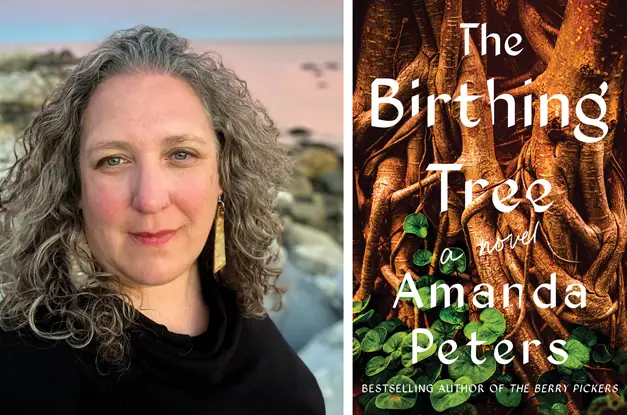
For acclaimed author Amanda Peters, the seed of her literary career was planted decades ago through a cryptic, fleeting memory. As a young woman in her late teens, Peters sat reading on a couch while her paternal grandmother, suffering from the advancing fog of dementia, gazed out a window. Out of nowhere, the older woman asked her granddaughter if she remembered a specific tree by the water’s edge on the family’s Nova Scotia property. When Peters gave a noncommittal response, her grandmother dropped a profound and haunting revelation: “That’s where we used to give birth.”
That singular, mysterious sentence—offered and never elaborated upon—would simmer in Peters’s consciousness for years. It eventually blossomed into The Birthing Tree, her highly anticipated second novel, published by Catapult. Set against the sweeping backdrop of mid-1960s to late-1990s Canada, the novel follows Aliet, a half-Mi’kmaq woman navigating love, loss, and the generational legacy of Indigenous midwifery. While the Canadian government worked systematically to suppress and erase Indigenous cultural practices, the ancient tree on Aliet’s family property stood tall, serving as a silent, enduring witness to the strength of Mi’kmaq women.
Coming off the runaway, international success of her 2023 debut, The Berry Pickers—which earned the prestigious Barnes & Noble Discover Prize and the Andrew Carnegie Medal for Excellence in Fiction—Peters finds herself navigating a new stratosphere of literary prominence. Yet, despite being translated into 25 languages and lauded by critics worldwide, the 49-year-old author remains characteristically grounded, balancing her anxieties about following up a blockbuster success with her deep-rooted love for her home in Nova Scotia’s Annapolis Valley. The Birthing Tree cements Peters not merely as a one-hit wonder, but as an essential voice in contemporary fiction, fearlessly plumbing the depths of identity, historical erasure, and community resilience.
Read Also
Detailed Chronology: From a Grandmother’s Whisper to International Acclaim
Early Life and the Seeds of Storytelling
Amanda Peters’s journey to becoming a literary powerhouse was neither direct nor traditional. Born in Nova Scotia’s picturesque Annapolis Valley to teenage parents, Peters grew up surrounded by a sprawling, tight-knit family network. Though her parents separated early on, they maintained a cooperative co-parenting dynamic, leaving Peters with a childhood split between her mother’s home on weekdays and her father’s on weekends. Between her extended maternal and paternal sides, she boasted 18 aunts and uncles, navigating a vast sea of cousins where community ties felt omnipresent.
School, however, presented early hurdles. Peters was a notoriously late reader, struggling to find her footing until the sixth grade. It took a cultural phenomenon—her peers’ obsessive fascination with Kristy’s Big Day, the sixth installment of The Baby-Sitters Club series—to spark her drive for literacy. Fearing exclusion from lunchtime conversations, she taught herself to read fluently, quickly graduating to Nancy Drew mysteries, the pulse-pounding thrillers of Sidney Sheldon and John Saul, and, finally, John Steinbeck’s Of Mice and Men, which firmly set her on a literary path.
Despite her early love for stories, practical concerns dictated her immediate future. As a mixed-race child from a working-class background in the Annapolis Valley, financial security came first. After earning a series of academic credentials—ultimately accumulating four master’s degrees in political science, public administration, information management, and later, creative writing—she spent several years teaching English abroad in the United Kingdom, Japan, and South Korea. Upon returning to Canada in 2011, she committed to a stable career in First Nations administration.
The Spark of The Berry Pickers
Writing remained an underlying ambition, but it took a gentle nudge from her father to alter the trajectory of her life. While Peters was pursuing a novel-writing certificate from the University of Toronto, her father suggested she write about his childhood summers spent picking blueberries in Maine. Skeptical at first, Peters accompanied him on a research trip to Portland.
The trip unlocked the premise for The Berry Pickers, a gripping narrative about a kidnapped Mi’kmaq girl and her grief-stricken brother. Published in 2023, the novel exploded past modest expectations. Peters had assumed a handful of Canadians would read it, her parents would offer polite approval, and she would gently fade back into obscurity. Instead, the book became a runaway commercial and critical phenomenon, securing the Barnes & Noble Discover Prize ahead of its U.S. launch, capturing the Andrew Carnegie Medal, and ultimately selling translation rights in 25 languages.
The Conception and Arrival of The Birthing Tree
While The Berry Pickers launched her into the global spotlight, Peters’s mind was already circling back to her grandmother’s cryptic words about the tree by the water. The mystery had deepened years prior when Peters interned for the Nova Scotia Department of Health and Wellness. Working closely with midwives revived her childhood curiosity about the tree’s cultural significance, though inquiries to her family yielded no straight answers.
This unresolved history culminated in The Birthing Tree. Centered on Aliet—who flees her childhood home for Halifax following a devastating teenage loss, only to return in her forties after her grandmother’s death—the novel explores the complex matrix of Indigenous midwifery, family secrets, and quiet resilience. Written under the crushing weight of following up a massive bestseller, Peters tackled the project by stripping away external noise, asking herself a vital question: If The Berry Pickers didn’t exist, how would you write this novel?
Supporting Context & Metrics: The Anatomy of a Literary Phenomenon
To fully appreciate Amanda Peters’s rise, one must examine the unique structural metrics of her career and the thematic undercurrents shaping her bibliography.
Academic and Professional Background
Unlike many contemporary novelists who tread a traditional MFA-to-publishing pipeline, Peters boasts an eclectic and rigorous academic foundation:
- Four Master’s Degrees: Political Science, Public Administration, Information Management, and Creative Writing (earned from the Institute of American Indian Arts in Santa Fe).
- Administrative Experience: Years dedicated to First Nations administration in Canada, grounding her fiction in authentic community structures and sociopolitical realities.
- Literary Representation: Managed by literary agent Marilyn Biderman of Transatlantic Agency.
Thematic Signatures in Peters’s Work
Literary critics and editors have noted distinct recurring motifs across Peters’s novels and short story collections (such as her 2024 collection, Waiting for the Long Night Moon):
- Identity and Colonization: Peters frequently examines how systemic colonization fractures Indigenous history, creating painful voids in personal and communal identity.
- The Interplay of Grief and Guilt: Characters like Aliet and the grieving brother in The Berry Pickers are propelled by profound emotional catalysts that reshape their life trajectories over decades.
- Filling Historical Gaps: While colonial archives often omit or mischaracterize Indigenous traditions, Peters uses fiction as an active reclamation tool—giving literal voice, in the case of The Birthing Tree, to the silent landscapes of her ancestors.
Official Statements and Authorial Insights
Speaking via Zoom from her home in Nova Scotia’s Annapolis Valley—where she battles an intense regional heat wave alongside her household companions, a dog named Holly and a cat named Pook—Peters offers candid reflections on her sudden literary fame, creative philosophy, and the paralyzing pressures of expectation.
Reflecting on the whirlwind success of her debut, Peters admits:
"I spent a lot of time in my head, wondering if people would like this or that part of the new book. It stymied the story, and eventually, I had to just say, If The Berry Pickers didn’t exist, how would you write this novel? I’m still terrified that people are going to absolutely hate it. But I’m hoping they don’t."
Despite her international accolades, Peters maintains a refreshingly modest perspective on her place in the world, often joking about her life’s hierarchy:
"My favorite title is auntie, and then maybe dog mom. Author comes last."
Discussing her creative process and the mysterious origins of her ideas, Peters resists tidy explanations, leaning into her fascination with astronomy, physics, and the concept of a universal consciousness:
"The setting is me, but the characters are not me. There’s no answer for creativity. I’m obsessed with astronomy and physics. I understand about 10% of what I’m reading and watching and listening to, but I find it fascinating."
On the broader socio-cultural weight of her writing, she identifies the driving force behind her thematic choices:
"My editor says I’m always going to write about identity. In Indigenous communities, there are a lot of gaps: gaps in our history, gaps in our stories. Colonization has not done well for us. Maybe, in my work, I’m unconsciously reflecting those gaps."
Future Outlook: Sustaining the Momentum
As The Birthing Tree hits bookshelves worldwide, Amanda Peters stands at a critical juncture in her literary trajectory. Having successfully crossed the dreaded sophomore slump threshold, she has proven that The Berry Pickers was merely the opening statement of a major literary career, not an isolated lightning strike.
Looking forward, Peters continues to reside in the Annapolis Valley, drawing creative sustenance from the geography of her youth while maintaining a disciplined, deliberate approach to her craft. Free from the constraints of children or domestic diversions that consume the schedules of many of her peers, she remains singularly devoted to unearthing the hidden histories, quiet tragedies, and resilient triumphs of Indigenous communities.
Whether she is contemplating the mysteries of quantum physics or listening to the metaphorical whispers of ancient trees, Peters has established herself as a vital custodian of memory. In giving voice to the voiceless—both human and arboreal—she ensures that the gaps left by history are not merely acknowledged, but beautifully, permanently filled.




Comments
Facebook App ID not configured. Please add it in the Customizer.