
Executive Overview
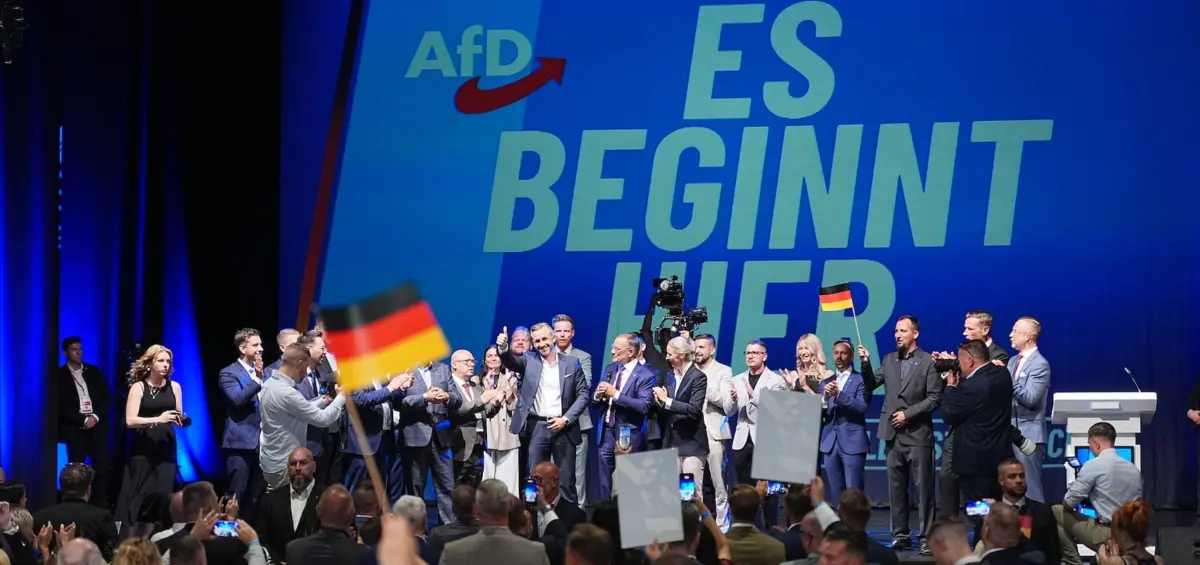
Three weeks before the German state of Sachsen-Anhalt headed to the polls for a high-stakes legislative election, the nation’s leading news magazine, Der Spiegel, deployed a striking front-page image: a mug shot of Ulrich Siegmund, the lead candidate for the Alternative for Germany (AfD) party, framed beneath the provocative headline: “Germany’s Most Dangerous Man.”
At first glance, Siegmund hardly fits the conventional archetype of a political radical. Young, untested, affable, and somewhat eccentric, he studied aromachology and marketing at university—maintaining a particular academic interest in the psychological impact of ambient scents on consumer behavior—and spends his free time restoring vintage East German motorbikes. Yet, what unnerved the editorial board of Der Spiegel was not his CV or his hobbies. It was the terrifying prospect that an individual representing the political extreme right was on the precipice of securing executive power at a regional level in Germany for the first time since the fall of the Third Reich.
Germany’s defensive political architecture—rooted in the concept of wehrhafte Demokratie (fortified democracy)—was explicitly designed in the post-war era to identify internal democratic threats and neutralize them before they could subvert the state. Today, however, this very defensive mechanism is facing an existential crisis. The AfD is no longer a marginal protest movement; it has morphed into a massive populist political force, commanding nearly 28 percent support nationwide in recent polls and dominating eastern German states like Sachsen-Anhalt, where it has polled at over 40 percent.
Read Also
As the traditional parties—the Christian Democratic Union (CDU) and the Social Democratic Party (SPD)—cling to a defensive political isolation strategy known as the Brandmauer (firewall), Germany finds itself locked in a tense struggle between an entrenched establishment consensus and a restless electorate demanding a fundamental reckoning with the nation’s most pressing socio-economic crises.
Detailed Chronology: From Euro Skepticism to Mass Populism
To understand how the AfD ascended to its current position of dominance, it is necessary to trace its evolution through a turbulent decade and a half of compounding European and domestic crises.
The Genesis: The 2008 Financial Crisis and the Euro
The origins of the AfD lie in the technocratic anxieties provoked by the global financial crash of 2008–2009 and the subsequent eurozone sovereign debt crisis. When heavily indebted Mediterranean nations—most notably Greece—faced default, Brussels engineered bailout packages that relied heavily on German financial guarantees.
Founded in 2013 by a cadre of Frankfurt economics professors, business leaders, and moderate conservatives like Bernd Lucke, the AfD initially emerged as a single-issue, technocratic party opposed to eurozone bailouts and the dilution of the mighty Deutsche Mark. In its inaugural national campaign, the party narrowly missed the mandatory 5 percent electoral threshold required to enter the Bundestag. Had Lucke’s faction retained control, the AfD might have evolved into a conventional, respectable fiscal watchdog akin to the Free Democratic Party (FDP). Instead, explosive socio-political shocks were waiting just over the horizon.
The 2015 Migration Crisis and Party Schisms
The turning point for the AfD—and for modern German politics—occurred in 2015. Amid the devastating fallout of the Syrian civil war, Chancellor Angela Merkel made the fateful decision to open Germany’s borders to hundreds of thousands of asylum seekers under the banner of Wir schaffen das (“We’ll get it done”).
While the foreign-born population surged from 8.1 million in 2014 to 13.4 million by 2022, the social fabric of the country strained under the weight of integration challenges, housing shortages, and high-profile criminal incidents. The influx hit eastern Germany particularly hard, where deindustrialized towns like Bitterfeld had already experienced decades of population drain following reunification.
This environment catalyzed a bitter ideological civil war within the AfD. Pragmatists who viewed immigration strictly through an economic lens clashed with nationalists like Frauke Petry, who argued that mass migration posed an existential threat to German culture and social cohesion. Petry outmaneuvered Lucke in 2015, transforming the AfD from an academic pressure group into a mass populist movement. Subsequent internal power struggles saw figures associated with the nationalist Der Flügel (The Wing) faction, such as Björn Höcke and Andreas Kalbitz, grapple for influence before the faction was formally dissolved under intense state surveillance pressure in 2020.
The COVID-19 Pandemic and the Return of Grand Coalitions
As the party navigated internal purges—culminating in the rise of co-leader Alice Weidel—external crises continued to provide fuel for its growth. The COVID-19 pandemic introduced draconian lockdowns and mandatory vaccination policies enforced with characteristic bureaucratic rigidity. While mainstream politicians and media outlets frequently dismissed lockdown opponents as Corona-leugner (denialists), the AfD positioned itself as the sole parliamentary defender of civil liberties and bodily autonomy.
Following Merkel’s departure, subsequent coalition governments led by Olaf Scholz and later Friedrich Merz struggled to maintain public trust. Despite promising a decisive break with the past, the Merz administration was forced into compromise coalitions with the unpopular SPD, handing critical ministries to politicians associated with pandemic-era restrictions and green energy transitions.
The Ukraine War and the Energy Crunch
The Russian invasion of Ukraine in 2022 struck a devastating blow to Germany’s industrial model. The sabotage of the Nord Stream pipelines, combined with Western sanctions, cut Germany off from cheap Russian natural gas, forcing the nation to pivot toward expensive American liquefied natural gas (LNG). Simultaneously, strict climate policies, the premature phase-out of nuclear power, and aggressive competition from Chinese electric vehicle manufacturers plunged Germany’s core automotive sector into a severe structural contraction.
The AfD capitalized on these compounding failures, campaigning aggressively against high energy costs, runaway inflation, and military escalations, thereby solidifying its status as the premier political vehicle for anti-establishment sentiment.
Supporting Context & Metrics: The Anatomy of a Fortified Democracy
Germany’s constitutional framework is built upon the doctrine of wehrhafte Demokratie—a fortified democracy empowered to suppress internal anti-constitutional forces before they can capture state apparatuses. Key instruments of this system include:
- The 5 Percent Threshold: Enforced to prevent the proliferation of fringe parties in parliament.
- The Verfassungsschutz (Federal Office for the Protection of the Constitution): An intelligence agency tasked with monitoring extremist groups, capable of classifying political parties and enabling their eventual prohibition by the Federal Constitutional Court (Bundesverfassungsgericht).
- The Brandmauer (Firewall): An informal political ostracism pact wherein mainstream parties refuse all forms of legislative and social cooperation with the AfD.
Despite these defensive structures, recent polling metrics reveal an unprecedented systemic disconnect between the electorate and the political establishment:
| Metric / Indicator | Statistical Reality |
|---|---|
| National Polling Support | AfD leads at 28%, ahead of the CDU at 21%. |
| Sachsen-Anhalt Regional Polling | AfD commands 42%–43%, doubling its nearest rivals. |
| Foreign-Born Population Growth | Rose from 8.1 million (2014) to 13.4 million (2022). |
| Social Media Reach (Sachsen-Anhalt) | Ulrich Siegmund (1.7 million followers) vs. incumbent CDU Minister-President Sven Schulze (24,000 followers). |
Official Statements and Political Rhetoric
The political discourse surrounding the AfD is characterized by extreme polarization, pitting establishment warnings of democratic collapse against populist accusations of systemic censorship.
- Mainstream Establishment Warnings:
Mainstream political figures continue to frame the party as an existential threat to the republic. Following visits by AfD delegations to Moscow, CSU General Secretary Martin Huber publicly accused the party of “treason.” Similarly, Green-affiliated human rights organizations have repeatedly published exhaustive legal briefs arguing for an outright ban on the party, claiming that its public messaging is a coded front for neo-Fascist ideology. - AfD Counter-Narratives:
Co-leader Alice Weidel and eastern leaders like Ulrich Siegmund reject these characterizations as partisan smears designed to stifle legitimate democratic debate. Addressing the nation’s stringent memory culture regarding World War II, prominent regional figures like Björn Höcke have argued that Germany’s historical consciousness has reduced the nation to the status of a “defeated people,” sparking fierce debates over patriotism and historical identity. - Conservative and Critical Commentary:
Even non-AfD figures have expressed alarm over the weaponization of legal mechanisms to eliminate political competition. Writing in the media, conservative commentators like Harald Martenstein have publicly rebuked progressive audiences, remarking during public debates: “You know that you are not trying to prevent the Fourth Reich, but only to eliminate your political competition. It would be child’s play to keep the AfD down. All you would have to do is tackle a few problems that are real problems.”
Future Outlook: Can the Firewall Hold?
As Germany navigates the aftermath of the Sachsen-Anhalt elections and looks toward future federal cycles, the long-term viability of the Brandmauer appears increasingly untenable.
The traditional parties are caught in a profound strategic trap. To lock out an AfD party commanding upwards of 40 percent of the regional electorate, establishment parties are forced into awkward, ideologically contradictory coalitions—sometimes relying on tacit cooperation with the Left Party, a successor to the communist-era Socialist Unity Party. This political engineering only deepens voter cynicism and reinforces the narrative that the Altparteien (“old parties”) are more interested in preserving their monopoly on power than addressing the real-world crises facing ordinary citizens.
Banning the AfD through the Federal Constitutional Court remains a high-stakes legal gamble. With millions of citizens casting ballots for the party—many of whom were born long after the fall of the Berlin Wall and feel no emotional connection to the mid-century catastrophes that birthed the wehrhafte Demokratie—an outright ban risks triggering profound social unrest and accelerating the very delegitimization of the state that the constitution was designed to prevent.
Ultimately, Germany’s fortified democracy is discovering that defensive walls and rhetorical quarantines cannot indefinitely substitute for effective governance. If the established political order is to survive the current century, its salvation will not come from courtrooms or magazine cover mug shots, but from a willingness to confront and resolve the complex socio-economic realities shaping the modern European landscape.





Comments
Facebook App ID not configured. Please add it in the Customizer.