In an era where contemporary verse frequently navigates the macro-political landscapes of our collective anxieties, master poet Michael Broek turns his lens inward, capturing the quiet, agonizing microcosm of familial trauma and mental illness. Selected as the Poem of the Week, Broek’s harrowing and tender work, "Stem," lays bare the profound helplessness, enduring devotion, and complex grief experienced by a parent watching a child battle severe psychological distress.
Published alongside profound authorial reflections, "Stem" is not merely an isolated piece of creative writing; it is a cultural artifact that speaks directly to the invisible epidemics of youth mental health crises, self-harm, and the emotional toll exacted upon caregivers. Broek—acclaimed author of Refuge/es, The Window Light, and multiple chapbooks—brings his signature lyrical precision to bear on a subject that many society-at-large prefers to shroud in silence.
This piece explores the thematic depth of "Stem," examining the literary lineage that birthed its title, the raw domestic realities it depicts, and the broader cultural conversation surrounding mental illness, family dynamics, and the limits of therapeutic intervention. Through rigorous analysis and contextualization, this feature unpacks the weight of Broek’s latest contribution to modern American poetry.
To understand the emotional resonance of "Stem," one must trace the developmental arc of Michael Broek’s literary career. Over the past decade, Broek has established himself as a vital voice in contemporary poetry, earning prestigious accolades including fellowships from the MacDowell Colony and the Marble House Project, a scholarship to the Bread Loaf Writers Conference, and three competitive grants from the New Jersey State Council on the Arts.
His breakthrough collection, Refuge/es, captured the Kinereth Gensler Award from Alice James Books, setting a high standard for lyrical exploration of displacement and emotional exposure. Subsequent works—such as The Logic of Yoo (published via Beloit Poetry Journal), The Amputation Artist (ELJ Publications), and his recent volume, The Window Light—demonstrated an increasing preoccupation with interiority, broken communication, and the mechanics of survival.
In recent years, however, Broek’s creative focus has pivoted sharply toward the domestic sphere, specifically investigating the collateral damage of mental illness within the family unit. "Stem" represents a zenith in this thematic exploration, functioning as both an artistic triumph and an emotional bleeding-out.
Anatomy of "Stem": A Close Reading
The poem opens with a stark, unsettling realization:
There must be a name / for the trauma of walking / into my son’s bedroom / when shirtless he rises from sleep / and the cuts on his arms / his shoulders / resemble war wounds / or the red gashes / of a lash.
By comparing self-inflicted wounds to "war wounds" and the marks of a "lash," Broek immediately elevates domestic suffering to the theater of epic trauma. The parent’s position is not one of detached observation, but of frontline exposure.
As the narrative progresses, the poem cataloging the mundane frustrations that bleed into existential despair:
Maybe it’s just another name for tired— / stealing his sister’s cash & stash. / Endless walks / to the therapist’s door & him saying / no—not today.
This juxtaposition of petty theft and clinical resistance captures the erratic, exhausting cadence of life with a child in crisis. The physical markers of distress—dishes caked with waste, canceled appointments, locked doors—form an oppressive landscape of domestic inertia.
Yet, amidst the despair, the poem pivots toward a paradoxical reverence:
There must be a name / for giving up while also / grasping. This is not some glass / I’d thought I’d hold— / its thin stem, mouth opened / upward like a gull’s beak / swallowing everything, even dark.
The central metaphor of the fragile glass vessel—its stem held desperately while its bowl swallows the surrounding darkness—encapsulates the precariousness of parental love under siege. Even when faced with the child’s desire for total alienation ("mostly / he’d like me to disappear. That’s okay"), the speaker maintains a fierce, tragic awe for the scars left behind by love that has run up against the limits of its healing power.
Supporting Context, Metrics, and Literary Lineage
The Beckettian Inspiration: Krapp’s Last Tape
In his authorial note, Broek reveals that the title "Stem" was born not from the medical terminology of botany or anatomy, but from Samuel Beckett’s seminal play, Krapp’s Last Tape.
In Beckett’s work, an aging man listens to audio diaries recorded decades prior, confronting the bitter realization that his life of grand ambition has culminated in isolation and emotional stagnation. However, amidst the bleakness, Krapp fixates on a specific, haunting memory of lying with a lover in a small boat:
"We drifted in among the flags and stuck. The way they went down, sighing, before the stem! […] We lay there without moving. But under us all moved, and moved us, gently, up and down, and from side to side."
Broek channels this Beckettian ethos into his poem. Just as Krapp’s memory captures both the insularity and the absolute necessity of human intimacy, Broek’s "Stem" reflects on how deeply shared experiences carry an isolated undertow. The natural world—represented in Broek’s final stanza by gulls flying indifferently above a millionaire’s yacht and a rusted dredge in the gray Navesink—operates in stark contrast to human pain:
Gulls refuse reason / and fly above the millionaire’s yacht / and fly above the rusted dredge / dawdling in the gray Navesink / not caring that one is a lie— / the other a hurt.
Visual Intertextuality: Helene Schjerfbeck
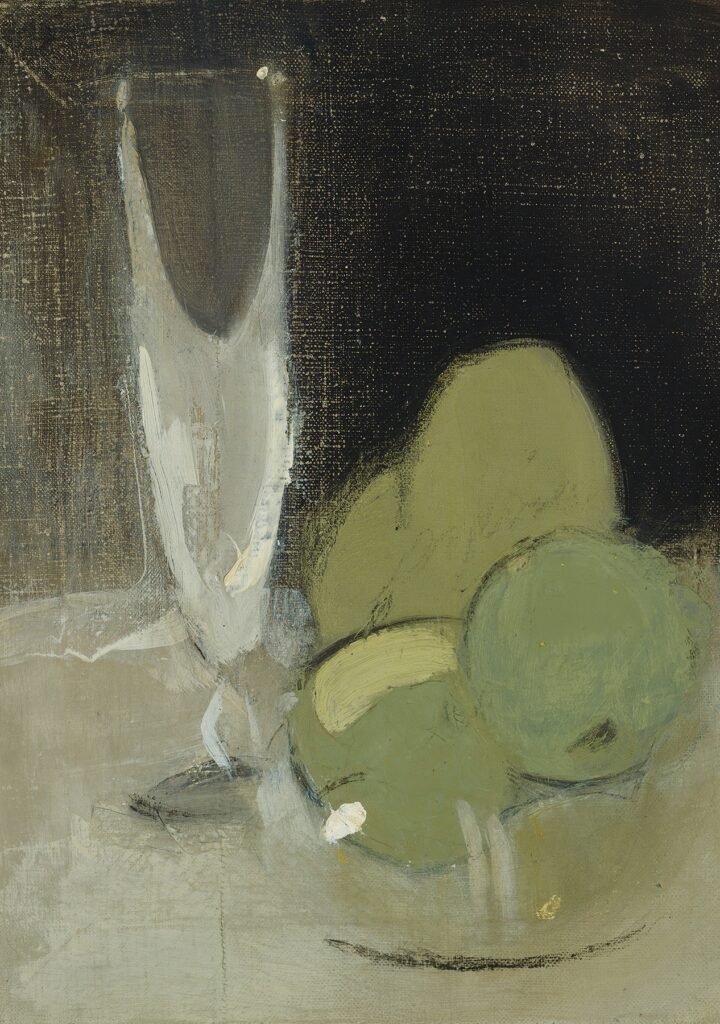
Adding another layer of depth to the publication is its companion imagery. The title image features Green Apples And Champagne Glass (1934) by Finnish modernist painter Helene Schjerfbeck. Known for her minimalist yet emotionally charged still lifes and self-portraits, Schjerfbeck’s inclusion mirrors Broek’s poetic aesthetic: sparse lines masking immense, turbulent interior weight. The delicate balance of the champagne glass in the painting echoes the fragility of the "stem" metaphor in the poem—a vessel holding sparkling expectations that ultimately reveals the bitter sediment at the bottom.
Official Statements and Authorial Insights
Reflecting on the genesis of the poem, Michael Broek provided profound context regarding the modern landscape of domestic writing:
"I’ve written a lot lately about mental illness and its impact on families," Broek notes. "This poem title, however, was inspired by a line from Beckett’s play Krapp’s Last Tape, which is not about mental illness per se, but about lost hope… What he [Krapp] remembers is both the insularity and the necessity of human intimacy, the way that what is experienced together is also experienced alone."
The tension between experiencing suffering together versus enduring it in absolute solitude sits at the heart of Broek’s commentary. When a child retreats behind locked bedroom doors, the parent is locked out of the internal theater of disease, forced to navigate the wreckage from the periphery.
Literary critics have noted that "Stem" avoids the traps of sentimentalism or didactic moralizing. Instead, it offers a raw documentary of endurance. There are no neat resolutions offered in the final lines; the gulls continue their flight over the Navesink River, indifferent to whether human constructs are lies of luxury or truths of injury.
Future Outlook: The Cultural Resonance of Domestic Poetry
As contemporary literature continues to grapple with the mental health epidemic sweeping post-pandemic societies, works like Michael Broek’s "Stem" serve an essential cultural function. They translate clinical statistics and therapeutic vernacular back into the human language of breath, blood, and bone.
The selection of "Stem" as Poem of the Week highlights a broader institutional shift within literary magazines toward radical honesty regarding family dynamics. As readers seek out art that mirrors their private griefs, poems that address caregiver burnout, adolescent self-harm, and the unyielding nature of parental love will remain vital touchstones.
Looking forward, Broek’s exploration of these themes suggests that his upcoming literary projects will continue to challenge polite silences, dragging the hidden traumas of the modern household into the illuminating light of high art. "Stem" stands as a testament to the fact that poetry remains one of our most potent tools for naming the unnameable—giving shape and structure to the fragile stems we hold onto, even as they threaten to shatter in our hands.







Comments
Facebook App ID not configured. Please add it in the Customizer.