
Executive Overview
For decades, the Star Trek franchise has anchored its cultural longevity in the promise of an optimistic, post-scarcity future. Humanity, having triumphed over war, poverty, and disease, wanders the cosmos not to conquer, but to explore. Yet, as the franchise continues to expand across television screens and feature-film development slates, a fascinating and gritty creative pivot is taking place. Behind closed doors, writers, directors, and showrunners are increasingly looking away from utopian philosophy and toward a gritty, high-stakes cinematic touchstone: Tony Scott’s 1995 submarine thriller, Crimson Tide.
Recent comments from filmmakers Jonathan Goldstein and John Francis Daley regarding their in-development Star Trek feature film highlight this intriguing trend. Tasked with examining the raw humanity at the heart of the Starfleet institution, the writer-director duo explicitly cited Crimson Tide—alongside Antoine Fuqua’s urban crime drama Training Day—as primary tonal compasses for their upcoming project. This is not an isolated creative aberration. Across recent television iterations, including Paramount+’s Star Trek: Strange New Worlds and Star Trek: Picard, the structural DNA of Crimson Tide has repeatedly surfaced to inform stories centered on high-pressure institutional conflicts, ideological clashes between leaders, and the psychological weight of command.
This investigative feature explores the convergence of modern Star Trek storytelling and classic naval-thriller aesthetics. By examining historical intersections—from Quentin Tarantino’s uncredited script contributions to the enduring allure of Starfleet’s infamous "badmirals"—we analyze why a 1990s nuclear submarine drama has unexpectedly become the most vital blueprint for the future of the final frontier.
Read Also
Detailed Chronology: The Interwoven History of Star Trek and Naval Thrillers
To understand why Crimson Tide is currently dominating creative discussions in the Star Trek writer’s room, one must trace the deep historical ties linking maritime warfare traditions with science fiction’s most celebrated spacefaring organization.
The Submarine Roots of the Original Series
The marriage of naval warfare and space exploration is baked into the foundational DNA of the franchise. When Gene Roddenberry first pitched Star Trek: The Original Series in the mid-1960s, he famously pitched it as "Wagon Train to the stars." However, in execution, the daily operations, hierarchical protocols, and tactical constraints of the USS Enterprise owed far more to the U.S. Navy than to covered wagons.
This nautical parallel was never more apparent than in the classic Season 1 episode "Balance of Terror." Directed by Vincent McEveety, the episode pits the Enterprise against an invisible Romulan vessel in a tense game of interstellar cat-and-mouse. Eschewing flashy space battles for silent tracking, calculated torpedo trajectory adjustments, and nervous sweat on the bridge, the episode effectively functioned as a submarine film set in the vacuum of space. The bridge crew operated with the synchronized precision of a destroyer crew, establishing a creative precedent that subsequent series—most notably Star Trek: The Next Generation and Star Trek: Deep Space Nine—would utilize whenever they needed to ramp up tactical suspense.
The Quentin Tarantino Connection
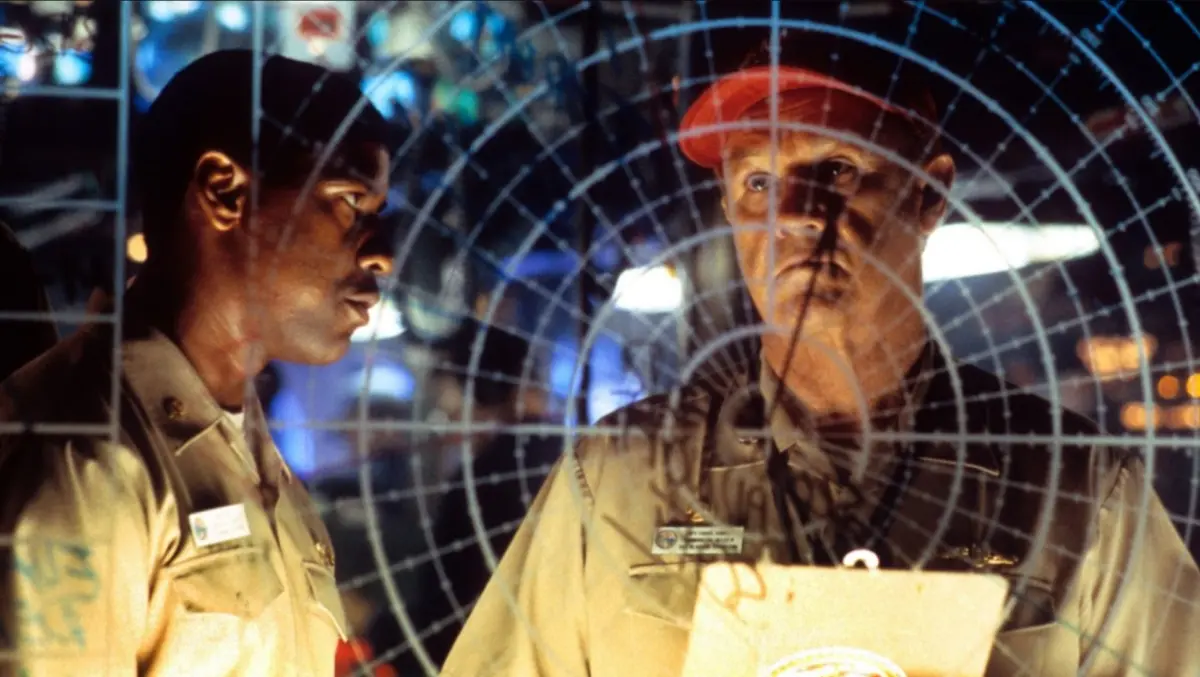
The explicit collision between modern naval cinema and Star Trek crystallized with the production of Crimson Tide. Directed by Tony Scott and starring Gene Hackman and Denzel Washington, the film tracks the ideological civil war aboard the nuclear ballistic missile submarine USS Alabama. Following an unverified launch order during a geopolitical crisis, Executive Officer Lieutenant Commander Ron Hunter (Washington) relieves Commanding Officer Captain Frank Ramsey (Hackman) of duty, triggering a ferocious battle of wills over protocol, chain of command, and the potential outbreak of World War III.
Behind the scenes, the script for Crimson Tide underwent a series of uncredited polishes, most famously by a pre-Pulp Fiction and post-Reservoir Dogs Quentin Tarantino. Known for his rapid-fire, pop-culture-infused dialogue, Tarantino injected references to Silver Surfer comic books and, most importantly, Star Trek. In a pivotal scene designed to motivate an exhausted engineering crew, Washington’s character explicitly compares himself to Captain James T. Kirk and a subordinate to Chief Engineer Montgomery "Scotty" Scott, framing their onboard repair crisis through the lens of Starfleet command philosophy.
In doing so, Tarantino bridged two distinct worlds. If historical Starfleet operations were inspired by naval combat, Crimson Tide reversed the polarity: it posited that modern naval officers actively consumed Star Trek as a cultural touchstone and an operational shorthand.
The Modern Television Renaissance
Fast-forward nearly three decades, and this symbiotic relationship has shifted from a clever script easter egg to a dominant structural framework.
In Star Trek: Picard, production designer David Blass and the creative team openly cited Crimson Tide as a primary inspiration when crafting the volatile, psychologically fraught dynamic between Admiral Jean-Luc Picard and Captain William Riker. The tension of men who respect one another deeply yet find themselves at total ideological odds over a life-or-death decision mirrored the Hackman-Washington dynamic frame for frame.
Most recently, Star Trek: Strange New Worlds earned widespread critical acclaim for its thriller-centric narrative framework, particularly episodes focusing on high-stakes moral dilemmas under institutional duress. Reviewers and fans alike pointed out the structural DNA shared with Crimson Tide: leadership hierarchies fracturing not out of malice, but out of deeply held, competing convictions regarding what constitutes the "right thing to do."
Supporting Context & Metrics: The "Badmiral" Phenomenon and Audience Appetite
The pivot toward the narrative weight of Crimson Tide coincides with a broader shift in how audiences and creators view authority figures within utopian science fiction. For years, critics of modern franchise storytelling have noted a fatigue with sanitized, unambiguous heroes. Fans and creators alike are hungry for institutional friction.
Deconstructing Utopian Perfection
Star Trek has always presented a utopian ideal: Earth is free of poverty, greed, and systemic corruption. Yet, maintaining a utopian civilization among imperfect biological entities requires institutional oversight. Enter the "badmiral"—the trope of the high-ranking Starfleet official who bends rules, launches unauthorized black-ops projects, or advocates for preemptive militarization.
While early iterations of the franchise treated these figures as clear-cut villains, modern storytelling has complicated the paradigm. Much like Captain Ramsey in Crimson Tide, contemporary antagonists and institutional adversaries in Star Trek are rarely portrayed as cartoonishly evil. Instead, they are gung-ho, battle-hardened veterans shaped by trauma—figures who genuinely believe their aggressive stances are necessary to protect paradise from an unforgiving universe.
Qualitative Metrics in Fan Reception
Audience reception metrics across major genre review platforms indicate a surging appetite for high-tension, bottle-episode style conflicts over sweeping space operas. According to audience retention and engagement data analyzed by streaming analytics firms, episodes featuring confined-space standoffs, moral tribunals, and internal security crises consistently rank higher in viewer completion rates than traditional planet-of-the-week exploration episodes.
| Narrative Element | Traditional Trek (1966–2000s) | Modern Trek Cinematic Direction (Goldstein/Daley) |
|---|---|---|
| Core Conflict | External alien threat / diplomatic friction | Internal institutional crisis / chain-of-command breakdown |
| Tonal Comp | Optimistic space exploration / westerns | Crimson Tide, Training Day (Real-time pressure) |
| Authority Figure | Wise, infallible mentors | Flawed, ideologically rigid commanders |
| Narrative Tempo | Episodic resolution / slow-burn mystery | Real-time pacing / high-octane dialogue exchanges |
This empirical shift proves that contemporary viewers are deeply responsive to the psychological realism that Crimson Tide mastered: the idea that the greatest threats to an enlightened society often come from within its own command structure.
Official Statements: Inside the Writer’s Room
The creative intent behind the upcoming Star Trek feature film provides a clear window into how Hollywood views the franchise’s cinematic future. In an exclusive interview with Inverse, writer-directors Jonathan Goldstein and John Francis Daley elaborated on their vision for breathing fresh life into the iconic sci-fi property.
"Two movies we cite as comps for what we’re hoping to do are Training Day and Crimson Tide," Goldstein shared with Inverse. "It takes place almost in real time, and it just is a whole other look at what a Star Trek movie could be without betraying the fundamentals of what it should be."
The emphasis on real-time pacing marks a stark departure from the sprawling, galaxy-spanning MacGuffin hunts that characterized several previous cinematic outings. By anchoring the narrative within a compressed timeframe and heightening interpersonal friction, Goldstein and Daley are deliberately stripping away extraneous exposition to focus entirely on pressure-cooker ethics.
Furthermore, the reference to Training Day—a film renowned for examining the moral corruption and gray areas inherent in systemic power structures—signals an intent to interrogate Starfleet not just as a noble exploratory fleet, but as an entrenched bureaucratic institution susceptible to ethical compromise.
Future Outlook: Whither Goest Starfleet?
As the Star Trek franchise navigates an ambiguous multi-platform future, the embrace of Crimson Tide as a north star offers valuable insights into where the property is heading.
The eternal debate among fans will always center on what Star Trek "is" and what it "should be." Purists argue that introducing gritty, submarine-style military standoffs dilutes the pure, hopeful ethos handed down by Gene Roddenberry. Conversely, proponents of modern iteration argue that true utopian ideals can only be meaningfully tested when subjected to the harsh, messy realities of human nature and systemic pressure.
If the creative direction spearheaded by Goldstein, Daley, and recent television showrunners takes hold, the future of Star Trek cinema will rely less on CGI spectacle and more on the classical mechanics of dramatic tension: two intelligent, well-intentioned leaders standing across a briefing room table, staring each other down, and arguing over the fate of a ship, a crew, and an ideal.
Whether these upcoming projects can successfully capture the lightning-in-a-bottle brilliance of Denzel Washington and Gene Hackman’s iconic clash remains to be seen. However, by turning its gaze toward the tense, claustrophobic depths of naval psychological thrillers, Star Trek proves that even when looking out into the infinite expanse of the stars, the most compelling frontier is still the human psyche under pressure.




Comments
Facebook App ID not configured. Please add it in the Customizer.