
Executive Overview
The intersection of artificial intelligence and academic publishing has long been a subject of speculative debate, but new empirical data suggests the theoretical has firmly given way to the practical. According to a comprehensive, data-driven investigation conducted by Utrecht University researcher Dr. Maximilian Noichl, an estimated 12% of published philosophy papers in 2026 involve some degree of artificial intelligence assistance.
While the stereotype of entirely automated, prompt-generated "slop" dominating serious academic venues remains largely hyperbolic, Noichl’s findings reveal a subtler, more pervasive integration of large language models (LLMs) into the daily workflows of academic philosophers. Far from being confined to the fringes of the discipline, AI-assisted text is increasingly making its way past peer review and into respectable journals, while preprint servers are experiencing an unprecedented influx of machine-assisted and automated content.
This investigation sheds light on a paradigm shift within the humanities. Long viewed as a deeply human-centric discipline defined by individual stylistic voice, rigorous dialectic, and painstaking manual drafting, philosophy is grappling with the same technological disruptions transforming computer science, biology, and the social sciences. As the academic community confronts these realities, Noichl’s research serves as both a wake-up call and a methodological baseline for understanding how generative AI is reshaping the intellectual landscape.
Read Also
Detailed Chronology: From Skepticism to Empirical Detection
To understand how AI-generated text breached the walls of academic philosophy, one must trace the rapid evolution of detection technology and publishing trends over the past three years.
Phase 1: The Blind Spot (2022–2024)
When OpenAI introduced ChatGPT in late 2022, the academic community was caught flat-footed. In the early days of generative AI, detection tools were notoriously unreliable, prone to false positives, and easily bypassed by simple prompt engineering or minor post-processing. Many epistemologists and philosophers assumed that the complex, nuanced arguments native to philosophy were inherently immune to mechanical replication. AI detectors were viewed as blunt, unreliable instruments, and most journals adopted a wait-and-see attitude without robust technological safeguards.
Phase 2: The Rise of Reliable Detectors (2024–2025)
The technological landscape shifted dramatically between 2024 and 2025. The introduction of advanced, high-accuracy detection frameworks—such as Pangram and transformer-based open-source models like MELD (developed by Li et al. in 2026)—revolutionized text analysis. These new systems leverage contextual semantics, token embeddings, and multi-dimensional prototype scoring to identify machine-generated text with remarkable confidence.
Despite these advancements, many researchers continued to underestimate how detectable AI writing had become. While false positives remained a legitimate concern, the sensitivity of these modern detectors allowed researchers like Noichl to move past anecdotal suspicion and begin large-scale empirical audits of academic literature.
Phase 3: The 2026 Reality Check
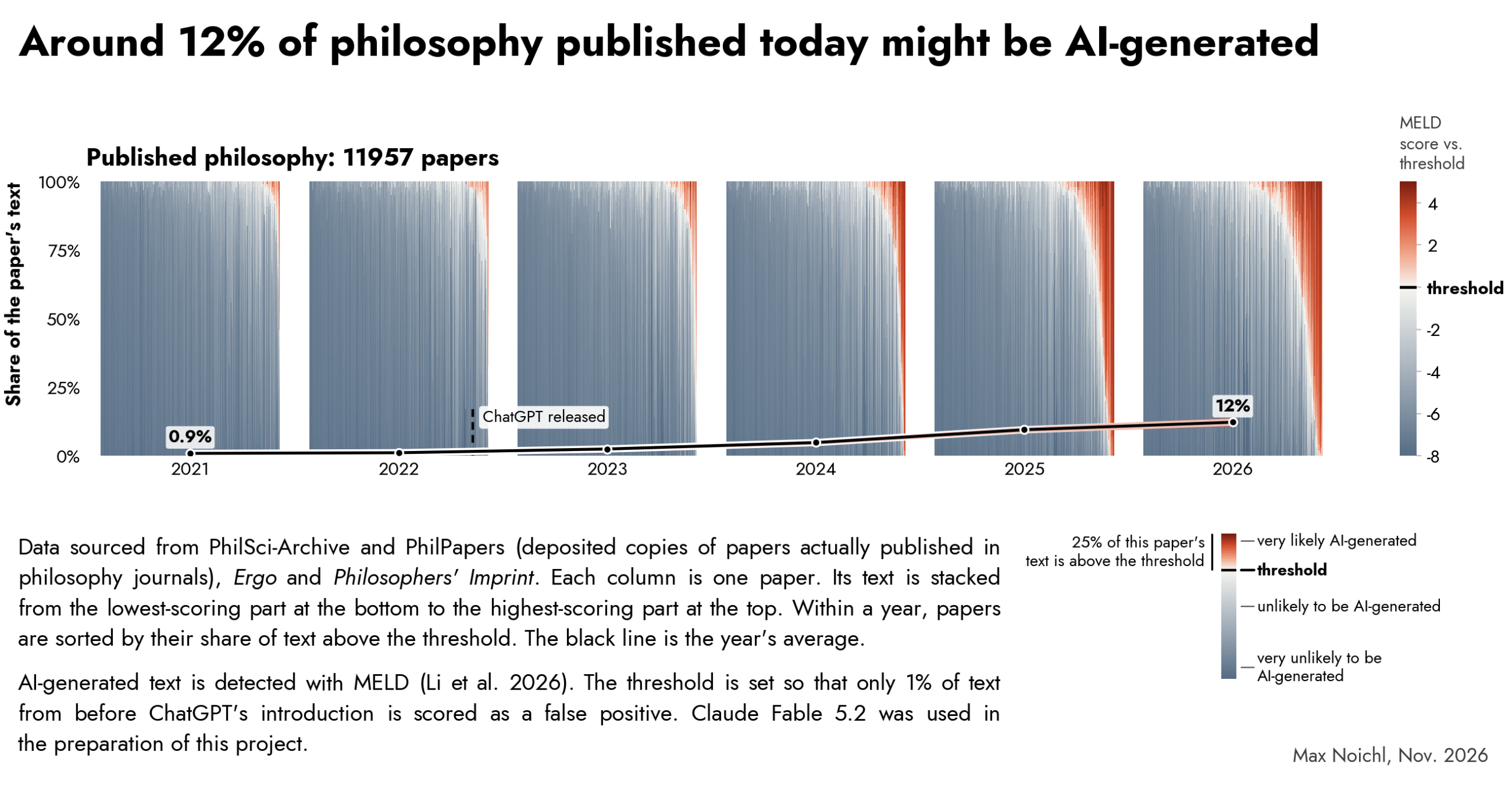
By 2026, the empirical data crystallized. Analyzing thousands of documents across open-access journals, published databases, and preprint archives, Noichl uncovered a distinct upward trajectory. While pre-2023 baseline data hovered around a nominal 1% false-positive rate, post-2023 metrics displayed a steady creep of AI-flagged passages, culminating in the 12% estimation for peer-reviewed philosophy articles published in 2026. Preprint servers, meanwhile, showed an even more dramatic saturation, with untamed repositories seeing massive influxes of machine-assisted drafts.
Supporting Context & Methodology: How the Investigation Was Conducted
Dr. Noichl’s investigation was designed to replace speculative hand-wringing with rigorous data science. To achieve this, he examined four major publicly available repositories of philosophical literature:
- Philosophers’ Imprint (197 papers analyzed)
- Ergo (374 papers analyzed)
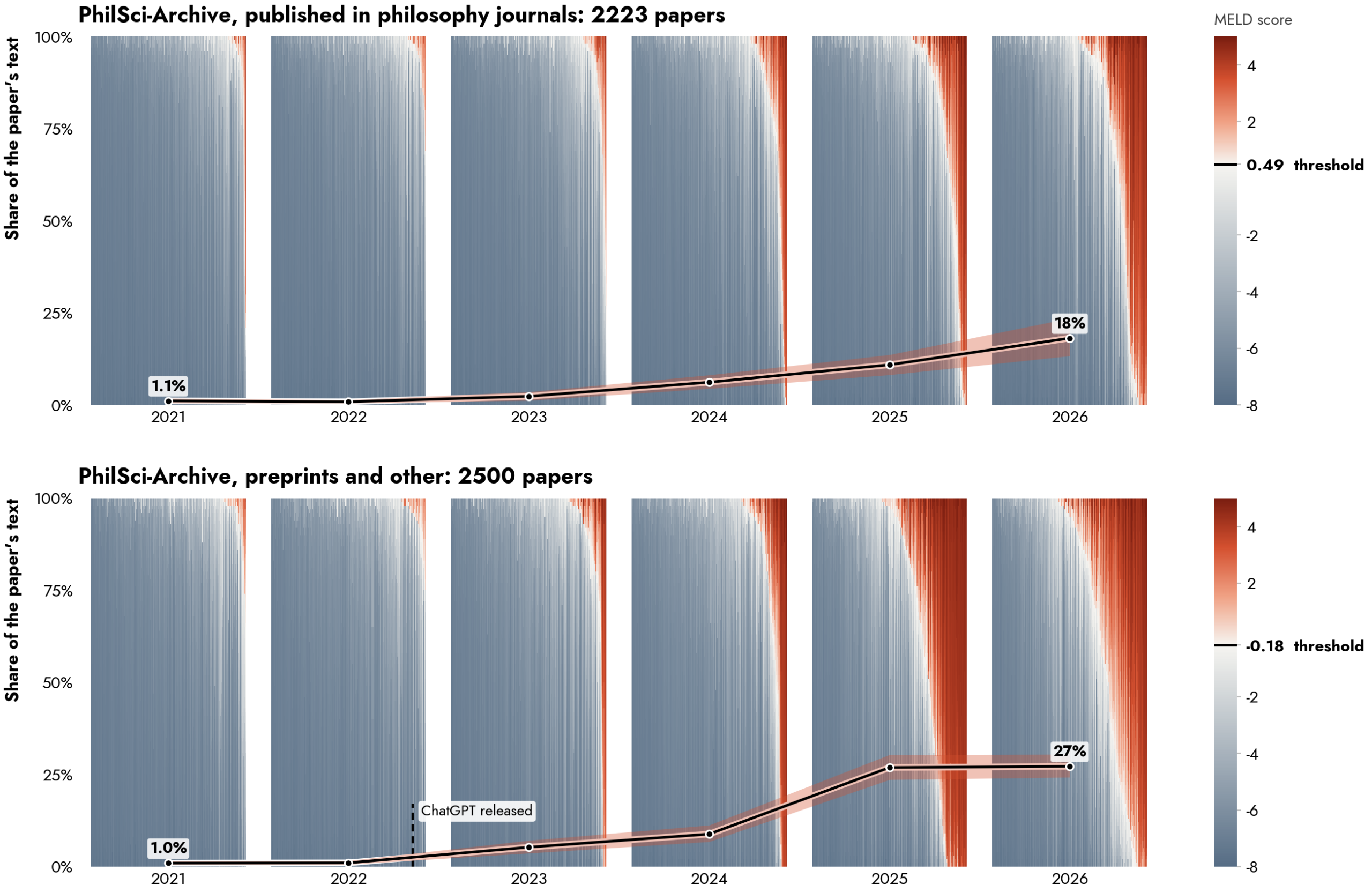
- PhilSci-Archive (4,723 papers analyzed)
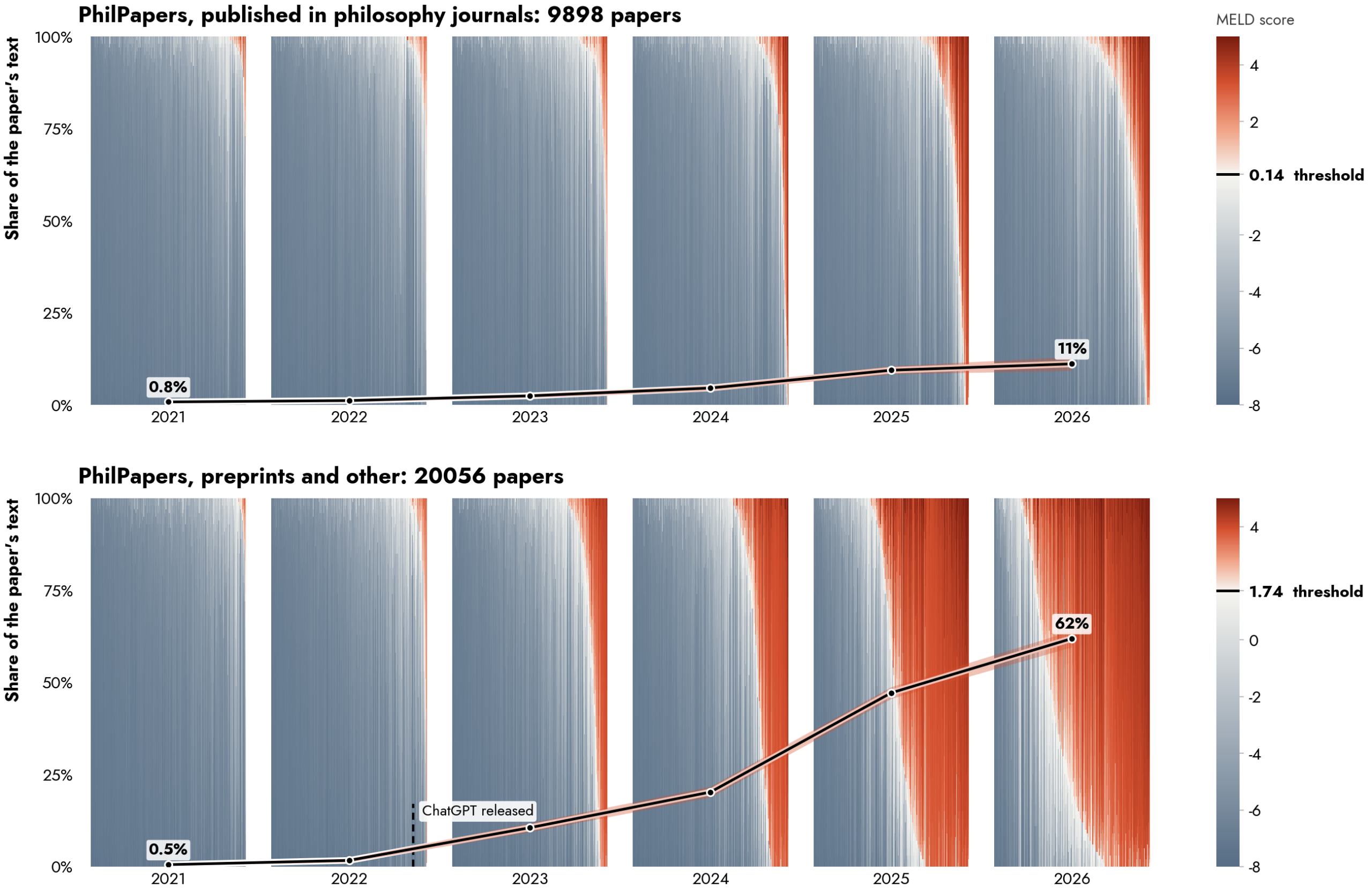
- PhilPapers / PhilArchive (nearly 30,000 papers analyzed)
The Technological Engine: MELD and Token Analysis
Rather than relying on prohibitively expensive commercial APIs, Noichl utilized MELD, an open-source transformer model built on the ModernBERT architecture. MELD processes text in 2,046-token windows (roughly 1,500 words), scoring individual tokens against learned "human" and "AI" prototype vectors.
To calibrate the system, Noichl established strict controls. Using pre-AI papers from 2021 and 2022 as a control group, he set thresholds to maintain a strict 1% false-positive rate. Passages were evaluated by calculating their semantic distance to AI-versus-human prototypes, with the top 25% of token scores determining the overall passage score. Spot-checks were subsequently cross-verified using Pangram to ensure methodological robustness.
Key Findings by Venue
The data revealed a stark contrast between heavily curated, peer-reviewed journals and unmoderated preprint servers:
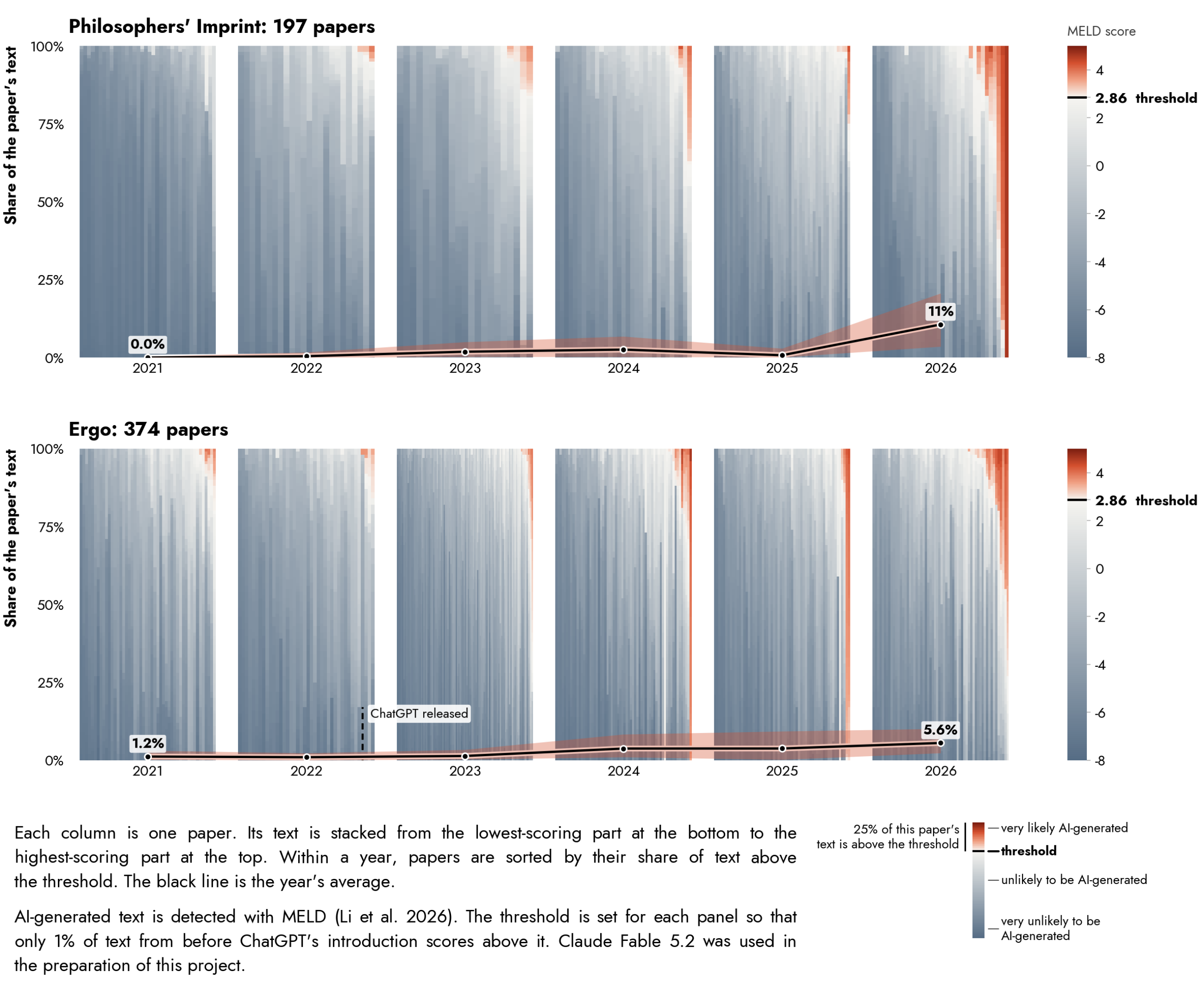
- Open-Access Flagship Journals (Ergo and Philosophers’ Imprint): While these venues maintained relatively low rates of flagged content through 2024, Ergo showed a slow, steady increase in localized AI-flagged passages, while Philosophers’ Imprint saw a noticeable uptick in 2026.
- The PhilSci-Archive: Among papers indexed as published in philosophy journals, 18% showed evidence of AI generation by 2026. Among unpubished preprints uploaded to the archive, that number rose to 27%. Notably, the rate stabilized following the implementation of new moderation policies in mid-2026.
- PhilPapers / PhilArchive: While published materials in this collection showed an 11% AI-assistance rate in 2026, unpublished preprints reached a staggering 62%. However, manual qualitative checks revealed that a significant portion of these highly flagged preprint texts were either low-quality peripheral submissions or barely related to core philosophy.
Nuance, False Positives, and the Ethics of AI Assistance
A crucial contribution of Noichl’s research is his transparent accounting for the limitations and "failure modes" of automated AI detection. He stresses that an algorithmic flag does not automatically equate to academic fraud or intellectual dishonesty.
1. Translation and Linguistic Inequality
A significant proportion of flagged papers appear to be the work of non-native English speakers utilizing AI tools for translation or stylistic polishing. Given well-documented concerns regarding linguistic inequality in academic publishing (noted by scholars such as Marsili & Rehren, and Peters et al.), using AI to bridge language barriers is viewed by many as a benign—if technically undisclosed—practice. While Noichl cautions against uncritical reliance on LLMs, he distinguishes sharply between tactical language assistance and wholesale intellectual fraud.
2. Quotational Artifacts
Another notable failure mode occurs when philosophers write about artificial intelligence, incorporating direct, properly attributed quotations from models like ChatGPT or Claude into their text. Naturally, detection models flag these authentic quotes as machine-generated, producing spurious results that require manual human auditing to parse.
3. Non-English and Specialized Scripts
The study also identified technical hurdles regarding specialized areas of research, such as Asian philosophy, where the presence of non-Latin characters occasionally triggered false positives in the MELD architecture—an error less common in commercial alternatives like Pangram.
Out of ethical concerns regarding career repercussions and the potential for false accusations, Noichl deliberately withheld raw data and author names, focusing entirely on aggregate trends. As he notes in his published disclosure, his own blog post and underlying analysis codes were built with AI assistance (utilizing MacWhisper and Fable 5.2), highlighting the complex, deeply entangled relationship contemporary researchers have with these tools.
Future Outlook: Navigating the Post-AI Philosophical Landscape
The integration of artificial intelligence into academic philosophy is no longer a hypothetical horizon; it is an established operational reality. As we look toward the future of the discipline, several critical challenges and imperatives emerge for journals, professional associations, and individual scholars:
- Standardized Disclosure Policies: While some venues like Ergo have instituted clear ethical guidelines requiring the disclosure of AI-generated content, many philosophy journals still lack explicit policies. Clear, enforceable guidelines regarding what constitutes permissible assistance (e.g., grammar checking vs. argument generation) will be vital.
- The Future of Preprint Moderation: The staggering volume of AI-flagged preprints on platforms like PhilArchive demonstrates that unmoderated servers are vulnerable to being swamped by low-effort submissions. Automated screening tools, similar to those deployed by PhilSci-Archive in mid-2026, may become a standard operational necessity to protect scholarly repositories from being overwhelmed.
- Redefining Academic Craftsmanship: Philosophy has historically prided itself on the agonizing, solitary labor of conceptual formulation and logical argument. As LLMs lower the barrier to mechanical text production, the discipline must foster an open, honest conversation about the boundaries of authorship, intellectual ownership, and the irreplaceable value of human ratiocination.
Ultimately, Dr. Noichl’s investigation demonstrates that while the soul of philosophy remains profoundly human, its textual surface is increasingly porous. The task ahead for the academic community is not to futilely bar the gates against technological progress, but to thoughtfully define the standards that keep intellectual rigor intact in an age of artificial intelligence.




Comments
Facebook App ID not configured. Please add it in the Customizer.