
Executive Overview
In the contemporary literary landscape, the intersection of community engagement, digital accessibility, and traditional poetic instruction remains a vibrant frontier. Recently, the online poetry community centered around established literary platforms experienced a brief, relatable hiccup: a delayed weekly prompt due to editorial fatigue. Yet, rather than dampening the creative momentum, this minor delay birthed an expansive, multifaceted thematic exploration built entirely around a single, highly versatile monosyllabic word: "Out."
Spearheaded by veteran poet and editor Robert Lee Brewer, the latest weekly poetry challenge invites writers of all backgrounds to deconstruct, subvert, and reimagine the concept of being "out." Whether interpreting the phrase through literal geography—such as stepping outside into the physical world—or through abstract existential states like being out of time, out of luck, or completely out of one’s mind, the initiative highlights the enduring utility of constrained writing prompts in generating fresh literary output.
Beyond the immediate mechanics of the weekly challenge, this development serves as a microcosm for broader trends in digital publishing and literary instruction. It underscores the vital role that interactive writing exercises play in sustaining reader engagement, the ongoing relevance of comprehensive reference guides like The Complete Guide to Poetic Forms, and the evolving dialogue between traditional print resources and modern podcasting mediums. This report provides an exhaustive examination of the recent prompt’s mechanics, the underlying philosophy of creative constraints, an analysis of Brewer’s complementary poem "Figure It Out," and an authoritative look at the future of digital poetry communities.
Read Also
Detailed Chronology: The Anatomy of a Delayed Prompt and Creative Pivot
The genesis of the "Out" poetry challenge unfolded through a sequence of transparent, community-oriented digital updates that illustrate the modern rhythm of online publishing.
Phase One: The Editorial Interruption
On a Tuesday evening, the routine cadence of mid-week literary publishing hit a temporary roadblock. Facing physical and mental exhaustion—famously described in the literary sphere as feeling "out of it"—the editorial team experienced a slight delay in drafting and releasing the scheduled prompt. In traditional corporate publishing, such delays are often managed through automated silence or rigidly sanitized corporate apologies. However, in community-driven literary spaces, transparency fosters intimacy.
The prompt’s introduction immediately addressed the early risers and dedicated poets who check in religiously for their mid-week creative spark. By framing the delay not as a failure, but as a shared human experience, the delay itself became the thematic bridge to the week’s overarching subject.
Phase Two: The Conceptualization of "Out"
Recognizing that a delayed prompt can cause a backlog for writers trying to maintain daily or weekly habits, the editorial direction pivoted toward a concept that offered maximum flexibility. The solution was the "out poem"—a conceptually elastic exercise designed to give writers an "easy way out" of creative blocks while simultaneously encouraging them to write a multitude of poems to catch up.
The chronological rollout of the prompt encouraged a multi-pronged brainstorming process:
- Existential States: Exploring themes of being out of touch, out of time, out of luck, or out of bounds.
- Idiomatic Play: Incorporating colloquialisms such as three strikes and you’re out, or examining the psychological space of being out of your mind.
- Physical Action: Pushing writers to literally get outside and get out and about to observe the physical world as a catalyst for verse.
Phase Three: Cross-Platform Integration
Simultaneously, the announcement leveraged broader multimedia channels. Integrating an appearance by Robert Lee Brewer on the Writer’s Digest Presents podcast—hosted in conversation with Michael Woodson—the release connected the immediate exercise of writing an "out poem" with deep, structural discussions on how poetry directly informs and elevates long-form prose and fiction writing.
Supporting Context & Metrics: The Mechanics of Creative Constraints and Reference Materials
To fully understand the weight of a weekly poetry prompt, one must examine the metrics of digital creative writing communities and the structural tools that support them.
The Psychology of Constraints in Poetry
In creative writing theory, imposing a constraint—such as writing exclusively around the word "out"—often feels restrictive to novices, but experienced writers recognize it as a liberating force. By narrowing the vast, terrifying expanse of a blank page down to a specific conceptual vector, the brain stops wasting energy on what to write and instead focuses entirely on how to write it.
The "Out" prompt utilizes semantic shifting. The word "out" functions across multiple parts of speech and idioms:
- Adverb: Moving away from a particular place or position (go out).
- Preposition: Indicating movement away from the inside of a container or area (out of the room).
- Adjective: No longer operating, valid, or in fashion (the style is out); unconscious (knocked out).
By challenging participants to explore these varied linguistic functions, the prompt functions as a diagnostic tool for poetic versatility. Writers can pivot from narrative poems about social isolation (being out of touch) to lyrical nature poems about physical geography (going out into the wild).
The Essential Toolkit: The Complete Guide to Poetic Forms
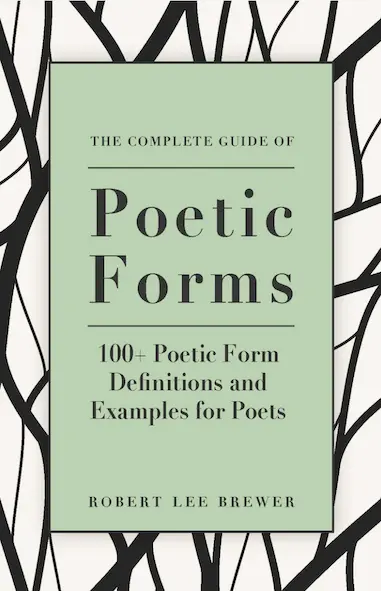
Contextualizing these micro-exercises requires a solid foundation in macro-structures. Within the publishing ecosystem supporting these prompts, Robert Lee Brewer’s The Complete Guide to Poetic Forms stands as a cornerstone resource. Featuring more than 100 poetic form definitions and examples, the volume acts as an indispensable taxonomy for poets looking to elevate their craft beyond free verse.
| Feature of Poetic Forms | Impact on Writing |
|---|---|
| Length Constraints | Forces concision or sustained narrative focus (e.g., Haiku vs. Epic). |
| Rhyme Schemes | Creates sonic architectures that aid memorization and emotional resonance. |
| Meter & Rhythm | Mimics natural human cadences, such as heartbeat rhythms in iambic pentameter. |
| Subject Matter Traditions | Connects contemporary writers to centuries-old thematic lineages (e.g., the Sonnet or Sestina). |
When writers combine a thematic prompt like "out" with a strict formal constraint from Brewer’s guide—such as writing a Pantoum or a Villanelle about being "out of time"—the resulting synthesis often yields the most striking and durable art.
Official Statements & Literary Analysis: "Figure It Out"
To anchor the theoretical discussion of the prompt, Brewer provided an exemplary original poem titled "Figure It Out." This piece serves not only as a stylistic model for participants but also as an autobiographical and philosophical statement on the nature of decision-making, perception, and poetic interpretation.
Text of the Poem
"Figure It Out," by Robert Lee Brewer
I’ve never been good at reading
between the lines. I’m a little too
literal at times, and interpretive
at other times. I guess I see all
the possible paths, and they
all look appealing and dangerous
and ordinary and exotic and,
well, when you asked me to
pick the perfect place for us
to order out, I find I can’t quite
figure it out.
Editorial and Thematic Breakdown
On the surface, the poem adopts a conversational, self-deprecating tone. Brewer establishes a paradox: despite being a professional poet—someone whose entire livelihood is ostensibly built on "reading between the lines"—he confesses to being "a little too literal at times, and interpretive at other times."
This confession bridges the gap between the writer and the reader. It dismantles the intimidating ivory tower often associated with poetry. The speaker’s paralysis is not born of ignorance, but rather of over-awareness. When faced with "all the possible paths," they recognize that every choice is simultaneously "appealing and dangerous and ordinary and exotic."
The comedic and poignant pivot arrives in the final three lines. After establishing a grand philosophical dilemma regarding paths, interpretation, and existential choice, the prompt abruptly collapses into an utterly mundane, universally relatable modern dilemma: deciding where to order takeout food.
This technique—moving seamlessly from the macro-cosmic to the micro-cosmic—is a masterclass in prompt utilization. It demonstrates to community members that a grand, abstract theme like "out" does not require an epic, grandiose treatment. It can be found hiding in the mundane anxiety of deciding between Thai food and pizza.
Future Outlook: The Evolution of Digital Poetry and Community Engagement
As we look toward the horizon of digital literary publishing, initiatives like the weekly poetry prompt and platforms like Writer’s Digest offer a clear blueprint for how creative communities will sustain themselves in an increasingly automated world.
1. The Human Element in an Era of AI Generation
With the proliferation of generative artificial intelligence capable of producing competent, rhyming verse in seconds, human-led poetry communities face a unique challenge. However, the value of platforms anchored by real human vulnerability—such as an editor apologizing for feeling "out of it" on a Tuesday night—cannot be replicated by algorithms. The future of poetry publishing relies heavily on community trust, shared emotional resonance, and peer-to-peer connection. The "Out" prompt proves that readers do not just want content; they want connection.
2. Multimedia Synergy in Literary Education
The integration of written prompts, reference textbooks, and audio-first mediums like podcasts represents the future of literary instruction. Writers consume information across multiple channels during their daily routines. By pairing a visual web prompt with an audio discussion on how poetry aids fiction writing, educators can capture a wider demographic of cross-genre creators. We can expect to see further convergence of text, audio, and interactive community commenting systems (such as Disqus-integrated verification networks) as standard infrastructure for literary education sites.
3. The Democratization of Poetic Forms
Historically, mastering complex poetic forms required formal university training or access to rare academic libraries. Today, resources like The Complete Guide to Poetic Forms combined with weekly digital prompts democratize this knowledge. In the coming years, we are likely to see an increase in hybrid forms—modern poets taking ancient structures (like the Ghazal or the Sestina) and injecting them with hyper-modern vernacular and themes of contemporary alienation, digital fatigue, and urban existence.
Conclusion
The weekly "Out" poetry challenge is much more than a temporary fix for a delayed editorial schedule. It is a testament to the resilience and adaptability of digital literary communities. By transforming editorial exhaustion into a multifaceted creative prompt, Robert Lee Brewer and his platform have once again demonstrated how constraints liberate the imagination. Whether participants interpret the prompt through the lens of being out of time, out of bounds, or simply paralyzed by the modern menu of takeout options, the resulting verse enriches the collective literary tapestry. As long as writers continue to face the blank page—and look for clever ways out of it—these prompts will remain the beating heart of online poetic expression.



Comments
Facebook App ID not configured. Please add it in the Customizer.