
Executive Overview
Take a moment to look down at what you are wearing. Did you consciously curate this outfit based on your personal aesthetic, or was your choice dictated by an invisible algorithm designed to maximize engagement and consumer spending?
For generations, human taste was directed by a distinct hierarchy. Creative directors at legacy luxury houses—think Karl Lagerfeld at Chanel—and elite magazine editors like Anna Wintour (immortalized by the famous "cerulean sweater" monologue in The Devil Wears Prada) dictated what the world wore months in advance. Today, that top-down model has been fundamentally upended. In the era of digital saturation, our clothing choices are increasingly dictated by computers, predictive analytics, and automated supply chains.
At the exact same time, a powerful counter-movement is taking shape. Millions of consumers, exhausted by the relentless churn of micro-trends and ultra-cheap garments, are turning away from traditional retail. They are migrating en masse toward thrift stores, vintage markets, and peer-to-peer resale apps. What was once viewed through a lens of economic necessity or countercultural rebellion has been scrubbed of its stigma, transforming into the ultimate status symbol of conscious consumption.
Read Also
Yet, as the secondhand market goes mainstream, it faces its own systemic pressures. Traditional brick-and-mortar charities are wrestling with corporate-style pricing models, while online resellers commercialize what was once a hunt for hidden treasures. This investigative report explores how technology conquered the modern wardrobe, how thrifting went from marginalized to mainstream, and what this high-stakes tug-of-war means for the future of personal style.
Detailed Chronology: From Runway Autocracy to "Instant Fashion"
To understand how our closets became battlegrounds for algorithmic control, we must trace the evolution of the fashion industry over the past century.
The Era of Elite Dictation (Mid-to-Late 20th Century)
For decades, fashion operated on a predictable, seasonal timeline. Twice a year, major design houses in Paris, Milan, New York, and London debuted collections for the upcoming seasons. High-fashion magazines filtered these trends down to the general public, establishing a deliberate gap between conception and consumption. This lag allowed garments to be viewed as investments—objects of durability and craftsmanship.
The Genesis of Fast Fashion (Late 1990s–2010s)
The turn of the millennium introduced traditional fast fashion, pioneered by giants like Zara and H&M. These brands compressed the design-to-shelf timeline from six months to a matter of weeks. Consumers no longer had to wait for autumn to buy winter coats; new collections arrived on weekly rotations. However, human buyers and traditional market research still guided these production cycles.
The Shift to Hyper-Fast and "Instant" Fashion (2010s–Present)
Enter the era of hyper-fast fashion, supercharged by digital-native behemoths such as Shein. According to Amy Odell, author of the Back Row newsletter and podcast, this modern iteration is better described as "instant fashion."
Unlike legacy fast-fashion retailers that produce tens of thousands of items per year based on projected trends, modern hyper-fast fashion relies on micro-batch production and real-time consumer tracking.
"The way it works is that they use algorithms to track trends and what people are interested in," Odell explains in an interview with Vox. "And then they make a few hundred of a very large number of different items and they test demand."
If a micro-batch of dresses captures online attention, the algorithm instantly signals automated factories to scale up production. If it fails, the item quietly disappears, minimizing unsold inventory waste at the source—even as the sheer volume of total production scales to unprecedented heights.
The Thrifting Renaissance (2020–Present)
As algorithmic curation reached a fever pitch during the COVID-19 pandemic, a parallel counter-revolution erupted. Confined to digital spaces, younger demographics—particularly Gen Z—turned to peer-to-peer resale apps like Depop, Vinted, and The RealReal. Thrifting ceased to be viewed as a fallback option for those who could not afford retail prices; instead, it became a form of digital social currency. Wearing vintage, unique, or pre-owned garments became a public declaration of individuality in a world saturated by algorithmic monotony.
Supporting Context & Metrics: The Scale of Modern Consumption
To grasp the magnitude of this industry shift, one must examine the numbers driving both sides of the fashion ecosystem.
The Hyper-Fast Output Matrix
The sheer volume of clothing introduced to the global market defies historical precedent. Consider the following production scale metrics:
- Legacy Fast Fashion (e.g., Zara): Produces approximately 20,000 distinct apparel styles per year.
- Hyper-Fast Fashion (e.g., Shein): Introduces an estimated 4,700 new apparel styles per day.
This output represents an exponential acceleration of consumer choice, transforming clothing from a durable good into a disposable, ephemeral commodity.
The Resale Ecosystem Landscape
As consumer fatigue sets in, the secondhand market has segmented into a sophisticated, multi-tiered digital economy:
| Resale Platform Tier | Target Audience / Focus | Business Model / Fee Structure | Primary Value Proposition |
|---|---|---|---|
| Consignment Houses (The RealReal) | Luxury and designer goods, high-end handbags, and fine jewelry. | Takes a substantial commission percentage; handles authentication and promotion. | Trust, professional authentication, and maximum return on luxury investments. |
| Trend-Focused Marketplaces (Depop, Vinted) | Gen Z consumers, streetwear, Y2K aesthetic, and independent curators. | Varies by platform (listing fees, final value fees, or buyer protection fees). | High social currency, aesthetic curation, and community engagement. |
| General Resale Platforms (eBay, Poshmark, ThredUp) | Broad demographic, mass-market apparel, and bulk secondhand buyers. | Commission cuts or flat subscription/listing fees depending on the tier. | Vast inventory depth, global reach, and established dispute resolution systems. |
Official Statements and Industry Insights
The tension between algorithmic fashion and the resale boom has drawn sharp commentary from prominent fashion journalists and cultural analysts.
Amy Odell on the Mechanics of Algorithmic Demand
Reflecting on the psychological impact of instant fashion, Amy Odell notes that modern consumers are caught in a feedback loop. When algorithms dictate what appears on social media feeds, personal style risks homogenization.
"We’re all feeling a bit tired of that business model," Odell observes, pointing out that consumers are actively searching for alternative avenues of self-expression that bypass corporate trend forecasting entirely.
Hannah Marriott on the Evolution of Secondhand Stigma
Fashion journalist Hannah Marriott offers deep historical context on how the perception of secondhand clothing has transformed over the past century. Speaking on Vox’s Explain It to Me podcast, Marriott explains that thrifting has historically swung between economic necessity and countercultural rebellion.
"For the last probably a hundred years, [the thrift store] has had lots of moments where it’s been cool within countercultures," Marriott notes. "Whether it’s grunge, or the surrealists in the 1920s, or the Rolling Stones in the 1960s, secondhand clothing was cool because of the stigma."
However, that stigma has entirely evaporated. When asked whether the mainstreaming of thrifting means the movement has "sold out," Marriott suggests that the shift is a natural evolution in how society views ownership.
"I remember when I was much younger, people would say, ‘Ooh, you got that secondhand.’ I just don’t think anyone would ever say that now because that’s kind of how we shop."
The Complex Realities of Traditional Thrift: Has Goodwill Lost Its Edge?
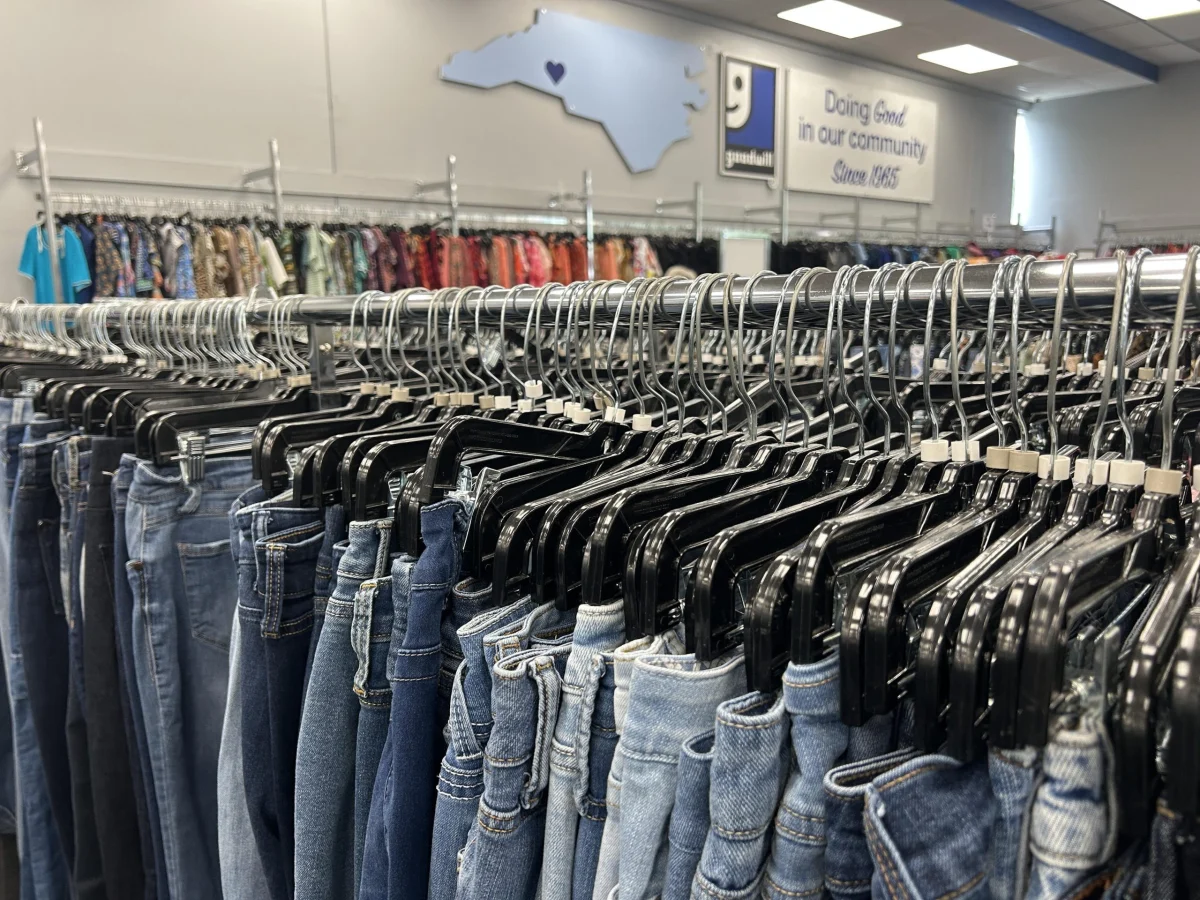
While digital resale apps thrive on curation and aesthetic branding, traditional neighborhood thrift stores—most notably Goodwill—serve a different foundational purpose. Historically, these institutions provided affordable apparel for lower-income communities. However, the secondhand boom has introduced severe strain on these traditional lifelines.
The Price Inflation Controversy
Frequent shoppers have increasingly voiced frustration over rising prices at physical charity stores. While inflation accounts for some of these adjustments, shoppers argue that modern pricing no longer reflects the mission of accessibility.
- The Reseller Effect: High-value vintage items are frequently intercepted by professional resellers who buy them up to flip on digital platforms for inflated prices.
- Corporate Adaptation: Some regional branches have introduced premium events. For instance, reports highlight localized initiatives such as thrift tour coaches charging upwards of $75 for early-access shopping passes—an amount that historically could have purchased dozens of items at baseline thrift rates.
Because organizations like Goodwill operate as decentralized networks of autonomous nonprofits rather than a single corporate entity, pricing strategies vary wildly by region, making standardized consumer experiences difficult to maintain.
Future Outlook: Reclaiming Personal Agency in the Wardrobe
As we look toward the future of fashion, the central question remains: Can personal style survive the algorithm?
The battle lines are drawn between frictionless, hyper-fast digital production and a deliberate return to tactile, singular garments. While algorithms will continue to refine how fast fashion captures short-term micro-trends, the surging popularity of the secondhand economy proves that human desire for originality, storytelling, and sustainability cannot be entirely automated.
Consumers are increasingly voting with their wallets—stepping away from the endless carousel of instant fashion and embracing wardrobes built on history, character, and conscious choice. Whether through high-end digital consignment or the tactile hunt of a local charity shop, the modern closet is undergoing a profound democratization. The future of style belongs not to the computer predicting what you want to buy tomorrow, but to the individual deciding what stories they want to wear today.





Comments
Facebook App ID not configured. Please add it in the Customizer.