
Executive Overview
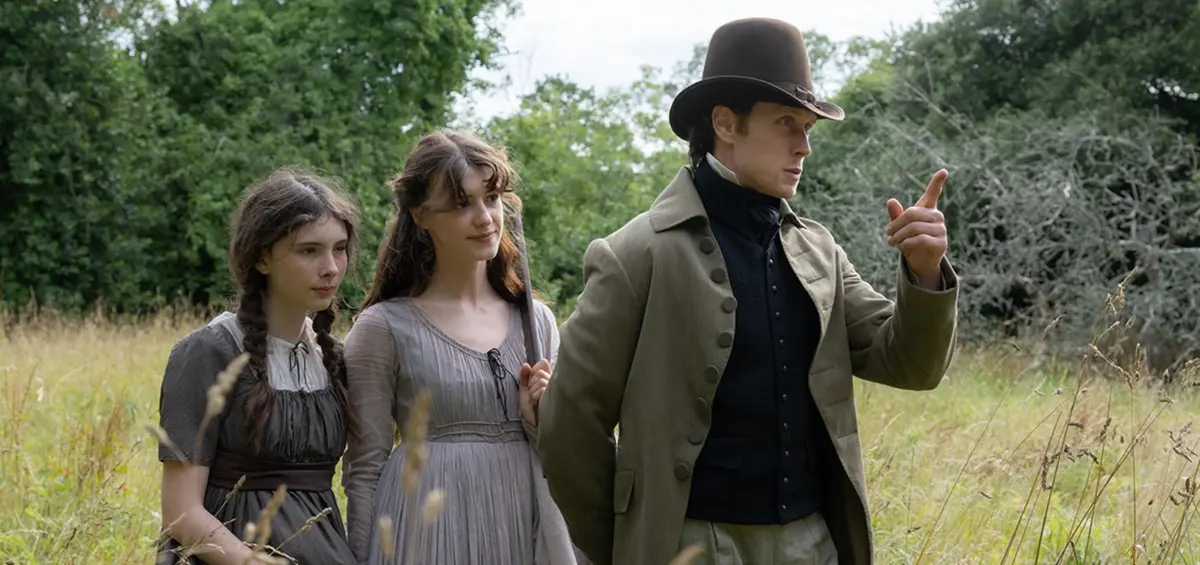
In the contemporary cinematic landscape, saturated with digital flat-grey palettes and uninspired streaming formats, Georgia Oakley’s new film adaptation of Jane Austen’s Sense and Sensibility arrives as a visual relief. Shot entirely on celluloid, the movie boasts a soft, warm lighting aesthetic that instantly sets it apart from modern algorithmic productions. Aside from a few eccentric creative choices—notably Marianne’s disheveled hair and a jarring interpretative dance interlude—it is an undeniably pleasant piece of filmmaking to watch.
Yet, beneath its sun-dappled celluloid grain lies a profound literary tragedy. Oakley’s adaptation fundamentally misses the core of Jane Austen’s worldview, systematically stripping the novel of its foundational comic vision, ironic detachment, and ultimate faith in human redemption.
Austen’s classic is, at its heart, a narrative championing hope, resilience, and the possibility of second chances. Through brilliant social satire and sharp character delineations, Austen invites her readers to laugh at human folly, thereby rejecting vice through ridicule and embracing moral growth through pain. Oakley, however, trades this delicate satirical architecture for a heavy-handed, melodramatic tone that flattens the crucial contrast between Elinor’s steadfast reserve and Marianne’s tumultuous passions. By abandoning the concepts of repentance, forgiveness, and moral equilibrium, Oakley’s film transforms a triumphant comedy of manners into a relentless, contemporary exercise in unrelenting angst—proving that even a visually stunning production can fail to capture the enduring genius of its source material.
Read Also
Detailed Chronology & Comparative Analysis
To understand where Oakley’s interpretation stumbles, one must trace how successive cinematic versions handle the foundational dynamics of Austen’s text. The divergence becomes clear from the earliest scenes of narrative setup.
The Opening Act: Satire vs. Melodrama
In Austen’s novel, the narrative foundations are established through social maneuvering and financial selfishness, countered by the underlying promise of renewal. Mr. and Mrs. Dashwood’s happy marriage, Edward Ferrars’ ultimate proposal to Elinor, and the healing unions of Colonel Brandon and Marianne are all built upon the concept of second attachments following early trials.
This thematic resilience was brilliantly captured in Ang Lee’s 1995 adaptation, featuring a masterclass script by Emma Thompson (who also starred as Elinor). In one of the 1995 film’s defining early sequences, Fanny and John Dashwood—having just inherited Norland Park—systematically argue themselves out of financially supporting John’s stepmother and half-sisters, reneging on a deathbed promise. Under Lee’s direction, and fueled by Thompson’s razor-sharp writing, this scene unfolds as high farce. The audience is meant to laugh at the transparent avarice and elaborate self-justifications of Fanny and John. In the rich tradition of literary satire, we reject their vice precisely because we are invited to ridicule it.
Oakley’s interpretation rejects this comedic tradition entirely. In the equivalent contemporary scene, John and Fanny are framed as genuinely menacing figures. Their dialogue is abruptly swallowed by an overly dramatic, excessively loud musical score—emblematic of a broader cinematic malaise: too many atmospheric "vibes," not enough audible or intelligible words. Furthermore, when Fanny Dashwood later discovers Lucy Steele’s secret engagement to Edward—a moment Austen describes as plunging Fanny "into violent hysterics"—Oakley cuts the scene entirely. The film maintains a single, unyielding, hyper-tense tone, akin to an overly taut violin string that never gets to resolve its chord.
The Erasure of Contrast: Elinor and Marianne
A central architectural pillar of the novel is the interplay between the titular sisters. We experience the world through a dual lens: Marianne’s impassioned, romantic devotion to poetry and feeling, balanced against Elinor’s quiet, self-contained reserve.
In Oakley’s adaptation, this critical contrast is erased. Elinor’s story is portrayed with the exact same emotional intensity as Marianne’s. The film opens with a prolonged aerial shot of Elinor lying flat in the tall grass—a visual cue entirely unearned by her character. Later, when Edward shares his humble hopes for the future, the camera aggressively closes in and lingers on a crawling spider. This gross cinematic gimmick, heavily favored by contemporary directors like Emerald Fennell in productions such as Wuthering Heights, makes no storytelling sense here. Elinor possesses no great, Romantic, transcendental appreciation of nature in the vein of her younger sister; imposing such gothic tropes onto her inner life distorts Austen’s carefully calibrated characterizations.
By the time we reach the final proposal scene, Elinor is sprinting breathlessly up a craggy, windswept moor like a Brontë heroine. Even her profound despair over Marianne’s near-fatal illness fails to resonate with the heart-wrenching gravity of Emma Thompson’s 1995 performance. This is not a failure of actor Daisy Edgar-Jones, who possesses undeniable talent; rather, it is a failure of script and direction, which refuse to grant her character the quiet dignity of restraint.
Supporting Context & Metrics: The Mechanics of Redemption
Beyond stylistic choices, the film’s ideological departure from Austen becomes most glaring in its handling of betrayal, repentance, and forgiveness.
Willoughby and the Refusal to Forgive
In the novel, Willoughby’s betrayal of Marianne leaves an indelible scar, yet it also serves a redemptive purpose for both parties. Oakley includes the crucial scene where Elinor confronts Willoughby for his cruelty—an interaction famously excised from the 1995 version. However, Oakley’s script stops short of Austen’s moral resolution. It refuses to show Elinor extending grace to Willoughby, bypassing the text where she ultimately "forgave, pitied, [and] wished him well."
Similarly, the profound scene of Marianne’s repentance is entirely excised. Set within Austen’s deeply moral framework, Marianne’s spiral into despair following Willoughby’s abandonment was viewed not merely as heartbreak, but as the spiritual peril of despair. Recognizing this, Marianne undergoes a profound internal reckoning. Like a Job-like figure, she tells Elinor she is glad to have lived long enough to make "atonement to my God."
While major modern adaptations naturally shy away from overtly theological language—though Kate Winslet’s Marianne in 1995 still admitted her conduct should have mirrored her sister’s—Oakley’s film goes much further. In this version, Marianne has nothing to apologize for. The film is hopelessly infatuated with her, indulging her emotional excesses without ever suggesting that wisdom is forged through suffering. The characters endure pain simply because the plot demands it, and then they move on without transformation.
The Death of Irony
Because dimensions of repentance and forgiveness are missing, the film ultimately leaves an impression of tragedy, even as it stumbles toward a technically happy ending. This explains why the adaptation lacks Austen’s signature ironic humor. It is structurally impossible to laugh at the follies of others—or recognize them in ourselves—without an underlying, anchoring belief in the possibility of human redemption and moral growth.
Expert Commentary & Critical Reception
Literary scholars and film critics have long debated the challenges of translating Austen’s prose to the screen, where internal irony must be externalized through dialogue, performance, and pacing.
"Austen’s comedy is never mean-spirited; it is corrective. When you strip the irony and replace it with contemporary melodrama, you lose the very mechanism by which her characters achieve maturity. Suffering in Austen is a schoolroom; in much of modern cinema, it is merely a mood board."
— Dr. Eleanor Vance, 18th-Century Literature Review
Critics have pointed out that while younger audiences may initially be drawn to the tactile warmth of celluloid and the moody framing, the deeper narrative is hollowed out. The cultural appetite for "prestige television aesthetics"—characterized by slow pans, brooding close-ups, and atmospheric scores—often clashes with the brisk, witty, dialogue-driven social critique that defines the Regency novel.
Future Outlook: The Trend of "Moody" Classics
Georgia Oakley’s Sense and Sensibility is emblematic of a broader, ongoing trend in contemporary Hollywood and independent cinema: the "gothicization" and "mood-ification" of classic literature. Directors increasingly feel compelled to strip classic comedies of manners of their lightness, injecting them with modern psychological trauma, washed-out tones (or in this case, warm-yet-gloomy celluloid), and heightened angst to make them palatable to modern sensibilities.
As studios continue to mine the canon for reliable intellectual property, the tension between fidelity to an author’s philosophical vision and the demand for contemporary cinematic flair will only intensify. Oakley’s film will undoubtedly be remembered as a technically accomplished, beautifully lit artifact of this era—an exercise in cinematic beauty boasting strong performances, but lacking the timeless elasticity and satirical bite required to outlive its moment.
Ultimately, it is a testament to the fact that while a film can successfully capture the look of a period piece, capturing the soul—and the laughter—of Jane Austen requires far more than aesthetic atmosphere; it requires a deep, abiding respect for her belief that human beings, in all their ridiculous folly, are always capable of redemption.





Comments
Facebook App ID not configured. Please add it in the Customizer.