
Executive Overview
The audiobook landscape is undergoing a profound paradigm shift. For decades, the medium has relied on a singular, linear sensory channel: audio. Listeners press play and absorb spoken word performances—ranging from solitary voice actors to sprawling multi-cast productions—while relying entirely on their own imaginations to anchor character dynamics, plot locations, and visual pacing.
However, as consumer expectations shift toward multi-modal digital experiences, audiobook leader Audible is breaking the mold. In a sweeping strategic announcement, Audible unveiled a suite of generative AI-driven enhancements designed to fundamentally transform how audiences interact with spoken-word content.
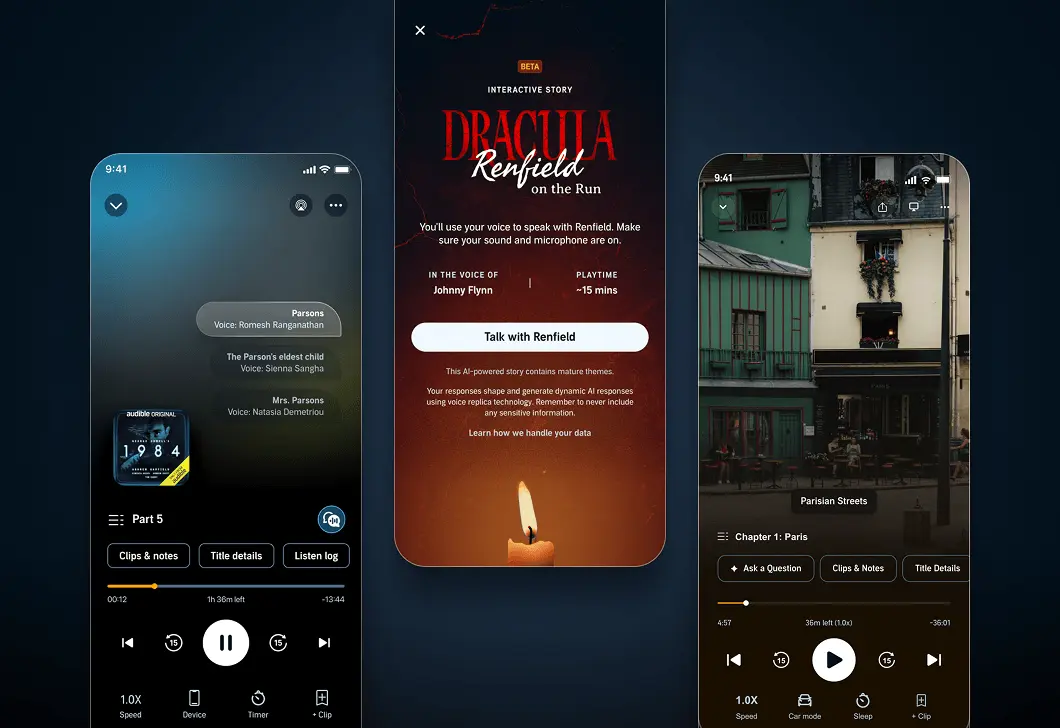
Over the coming months, the platform will roll out three groundbreaking additions: the Character Guide, Interactive Stories, and the Visual Explorer. Far from serving as simple technological gimmicks, these features are deeply integrated into flagship Audible Originals and multi-cast productions. From timeless classics like Dracula and George Orwell’s 1984 to contemporary sci-fi epics like Exoplanet—produced by Andy Weir and written by Benjamin Percy—Audible is bridging the gap between passive listening and active, personalized engagement.
Read Also
Currently debuting in a limited beta for users in the United States and the United Kingdom, this initiative signals a calculated bet by Audible’s leadership. By leveraging generative artificial intelligence, conversational design, and dynamic sound engineering, the company aims to capture the attention of younger, digitally native demographics who demand deeper, more immersive narrative entry points while fiercely preserving the foundational visions of authors.
Detailed Chronology: The Rollout of Next-Gen Audio
The conceptualization and deployment of Audible’s new interactive ecosystem represent a deliberate, phased approach to integrating advanced machine learning into commercial entertainment. While the company has spent years refining its backend algorithms for recommendations and audio mastering, this marks its most visible and ambitious front-facing AI deployment to date.
Phase 1: Conceptual Framing and Technological Alignment
In the months leading up to the announcement, Audible’s product development and analytics teams evaluated the shifting habits of modern consumers. Industry data consistently showed that while traditional audiobooks remain immensely popular, younger demographics—accustomed to the branching narratives of video games, the real-time interactivity of social platforms, and the multi-sensory nature of modern streaming—frequently sought deeper layers of engagement.
Rather than altering the core audio files, Audible’s engineers focused on metadata tagging, real-time dialogue generation, and contextual data synchronization. By combining generative AI large language models (LLMs) with high-end audio production pipelines, the tech team built lightweight companion layers that operate seamlessly inside the standard Audible player application.
Phase 2: The U.S. and U.K. Beta Launch
Audible officially pulled back the curtain on its AI-powered features with a targeted rollout across key English-speaking markets. By restricting the initial deployment to a limited beta in the U.S. and U.K., the platform can stress-test its conversational AI models, evaluate user feedback regarding interface design, and ensure server-side stability under peak streaming loads.
During this initial phase, the features are being tied directly to specific high-profile releases to maximize user adoption and testing metrics:
- The Character Guide is rolling out across select Audible Originals featuring large ensemble casts.
- Interactive Stories made their splashy debut with a modernized, conversational adaptation of Bram Stoker’s Dracula, setting the stage for subsequent narrative drops.
- Visual Explorer launched alongside The Cultural Tutor’s Grand Tour: The Story of Europe in Six Cities, setting a high-water mark for educational and non-fiction multimedia integration.
Phase 3: Upcoming Milestones and Global Expansion
The rollout schedule continues aggressively. On November 5, Audible will expand its Interactive Stories catalog with the release of Exoplanet, an immersive sci-fi experience developed in tandem with acclaimed author Benjamin Percy.
Following this release, the company plans to aggregate user telemetry and qualitative feedback from the U.S. and U.K. beta cohorts. These insights will dictate the optimization roadmap, smoothing out conversational latency in interactive prompts and expanding compatibility to broader literary catalogues before scaling the features to international markets.
Supporting Context & Metrics: The Mechanics Behind the AI
To understand the weight of Audible’s latest announcement, one must examine the specific mechanics of the three features and the engineering hurdles they overcome.
+-----------------------------------------------------------------+
                 AUDIBLE'S THREE-PILLAR AI SUITE
+-----------------------+-----------------------------------------+
| Feature               | Core Functionality & Technology         |
+-----------------------+-----------------------------------------+
| Character Guide       | Real-time speaker identification,       |
|                       | narrator bios, and headshots.           |
+-----------------------+-----------------------------------------+
| Interactive Stories   | Generative AI dialogues, real-time      |
|                       | roleplay, and branching audio stakes.   |
+-----------------------+-----------------------------------------+
| Visual Explorer       | Contextual maps, artwork, and historical|
|                       | data synchronized to listening timestamps.|
+-----------------------+-----------------------------------------+
1. Character Guide: Solving the Ensemble Dilemma
For avid listeners of epic fantasy, historical fiction, and complex thrillers, keeping track of a sprawling cast of characters can be a cognitive burden. Unlike a physical book where a reader can easily flip back to a Dramatis Personae page, audiobook listeners historically had to rely entirely on subtle shifts in a narrator’s vocal inflection.
The Character Guide directly addresses this friction point. Operating in real-time as the audio plays, the tool visually indicates precisely which character is speaking at any given moment. Furthermore, recognizing that listeners often form deep attachments to voice talent, Audible has embedded narrator headshots and comprehensive biographies directly within the player page. This bridges the gap between the listener and the human artist, fostering a more connected, transparent listening experience.

2. Interactive Stories: Redefining Narrative Agency
Perhaps the most ambitious feature in Audible’s new lineup is Interactive Stories, which blurs the line between traditional audiobooks and role-playing video games.
Kicking off with Dracula, this feature leverages generative AI and advanced conversational design principles. When a listener reaches specific narrative junctures, they are assigned a distinct role and mission within the story’s universe. The fictional character initiates a direct conversation with the listener, who must respond in their own words.
Powered by sophisticated natural language processing (NLP), the character reacts instantly and dynamically to the user’s input, altering the immediate conversational flow while keeping the broader narrative arc tethered to the author’s original vision. The upcoming November 5 release of Exoplanet—crafted alongside Benjamin Percy—will further test the boundaries of this technology, placing listeners on alien terrain where every spoken response carries narrative stakes.
3. Visual Explorer: Contextualizing the Auditory Canvas
While audio is a powerful medium, certain genres—particularly non-fiction, travelogues, and historically dense narratives—thrive on visual context. The Visual Explorer feature solves this by dynamically delivering relevant images, maps, and illustrative artwork directly to the listener’s screen, perfectly synchronized with the spoken narrative.
Featured prominently in The Cultural Tutor’s Grand Tour: The Story of Europe in Six Cities, Visual Explorer transforms a standard travel narrative into a multimedia journey. As the narrator discusses a specific European landmark, architectural style, or historical figure, supplementary imagery and curated informational cards appear on the user’s interface. This satisfies the cognitive cravings of modern multi-tasking consumers who expect richer, multi-sensory data feeds from their digital media subscriptions.
Official Statements: Leadership Perspectives on the Future of Audio
The integration of artificial intelligence into creative media remains a sensitive subject across the publishing and entertainment industries. Aware of these sensitivities, Audible’s executive leadership has been careful to frame these new features not as replacements for human creativity, but as enhancements designed to honor and amplify the author’s intent.
Andy Tsao, Chief Product and Analytics Officer at Audible, emphasized this philosophy during the product unveiling:
"AI is allowing us to create new interactive experiences that today’s listeners, especially younger audiences, are craving. We are opening up entry points into stories that are still part of the authors’ vision, but that make our customers’ experiences more personal and unique."
Tsao’s remarks highlight a critical strategic pivot for the platform. By positioning generative AI as a tool for personalization rather than homogenization, Audible aims to reassure creators, publishers, and purists alike. The underlying narrative structures—whether written by Bram Stoker centuries ago, George Orwell decades ago, or modern visionaries like Benjamin Percy and Andy Weir today—remain the inviolable anchor of the experience. AI simply provides the dynamic scaffolding that allows modern consumers to step inside the world rather than merely listen from the outside.
Future Outlook: What Lies Ahead for Spoken-Word Entertainment
The launch of Audible’s AI-enhanced feature suite serves as a bellwether for the broader digital publishing and audio entertainment industries. As generative artificial intelligence matures, the historical boundaries separating books, podcasts, video games, and interactive media are rapidly dissolving.
1. The Proliferation of Conversational AI in Publishing
If the beta trials for Dracula and Exoplanet prove successful, expect other major audiobook publishers and platforms to accelerate their own interactive development pipelines. We may soon see a world where standard fiction releases routinely ship with optional conversational companions, allowing readers to "interview" fictional detectives about ongoing murder mysteries or debate philosophy with fantasy protagonists.
2. Creator Collaboration and Copyright Evolution
As these technologies scale, the industry must navigate complex questions regarding creator compensation, voice cloning rights, and generative model training. Audible’s strategy of partnering directly with high-profile authors (such as Benjamin Percy and Andy Weir) and highlighting human narrators through features like the Character Guide suggests a cooperative pathway forward. By ensuring that human artists remain front and center—both in the audio performances and through dedicated biographical profiles—Audible is attempting to build a sustainable ecosystem that respects creative labor while embracing technological progress.
3. Catering to the Next Generation of Consumers
Ultimately, the driving force behind Audible’s innovation is generational attrition. To maintain market dominance in an attention economy crowded with short-form video apps, interactive gaming platforms, and hyper-personalized feeds, legacy audio platforms must evolve. By infusing linear audiobooks with visual exploration, character tracking, and real-time conversational agency, Audible is future-proofing the spoken-word medium.
As these features transition out of beta and roll out to global audiences in the coming months, they will test the appetite of traditional book lovers while unlocking entirely new dimensions of immersive storytelling for the digital age.




Comments
Facebook App ID not configured. Please add it in the Customizer.