
Executive Overview
The audio entertainment landscape is undergoing a profound paradigm shift. As consumer expectations evolve—driven heavily by younger demographics accustomed to multi-sensory, interactive digital environments—traditional linear storytelling is no longer the sole frontier of audio publishers. Entering this dynamic arena with a transformative suite of tools, Audible has officially announced the rollout of three cutting-edge, artificial intelligence-powered features: Character Guide, Interactive Stories, and Visual Explorer.
Aimed at redefining how listeners engage with audiobooks and Audible Originals, this suite of tools moves past passive listening. By blending generative AI, advanced conversational design, and rich multimedia integration, Audible is bridging the gap between books, video games, and visual media. Initially launched as a limited beta test for users in the United States and the United Kingdom, these features are being paired with high-profile multi-cast productions and literary classics such as Bram Stoker’s Dracula, George Orwell’s 1984, and Exoplanet—an original sci-fi epic produced by Andy Weir and written by Benjamin Percy.
This strategic initiative signals a broader industry trend: the convergence of synthetic intelligence and creative arts. Rather than replacing human narration, Audible’s new tools aim to contextualize, enhance, and personalize the listening experience, offering new entry points into complex narratives while fiercely respecting the foundational vision of the original authors.
Read Also
Detailed Chronology of the Launch and Rollout
The introduction of these immersive, AI-driven features represents the culmination of months of behind-the-scenes technological development and strategic planning by Audible’s product, analytics, and content teams.
The Lead-Up and Announcement
In early October, industry whispers and official press releases from Audible outlined a sweeping vision for the future of spoken-word entertainment. Recognizing that modern audiences—particularly digital natives—crave deeper layers of immersion, Audible’s leadership greenlit a project to integrate context-aware AI tools directly into its native playback apps.
Phased Deployment Strategy
Rather than deploying a massive global update that could overwhelm users or strain backend server architecture, Audible opted for a measured, phased rollout:
- Limited Beta Testing: The features debuted last week as a closed or limited beta test restricted to select cohorts of users in the US and the UK. This geographic concentration allows the company to monitor system performance, server-side AI processing times, and initial user reception under controlled conditions.
- Feature-by-Feature Integration: Instead of dropping all tools simultaneously into every title, Audible has strategically mapped specific features to landmark releases. For instance, Dracula serves as the testing ground for Interactive Stories, while multi-cast dramatic productions utilize the Character Guide.
- Upcoming Milestone Releases: The rollout roadmap includes specific milestone dates. Notably, November 5 marks the integration of the Interactive Story format into the universe of Exoplanet, setting the stage for broader public adoption heading into the holiday season.
Supporting Context & Metrics: The Evolution of Immersive Audio
To understand the weight of Audible’s announcement, one must examine the macro-economic and cultural shifts currently reshaping the publishing and media industries.
The Consumer Shift Toward Interactivity
For decades, the audiobook format remained largely insulated from technological disruption beyond the transition from cassette tapes and compact discs to downloadable mobile apps. However, the rise of podcasts, interactive fiction apps, and video game narratives has altered consumer habits. Younger demographics, in particular, expect media to be reactive. They do not merely want to consume a story; they want to inhabit it, question it, and visualize its world instantly.
Technological Enablers: Generative AI and Conversational Design
The technical backbone of Audible’s new features relies on a sophisticated triad of technologies:
- Generative AI: Allows real-time synthesis of character dialogue and dynamic plot reactions without breaking narrative continuity.
- Conversational Design: Ensures that when a user speaks or responds to a character within an Interactive Story, the system parses intent, tone, and context to generate a dramatically appropriate response.
- Metadata and Visual Synchronization: Links timestamped audio triggers with visual databases, pulling up maps, portraits, and historical context precisely when they are referenced in the spoken text.
Target Content Categories
Audible is not applying these features uniformly across its millions-strong catalog. Instead, the company is focusing its initial efforts on high-production-value titles where these tools provide maximum utility:
- Multi-Cast Productions: Complex casts with numerous actors benefit immensely from real-time identification tools.
- Dense Classics: Literature with sweeping historical or geographical contexts (such as Grand Tour: The Story of Europe in Six Cities by The Cultural Tutor) serves as an ideal testing ground for visual aids.
- Sci-Fi and Speculative Fiction: Original speculative audiobooks offer fertile ground for branching narratives and simulated interactions with fictional characters.
Breaking Down the Features: Character Guide, Interactive Stories, and Visual Explorer
Audible’s new suite is divided into three distinct pillars, each designed to solve a specific friction point in the traditional audiobook listening experience.

+-----------------------------------------------------------------+
|                    AUDIBLE AI FEATURE SUITE                     |
+-------------------------+---------------------------------------+
| 1. Character Guide      | Solves cast confusion with real-time  |
|                         | identification, headshots, and bios.  |
+-------------------------+---------------------------------------+
| 2. Interactive Stories  | Merges generative AI and sound design |
|                         | for real-time dialogues with avatars. |
+-------------------------+---------------------------------------+
| 3. Visual Explorer      | Enhances world-building with maps,    |
|                         | artwork, and historical context.      |
+-------------------------+---------------------------------------+
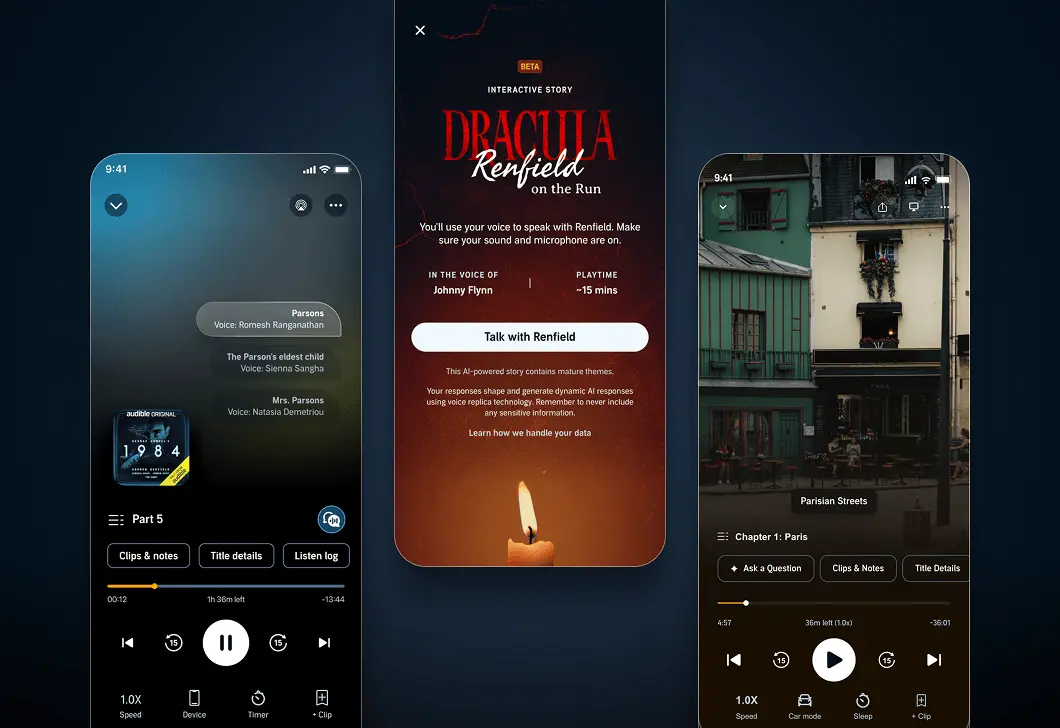
1. Character Guide
- The Problem: Listeners frequently struggle to keep track of expansive character rosters in audiobooks, often losing track of who is speaking during intense dialogue scenes.
- The Solution: The Character Guide dynamically tracks the narrative flow. As a scene unfolds, the interface highlights which character is currently speaking.
- Additional Perks: For listeners eager to learn more about the voice talent behind the performance, the player page has been updated to include actor headshots, short biographies, and role breakdowns, humanizing the digital listening experience.
2. Interactive Stories
- The Problem: Traditional audiobooks offer zero agency; the listener is entirely passive, unable to influence or query the characters inhabiting the world.
- The Solution: Pioneered with the launch of Dracula, this feature transforms passive listening into an active, conversational adventure. Powered by generative AI and immersive sound design, listeners are assigned specific roles and missions within the narrative framework.
- The Mechanics: Characters initiate conversations with the user at pivotal moments. The listener responds using their own words (either via voice input or text), and the AI-driven character reacts instantly on the spot, heightening dramatic stakes while maintaining the integrity of the original plotline.
- Upcoming Launch: A major expansion of this feature arrives on November 5 with the inclusion of the Audible Original Exoplanet, co-created with author Benjamin Percy.
3. Visual Explorer
- The Problem: Audio is inherently disembodied. When a story references an obscure geographical location, an architectural marvel, or historical artwork, listeners often have to pause playback to search the web manually.
- The Solution: The Visual Explorer bridges this gap by automatically serving up relevant images and contextual visuals directly within the app interface.
- Integration Example: Featured prominently in The Cultural Tutor’s Grand Tour: The Story of Europe in Six Cities, this tool provides listeners with supplementary maps, architectural photographs, and informative profiles of significant historical figures and landmarks across six major European destinations, perfectly timed to the unfolding audio narration.
Official Statements and Industry Perspective
The rollout has garnered significant attention from industry analysts and company executives alike, who view this move as a defining moment for digital publishing.
In an official statement detailing the strategic rationale behind the tools, Andy Tsao, Chief Product and Analytics Officer at Audible, emphasized the company’s commitment to balancing innovation with artistic integrity:
"AI is allowing us to create new interactive experiences that today’s listeners, especially younger audiences, are craving. We are opening up entry points into stories that are still part of the authors’ vision, but that make our customers’ experiences more personal and unique."
Tsao’s comments underscore a delicate tightrope walk that tech platforms must navigate: introducing disruptive technologies without alienating traditional purists or violating creators’ copyright. By collaborating closely with established authors—such as Benjamin Percy on Exoplanet—Audible is attempting to position these AI enhancements as collaborative extensions of the source material rather than unauthorized alterations.
Industry insiders note that if these beta trials prove successful, publishers across the board will likely accelerate their own investments in conversational AI and multimedia-synced publishing formats. The transition from static audio files to dynamic, reactive entertainment ecosystems is officially underway.
Future Outlook: What Lies Ahead for Audible and Spoken-Word Media
As Audible gathers telemetry and qualitative feedback from its U.S. and U.K. beta cohorts, the roadmap for the remainder of the decade comes into sharper focus.
1. Global Scaling and Localization
Following the refinement of the beta features, Audible plans to expand Character Guide, Interactive Stories, and Visual Explorer to broader international markets and non-English catalogs. This will require complex localization frameworks to ensure that generative AI models handle regional dialects, cultural nuances, and multi-language translations with high fidelity.
2. Creator Tools and Author Empowerment
Looking forward, industry watchers expect Audible to extend some of these AI-assisted creation tools to indie authors and smaller publishing houses. By lowering the technical barrier to producing multi-cast assets, character guides, and visual companions, Audible could democratize high-end production values across the entire literary supply chain.
3. Potential Challenges and Ethical Considerations
Despite the excitement surrounding the launch, challenges remain on the horizon:
- Purist Backlash: Some traditional audiobook purists may resist interactive elements or visual pop-ups, arguing they detract from the pure, unadulterated auditory experience.
- Copyright and Voice Cloning Debates: As generative AI becomes more integrated into voice performance and character simulation, platforms must maintain rigorous ethical standards to protect voice actors’ rights and compensation structures.
Conclusion
Audible’s introduction of the Character Guide, Interactive Stories, and Visual Explorer marks a watershed moment for the audiobook industry. By fusing classic literary works and high-end audio productions with real-time generative AI and multimedia context, Audible is successfully future-proofing the medium. As the beta test expands and upcoming titles like Exoplanet drop later this year, the world will be watching to see how listeners embrace this bold new frontier of interactive storytelling.



Comments
Facebook App ID not configured. Please add it in the Customizer.