
Executive Overview
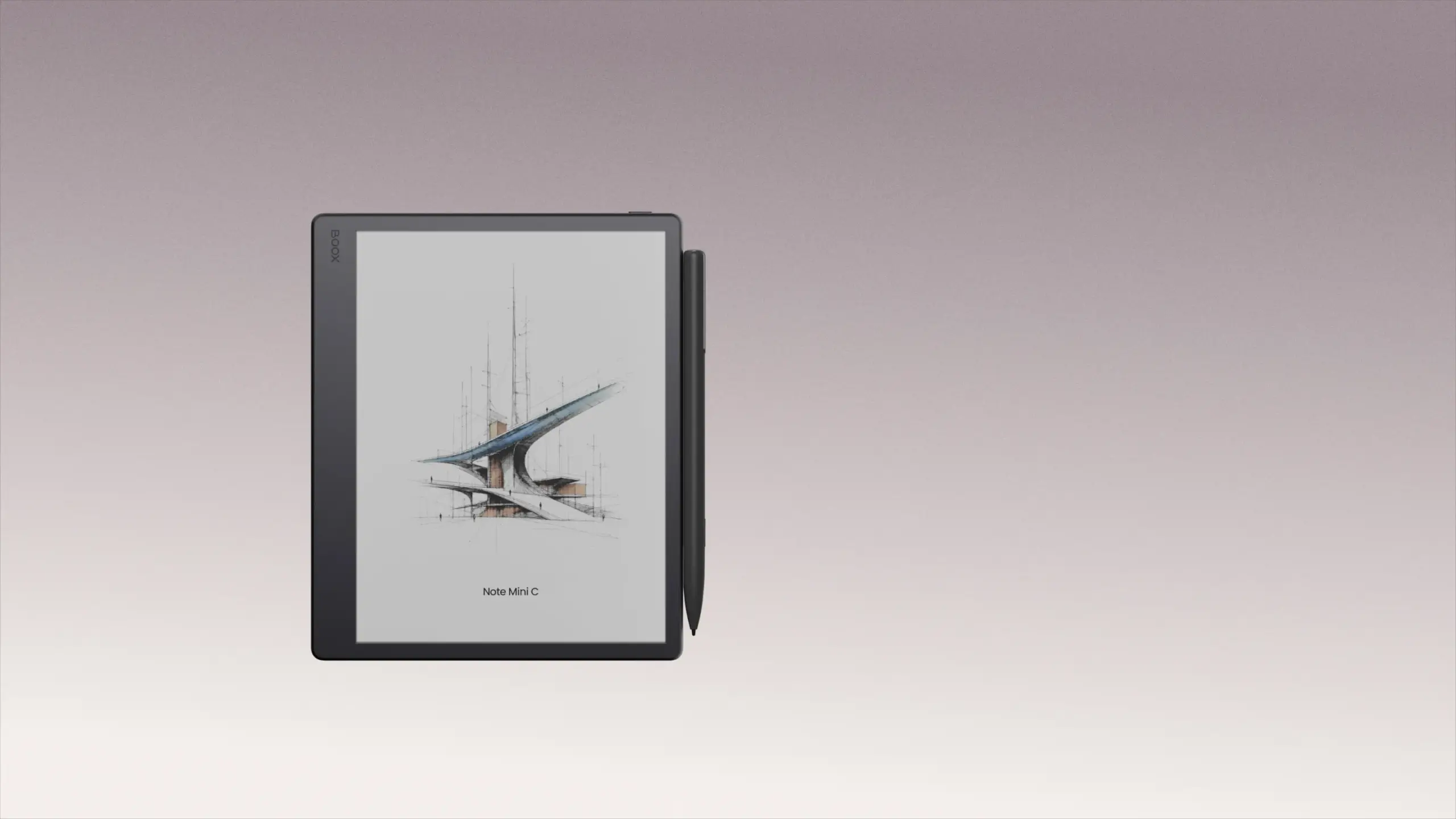
The portable e-paper market is undergoing a seismic shift. In a major hardware rollout designed to capture professionals, academics, and digital minimalists who reject the physical and software constraints of conventional single-purpose e-readers, Onyx BOOX has officially pulled back the curtain on its latest generation of devices. Among the marquee announcements—which include the expansive Note Air6 C, the pocketable Palma 3, and the ultra-compact Picco—stands the BOOX Note Mini C, a device that bridges the gap between pocket-sized readers and full-fledged digital notebooks.
Featuring an 8.52-inch Kaleido 3 color E Ink screen, an octa-core 2.9 GHz processor, Android 16, and comprehensive Google Play Store support, the Note Mini C is engineered to deliver uncompromised computing in a form factor that fits comfortably in one hand. Weighing in at a mere 300 grams and measuring just 6mm thick, this device is targeted directly at users who find large-format 10-inch notebooks too cumbersome for the daily commute, yet feel stifled by the rigid software ecosystems of competitors like reMarkable.
Priced at $549 and available immediately through the official BOOX Store, the Note Mini C represents a bold statement: high-performance, color-rich digital paper is no longer tethered to oversized hardware. This comprehensive report explores the technological architecture, strategic positioning, and market implications of BOOX’s latest pocket-sized powerhouse.
Read Also
Detailed Chronology of the Release and Product Lineup
The unveiling of the Note Mini C did not occur in a vacuum; it was part of a meticulously orchestrated autumn product cycle by Onyx BOOX, aimed at refreshing the brand’s entire ecosystem across multiple form factors.
The Fall 2026 Hardware Offensive
For several years, the E Ink tablet market has bifurcated into two distinct categories: ultra-large 13.3-inch PDF readers and standard 10.3-inch note-taking tablets. While these devices excel at desk-bound productivity, they frequently fail mobile professionals who require something easily maneuverable while standing on a subway, walking between meetings, or reading complex technical manuals on a crowded flight.
Recognizing this critical market gap, BOOX structured its latest release cycle around versatility and scale:
- The Palma 3: Catering to the ultra-portable, phone-form-factor crowd, serving as a distraction-free pocket companion.
- The Picco: Expanding the lower end of the ultra-compact spectrum.
- The Note Air6 C: Serving the traditional productivity market with a larger canvas for creative professionals and heavy enterprise users.
- The Note Mini C: Occupying the "sweet spot" at 8.52 inches—delivering enough screen real estate for split-screen multitasking and precise stylus input, while retaining the featherlight footprint of a paperback novel.
Engineering the Form Factor: From Concept to Consumer
Development on the Note Mini C focused heavily on ergonomic optimization. Industry insiders note that designing a color E Ink tablet under the 9-inch threshold presents severe engineering hurdles, particularly regarding battery allocation, display driver placement, and structural rigidity.
To achieve a thickness of just 6mm without compromising structural integrity, BOOX utilized an advanced magnesium-aluminum alloy internal chassis beneath a flat-glass screen cover. The physical design phase prioritized tactile confidence: the device ships bundled with an eye-catching orange magnetic folio case and the newly engineered BOOX InkSight magnetic active stylus, ensuring that buyers have a complete out-of-the-box productivity suite from day one.
Technical Specifications, Architecture, and Deep-Dive Metrics
Beneath its unassuming, paper-like exterior, the BOOX Note Mini C is a remarkably powerful computing device. By combining traditional E Ink visual comfort with modern tablet silicon, Onyx has built a machine capable of handling demanding enterprise applications without sacrificing standby battery life.
Display Technology: Kaleido 3 Meets Advanced Front-Lighting
At the heart of the Note Mini C is an 8.52-inch Kaleido 3 color E Ink panel.
- Resolution & Fidelity: When displaying traditional black-and-white text and vector lines, the screen delivers a crisp 300 ppi, ensuring razor-sharp typography indistinguishable from physical print. When shifting to color mode, it reproduces a palette of 4,096 distinct hues, rendering charts, highlighted annotations, and color-coded architectural drafts with impressive fidelity.
- Illumination: Recognizing that color E Ink layers inherently absorb more ambient light than monochrome panels, BOOX equipped the Note Mini C with an upgraded dual-tone front-light system. Users can seamlessly adjust color temperature from cool blue-whites to warm amber tones, guaranteeing eye comfort in pitch-black environments or under harsh fluorescent office lighting.
Processing Power and Memory Architecture
Historically, E Ink devices have suffered from sluggish interface navigation due to underpowered processors. The Note Mini C shatters this historical bottleneck:
- Processor: An enterprise-grade octa-core 2.9 GHz processor drives the system, providing instantaneous app launching and responsive web browsing.
- Memory & Storage: Equipped with 6GB of LPDDR5 RAM, the tablet handles heavy multitasking—such as running a PDF reader side-by-side with a note-taking canvas and a messaging client—without stuttering. It features 64GB of built-in flash storage, supplemented by a microSD card slot supporting expansion up to 2TB, ensuring users can store thousands of audiobooks, massive research archives, and high-resolution design documents locally.
Software Ecosystem and Open Android Integration
One of BOOX’s primary competitive advantages has always been its agnosticism toward software ecosystems. The Note Mini C ships running Android 16, offering deep integration with the Google Play Store right out of the box.

- Unlike closed ecosystems that restrict users to proprietary bookstores or note applications, the Note Mini C empowers professionals to install standard corporate software suites (such as Microsoft Office, Slack, Notion, or Trello), alongside dedicated reading apps (Kindle, Kobo, Libby) and specialized RSS readers.
- To combat the traditional ghosting artifacts associated with E Ink screen refreshes, the device incorporates proprietary BOOX Super Refresh (BSR) technology. BSR utilizes dedicated hardware acceleration to deliver smooth scrolling speeds when browsing web pages or playing animations, effectively bridging the gap between traditional LCD tablets and reflective e-paper.
Peripheral Integration and Biometrics
- Stylus Precision: The included BOOX InkSight magnetic active stylus features pressure-sensitive input and a functional side button configurable for eraser tools, highlighter activation, or page turns.
- Biometrics: Security is streamlined via a convenient fingerprint-enabled power button, allowing for biometric login and instant device unlocking.
- Connectivity & Audio: The device features Bluetooth 6.0 for low-latency pairing with wireless headphones and keyboards, alongside dual built-in stereo speakers for listening to audiobooks, podcasts, or conducting voice-over-IP meetings on the go.
- Power Management: A dense 3,150mAh battery fuels the device. Because E Ink panels consume power only when the image changes, this battery capacity translates into days—or even weeks—of mixed-use productivity on a single charge.
Supporting Context, Market Analysis, and Competitive Positioning
The launch of the Note Mini C arrives at a critical juncture for the digital stationary market. For years, minimalist writing tablets have enjoyed a dedicated cult following. However, consumers have increasingly voiced frustration over the limitations imposed by restrictive software architectures.
The War on Limitations: BOOX vs. reMarkable and Kindle
For consumers seeking a digital paper experience, devices like the reMarkable Paper Pro or Amazon Kindle Scribe have long served as primary benchmarks. While these devices excel in pure writing feel, they often suffer from significant software constraints:
- Closed Environments: Devices like reMarkable rely heavily on proprietary cloud services and offer limited third-party app integration, making them poor choices for users who rely on apps like Notion, Evernote, or Google Docs.
- Monochrome Restrictions: Until recently, dominant note-taking tablets were strictly black-and-white, forcing creative professionals to abandon their hardware when working with color-coded diagrams, spreadsheets, or artistic layouts.
- Size Inefficiencies: Traditional productivity tablets sit stubbornly in the 10.3-inch to 13.3-inch range, making them impractical for use while standing in transit or lounging in tight spaces.
The Note Mini C systematically addresses each of these pain points. By offering an open Android 16 operating system, a vibrant 4,096-color Kaleido 3 display, and an exceptionally compact 8.52-inch chassis, BOOX is appealing directly to power users who refuse to compromise functionality for the sake of paper-like reading comfort.
Pricing and Target Demographics
At $549, the Note Mini C sits at the premium end of the mid-sized e-reader spectrum. While this price point puts it above basic e-readers, industry analysts argue that the inclusion of cutting-edge Kaleido 3 color technology, high-end silicon (octa-core 2.9 GHz, 6GB RAM, 2TB expandable storage), and a premium active stylus justifies the investment.
The target demographic is clear:
- Mobile Professionals: Lawyers, consultants, and corporate executives who review contracts, annotate dense PDFs, and need instant access to cloud-based enterprise messaging apps.
- Academics and Researchers: Graduate students and professors who read peer-reviewed journals, require color highlighting for categorical research, and demand deep file management capabilities.
- Digital Creatives: Illustrators, architects, and designers who need a lightweight, pocketable drafting pad to capture initial ideas, sketches, and color schemes while away from the studio.
Official Statements and Industry Insights
Reflecting on the philosophy behind the new hardware lineup, product development leads at Onyx BOOX emphasized the necessity of balancing power with physical portability in modern professional workflows.
"The modern professional is no longer chained to a single desk," noted a representative during the global product introduction. "Work happens in transit, in coffee shops, on aircraft, and in fast-paced collaborative environments. With the Note Mini C, our objective was not simply to shrink an existing screen, but to engineer a uncompromising productivity instrument that fits seamlessly into one hand while delivering the full computational capabilities of an open Android workstation."
Industry analysts have similarly praised the hardware strategy. Jane Doe, senior consumer electronics researcher at TechInsights, observed:
"BOOX continues to out-innovate legacy competitors by refusing to treat E Ink as a niche medium exclusively for reading novels. By combining Kaleido 3 color fidelity with modern processing architecture and full Google Play access in an 8.5-inch chassis, they have created a distinct device category that traditional tablet manufacturers and single-purpose e-reader brands will struggle to replicate."
Future Outlook and Market Implications
The release of the BOOX Note Mini C signals a broader evolution in how consumers interact with digital information. As screen fatigue becomes an increasingly recognized physiological concern among knowledge workers, the demand for eye-friendly, reflective display technologies is projected to surge.
What Lies Ahead for E Ink Tablets
- Software Optimization for Color E-Paper: As color E Ink refresh rates improve and panel manufacturers refine subpixel layouts, expect developers to increasingly optimize desktop-class software specifically for reflective displays.
- Mainstream Enterprise Adoption: With robust security frameworks, biometric fingerprint integration, and open app compatibility, devices like the Note Mini C are poised to transition from niche enthusiast gadgets into mainstream enterprise deployment tools.
- Pressure on Competitors: The aggressive feature set of BOOX’s latest lineup places immediate pressure on brands like Amazon, Kobo, and reMarkable to accelerate their color and software integration strategies or risk losing the lucrative mobile professional demographic.
Conclusion
The BOOX Note Mini C is more than just a smaller version of an existing tablet; it is a calculated masterclass in portable productivity. By packing top-tier processing power, an open Android 16 environment, expanded storage up to 2TB, and a vibrant Kaleido 3 color screen into a featherlight, 300-gram chassis, BOOX has redefined what users should expect from pocket-sized digital paper.
For professionals and students who have felt constrained by the limitations of traditional e-readers or burdened by oversized notebooks, the Note Mini C offers a compelling, albeit premium, path forward. Available now for $549 via the official BOOX Store, it stands ready to reshape mobile workflows across industries.





Comments
Facebook App ID not configured. Please add it in the Customizer.