
Executive Overview
Six decades after she first began carving out a wholly singular space within the American Pop art movement, the late Rosalyn Drexler remains an electrifying cipher of creative defiance. Long celebrated for her uncanny ability to merge mass-media source material with deeply psychological undertones, Drexler’s aesthetic footprint is currently experiencing a monumental cultural resurgence. This revival is anchored by a landmark retrospective, “My Life Has a Life of Its Own,” which proudly inaugurates one of Garth Greenan Gallery’s brand-new downtown Manhattan spaces on Greene Street.
Running through October 24, the exhibition features nearly 50 paintings and drawings executed between 1960 and 1969—a critical decade that captures Drexler’s pivot from commercial imagery to the realms of avant-garde playwriting and literature.
Simultaneously, just blocks away in downtown New York, the spirit of Drexler’s fearless, cross-disciplinary ethos bled into the fashion world. Acclaimed designer Rachel Comey dedicated her Spring runway collection to the artist, translating Drexler’s punchy color palettes, recurring motifs, and uncompromising attitude into wearable art.
Read Also

Together, these parallel cultural moments do more than simply celebrate an under-recognized master; they position Drexler not merely as a painter of historical note, but as an enduring case study in how art, resistance, and relentless self-reinvention can collide in New York City.
Detailed Chronology: The Evolution of an Artistic Iconoclast
To understand the weight of the current Garth Greenan Gallery exhibition, one must retrace the idiosyncratic trajectory of Rosalyn Drexler’s life. Primarily self-taught, Drexler’s entry into the New York art world began not with the brush, but with the chisel.
1960–1961: The Shift from Sculpture to Canvas
Drexler’s debut New York solo exhibition took place at the short-lived Reuben Gallery in 1960, where she showcased her early sculptures. When the gallery closed its doors shortly thereafter, its male artists swiftly secured representation elsewhere. Drexler, however, was left out in the cold. Concluding that the art market’s hesitancy was rooted in skepticism toward female sculptors rather than women artists at large, she made a radical pivot: she picked up the paintbrush.

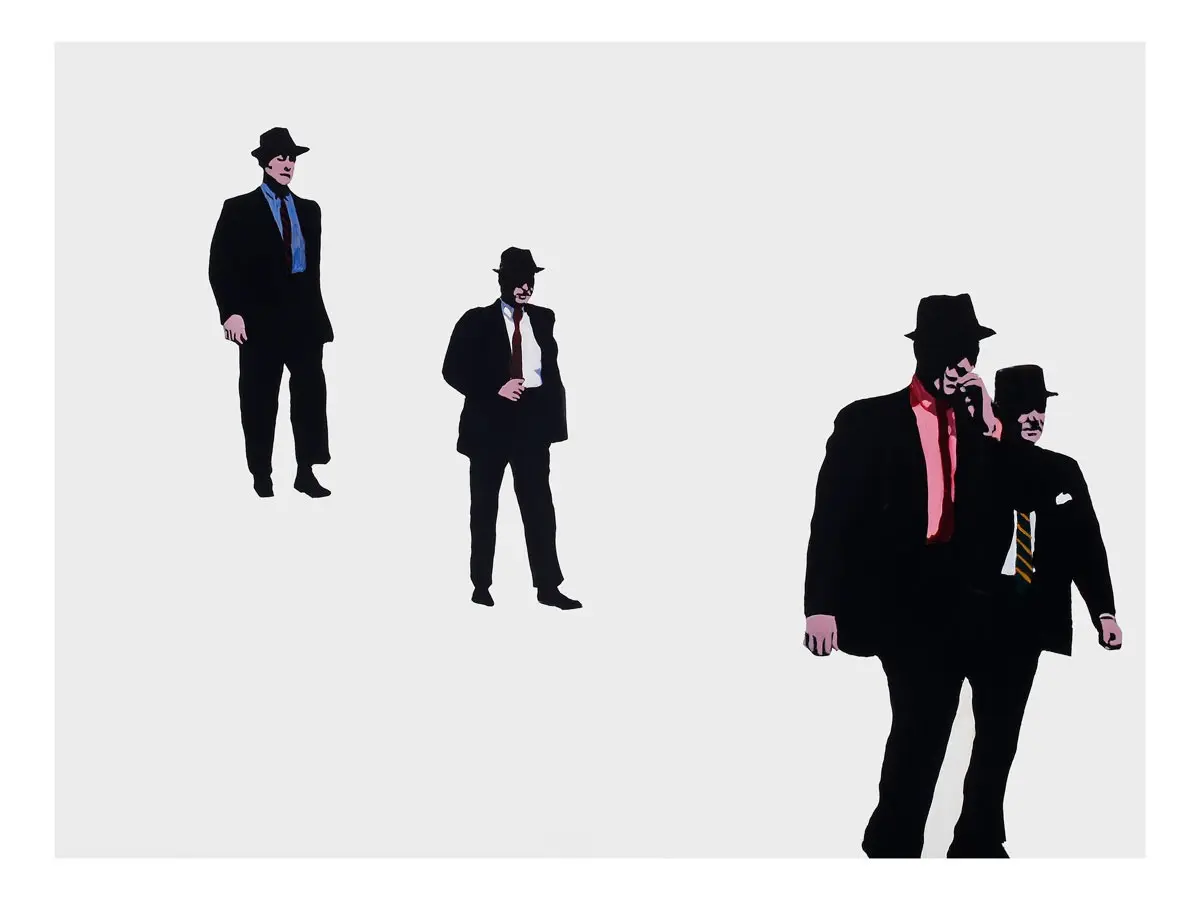
By 1961, she was fully immersed in developing the visual language that would define her career. Setting her heavily edited figures against stark, solid backgrounds reminiscent of first-generation Pop art, she began pulling source material directly from print media, pulp magazines, and movie posters gifted to her by a cousin who worked in a cinema.
1964: The Kornblee Breakthrough
Drexler’s distinct technique—affixing photocopied iterations of found imagery to canvas or board and subsequently burying them in aggressive applications of paint—culminated in her celebrated 1964 second solo show at the Kornblee Gallery. Several of the works featured in that historic presentation are currently on view in the Greene Street inaugural exhibition, offering contemporary viewers a direct line of sight to her mid-century genius.
1969–1979: The Literary Interlude
Around 1969, at the height of her painting productivity, Drexler executed another unexpected pivot. She stepped back from visual art to focus intensely on playwriting and fiction. Over the next decade, she penned acclaimed novels and plays—such as To Smithereens (1972) and Home Movies (1964)—that frequently bridged the gap between gritty urban realism, subculture worlds (like women’s professional wrestling, in which Drexler herself briefly participated), and psychological introspection.

2015–Present: The Institutional Reevaluation
For the past decade, art dealer Garth Greenan has spearheaded a concerted effort to reintroduce Drexler’s multifaceted oeuvre to contemporary audiences. The opening of the new Greene Street space with “My Life Has a Life of Its Own” marks a triumphant chapter in this long-term recovery project, culminating in plans for an upcoming catalogue raisonné.
Supporting Context & Metrics: Inside the Exhibition and the Archive
“My Life Has a Life of Its Own” takes its evocative title from a stray entry in one of Drexler’s personal journals. Curated by Fiona Laugharn, the exhibition is meticulously organized into three distinct chronological and thematic sections: “The Image,” “Image & Text,” and “Return to Image.”
To heighten the visitor experience, Laugharn integrated three dense archival vitrines that echo the sprawling, collage-like nature of Drexler’s personal research files.

+--------------------------------------------------------------------------+
|                     EXHIBITION STRUCTURE AT A GLANCE                     |
+--------------------------+-----------------------------------------------+
| Thematic Section         | Archival / Conceptual Anchor                  |
+--------------------------+-----------------------------------------------+
| The Image                | Early pulp imagery & mobster motifs           |
| Image & Text             | Newspaper clippings & novel manuscripts       |
| Return to Image          | Mature compositions & high-contrast palettes  |
+--------------------------+-----------------------------------------------+
The center vitrine serves as a treasure trove of Drexler’s inspirations. It houses roughly a dozen newspaper clippings—including a morbidly fascinating snippet about a "Rothschild heir [who] committed suicide in Paris"—alongside copies of her novels and hand-drawn silhouettes.
Across from the vitrines hang original movie posters from B-movies like FBI Code 98 (1962) and Pretty Boy Floyd (1960). Rather than passively consuming these films, Drexler treated their promotional materials as raw data. As dealer Garth Greenan notes, her creative process was essentially an act of aggressive editing. She would lift recurring characters—such as the shot-up mafioso Dutch Schultz in Portrait of a Mobster (1961) or the star-crossed couple in Discovered (1963)—and thrust them into emotionally charged, hyper-vibrant compositions.
Working at an intimate scale due to studio spatial constraints and practical economics, Drexler bypassed the need for commercial print enlargers. She relied on her "morgue file" of clippings, marrying headline tragedies with striking visual equivalents, burying them in rich coats of paint, and ultimately crafting icons of American anxiety and desire.

Official Statements & Industry Perspectives
The convergence of Drexler’s retrospective and Rachel Comey’s runway show has generated profound commentary from curators, dealers, and the fashion designer herself.
-
Fiona Laugharn, Exhibition Curator:
Discussing the journals that gave the show its name, Laugharn noted, "In the journal, she talks about this quote, and she’s like, maybe one day I’ll figure out what it means." On the design of the archival vitrines, she added, "I wanted them to echo that experience of going through the archive, to have it be very dense. They almost [look] as if they’re collages too." -
Garth Greenan, Art Dealer:
Reflecting on Drexler’s methodology and legacy, Greenan observed, "So much of the way she paints is by editing the image together… It’s like an aggressive editing process. She lifted these people because there was the most potential here. She was interested in how really intense emotions—anger, fear, love, violence—translate to a work of art, where she could imbue the figure with those." Greenan further emphasized the broader scope of the exhibition, stating, "This exhibition is less about why Rosalyn is a great painter, which she was, and more about why she’s such an interesting case study in art as possibility in New York City."
-
Rachel Comey, Fashion Designer:
Following her runway presentation just blocks from the gallery, Comey shared her deep admiration for Drexler’s multi-hyphenate career: "She presented herself in that time with such strength and provocation, which I thought was really quite interesting. She was so brave and so bold—I just love that type of woman." Comey emphasized that her tribute was designed with deep intentionality: "I didn’t want to just take her art and just slap it on the fabric and wear it; I need to make sure it’s something that makes sense for our clients and has meaning and history." -
Lloyd Wise, Garth Greenan Gallery Director:
Detailing the genesis of the cross-industry collaboration, Wise remarked, "I felt that she would respond to the work," noting the gallery’s ongoing commitment to introducing Drexler’s art to fresh, unexpected audiences outside traditional museum and gallery spaces.
Future Outlook: Cementing a Legendary Legacy
The dual cultural moment of “My Life Has a Life of Its Own” and Rachel Comey’s Drexler-inspired fashion collection signals a turning point in the art historical consensus surrounding Rosalyn Drexler. For decades, multidisciplinary artists who refused to remain neatly boxed into a single category often found themselves penalized by commercial markets that prioritized strict stylistic consistency. Drexler, who fluidly traversed painting, sculpture, playwriting, novel writing, nightclub singing, and professional wrestling, defied these boundaries at every turn.

As Garth Greenan prepares to embark on the monumental task of compiling a catalogue raisonné for the artist, the cultural landscape is finally catching up to Drexler’s prophetic vision. The ability of her 1960s canvases to feel intensely contemporary in the mid-2020s proves that her raw materials—mass-media saturation, psychological violence, and high-contrast emotional intensity—are more relevant today than ever before.
Ultimately, Rosalyn Drexler’s work stands not merely as a relic of first-generation Pop art, but as a masterclass in creative liberation. Whether viewed through the pristine white walls of Garth Greenan’s new Greene Street gallery or translated into the high-fashion textiles of a downtown runway, Drexler’s life and art continue to prove that true innovation obeys no rules, respects no categories, and—most importantly—possesses a stubborn, enduring life of its own.




Comments
Facebook App ID not configured. Please add it in the Customizer.