
Executive Overview
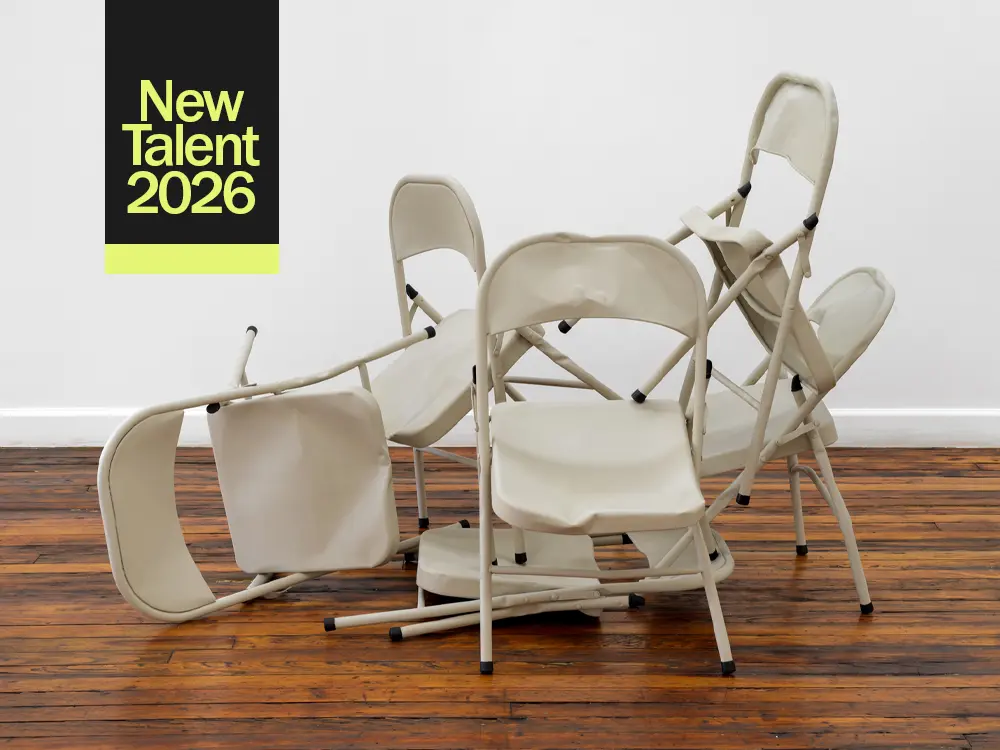
Deep within the industrial labyrinth of Permanent Maintenance—an artist-run incubator housing a dense warren of fabrication shops and ateliers in the gritty yet culturally vibrant neighborhood of Ridgewood, Queens—lies the studio of sculptor Mitchell Charbonneau. To step across the threshold of his workspace is to immediately surrender your perceptual footing. Upon a recent visit to the studio, a visitor reflexively moved to drape a winter coat over a worn, half-open folding chair resting casually against a wall. Just inches away, the hand halted mid-motion: the chair was not an ordinary piece of utility furniture, but a meticulously crafted work of art, fashioned from polyurethane and painted with such uncanny exactitude that it commanded absolute visual and psychological authority.
Charbonneau’s practice operates entirely within the tensioned boundary dividing the mundane from the miraculous. His exhibitions are organized into spare, laconic arrangements of banal detritus—a visual vocabulary dominated by the cultural residue of contemporary life: pine-scented Little Trees air fresheners, buckling aluminum cans of Monster Energy drinks, dinged-up and battered furniture, and burnt-out or discarded fluorescent light tubes. At first glance, these installations present themselves as nonchalant readymade tableaux, echoing the Duchampian legacy of elevating factory-produced items directly into the gallery sphere. Yet this initial reading collapses under closer scrutiny. None of the objects are real.
Instead, Charbonneau engages in an exhaustive, labor-intensive process of recreation. He transforms materials like polyurethane, fiberglass, bronze, copper, aluminum, and lead into uncanny facsimiles of mass-produced obsolescence. By treating, casting, and painting surfaces to the threshold of absolute verisimilitude, the artist forces viewers into a state of hyper-awareness. His works are not merely exercises in technical wizardry; they are psychological landscapes imbued with the quiet pathos of decay, vulnerability, and human absence.
Read Also
This profile explores the conceptual framework, fabrication methodology, and psychological resonance of Charbonneau’s emerging body of work. By examining his roots in photography, his methodical manipulation of materials, and his ongoing exhibitions at venues such as Manhattan’s Off Paradise, we uncover an artist who uses the hyperreal to expose the hidden narratives embedded within the discarded artifacts of modern civilization.
Detailed Chronology and Artistic Evolution
To understand the trajectory of Mitchell Charbonneau’s current sculptural practice, one must trace his artistic evolution backward to its foundational roots. Long before he was casting metal and polyurethane in Queens, Charbonneau was captivated by the camera lens. He roots his hyperrealist methodology firmly in a childhood love of photography—a medium predicated on the capture, framing, and permanent freezing of fleeting temporal moments.
"I’ve always thought of the way I work now as still capturing things from the world," Charbonneau reflected during a recent studio conversation. "The world has to pass through my whole body, my hands, and these different materials to reproduce those things."
This transition from two-dimensional optical capture to three-dimensional physical synthesis defines his unique sculptural language. Rather than clicking a shutter to isolate an abandoned can or a dented chair, Charbonneau forces the object to migrate through his own physical labor. The process requires an intense physical and psychological absorption of the object’s history—every scratch, warp, and discoloration must be studied, internalized, and manually resurrected.
The 2021 Breakthrough at Off Paradise
Charbonneau’s mature aesthetic crystallized in his 2021 solo exhibition at Off Paradise, an intimate and critically acclaimed gallery space housed in a historic building in lower Manhattan. For this breakout show, the artist presented polyurethane replicas of warped, bruised, and bent folding chairs.
Stripped of their utilitarian function, these chairs functioned as somatic stand-ins. The deliberate distortions—buckled metal frames, compressed seats, and scraped enamel finishes—carried deep emotional resonance. Critics and gallery-goers alike noted how the inanimate furniture began to evoke human narratives. The trauma inscribed on the polyurethane surfaces suggested acts of sudden violence, passionate encounters, or the quiet exhaustion of endurance. The chairs were no longer just seating apparatuses; they were proxies for the human body, bearing the invisible weight of physical interaction.
The 2023 Energy Drink Assemblages and Foundations
Building upon the conceptual groundwork laid in 2021, Charbonneau’s 2023 exhibition at Off Paradise expanded his material lexicon. Here, clusters of beverage cans simulated the chaotic, adrenaline-addled aftermath of a late-night gathering. Fabricated from metals and treated with exacting finishes, the crumpled aluminum vessels captured a specific moment of contemporary urban fatigue.
Simultaneously, the artist introduced his ongoing series titled Foundations (2023–present). Comprising metal reliefs that meticulously mimic the textures of concrete cellar walls, this series shifted the psychological tenor of his work downward—literally and metaphorically. The basement, in Charbonneau’s visual lexicon, serves as a crepuscular subconscious. It is a subterranean site of covert activities, illicit poker games, underage inebriation, and adolescent rebellion. By casting these foundational textures in metal, the artist externalized the hidden architectures of domestic spaces, linking the physical foundation of a building to the repressed psychological foundations of the human psyche.
The Current Exhibition: Light, Endings, and Obsolescence
In his most recent exhibition at Off Paradise, scheduled to remain on view through July, Charbonneau addresses the themes of technological obsolescence and illumination. The centerpiece of the show features hand-painted glass and bronze objects that approximate standard fluorescent tube lights. Propped and leaning against one another in fragile, interdependent clusters, these tubes appear almost human—seeking solace in their shared obsolescence.

The conceptual implications of these lightless sculptures are manifold. By utilizing fluorescent tubes—a technology rapidly being eclipsed by energy-efficient, ubiquitous LEDs—Charbonneau invokes a rich metaphorical pun on "enlightenment" and "being kept in the dark." These sculptures refuse to illuminate the physical space around them; instead, they cast a conceptual light on the rapid cycle of technological obsolescence, economic shifts, and the quiet dignity of discarded things.
Supporting Context & Metrics: The Mechanics of Deception
The power of Charbonneau’s art lies not merely in the initial shock of recognition, but in the slow unravelling of illusion that occurs under prolonged inspection. The intimacy and intensity of focus that characterize his studio process are directly mirrored in the minute inspection his sculptures demand from the viewer.
Cues of the Uncanny
Charbonneau deliberately embeds subtle discrepancies within his hyperrealist sculptures, planting clues that allow the astute viewer to discern the artificial from the authentic:
- Olfactory Absence: In his sculptures of Little Trees air fresheners, the olfactory dimension is conspicuously missing. The absence of the synthetic pine or vanilla scent strips the object of its primary functional purpose, leaving behind a pure, silent signifier.
- Dimensional Alteration: His fluorescent light sculptures subtly depart from standard manufacturing dimensions. While commercial fluorescent tubes are universally standardized at four feet in length, Charbonneau’s sculptural counterparts are deliberately elongated to six feet, quietly breaking the spell of industrial replication.
- Material Transmutation: The physical weight, thermal conductivity, and tactile feedback of bronze, copper, lead, and aluminum fundamentally alter how an object is perceived once touched or hefted.
Materiality and Production Metrics
To achieve near-verisimilitude, Charbonneau employs a rigorous array of industrial and fine-art fabrication techniques. The following breakdown illustrates the material taxonomy central to his studio practice:
| Material | Primary Applications | Conceptual & Aesthetic Function |
|---|---|---|
| Polyurethane | Folding chairs, flexible structural elements | Simulates pliable plastics and vinyls; captures organic warping and bodily vulnerability. |
| Aluminum & Copper | Beverage cans, hardware components | Recreates lightweight packaging detritus; registers denting, crushing, and metallic sheen. |
| Bronze & Lead | Fluorescent tubes, structural reliefs, heavy objects | Provides deceptive weight and permanence to fragile, ephemeral, or industrial forms. |
| Fiberglass | Structural cores, rigid housing shells | Enables complex molding of hollow, mass-produced items with high fidelity. |
This rigorous material translation transforms trash into treasure, or more accurately, garbage into monument. By casting disposable consumer goods in enduring archival metals like bronze and copper, Charbonneau enacts a paradoxical preservation: the ultimate symbols of throwaway consumer culture are immortalized as museum-grade artifacts.
Psychological Tenor and Cultural Critique
Beyond their formal brilliance, Charbonneau’s installations function as incisive critiques of contemporary consumerism and psychological repression. His selection of specific commercial brands and environments is loaded with cultural semiotics.
Consider, for instance, his repeated deployment of Monster Energy drink cans. The brand’s audacious corporate slogan—"Unleash the Beast!"—is an aggressive marketing pitch promising consumers access to raw, untamed energy fueled by astronomical doses of caffeine and glucose. In Charbonneau’s hands, the crushed, discarded remnants of these energy drinks cease to be mere litter; they become physical manifestations of late-capitalist exhaustion. They point toward the cultural imperative to constantly extract productivity from the human body, leaving behind a trail of aluminum shells like molted exoskeletons.
This interplay between the repressed bestial self and the sterile demands of modern life runs through his entire oeuvre. Whether through the battered folding chairs that suggest private domestic dramas or the cellar walls of the Foundations series that evoke subterranean secrets, Charbonneau stages a dialectic between what is visible and what is concealed. His art asks us to confront the class anxiety, environmental degradation, and emotional fatigue that we routinely walk past, hiding them in plain sight.
Future Outlook
As Mitchell Charbonneau’s practice continues to gain critical momentum, his ability to merge meticulous technical craftsmanship with profound conceptual depth positions him as a vital voice in contemporary sculpture. The art world’s increasing appetite for work that bridges the gap between hyperrealism and post-minimalist installation finds an ideal practitioner in Charbonneau—an artist who refuses to accept the world at face value.
Looking ahead, Charbonneau plans to expand his exploration of architectural and domestic debris, scaling up his investigations into the hidden spaces of human habitation. As his current exhibition at Off Paradise demonstrates through July, the artist’s capacity to unearth poetry in the obsolete ensures that his work will continue to challenge our perceptions.
Ultimately, Mitchell Charbonneau’s sculptures serve as quiet, enduring testaments to a fundamental truth of contemporary existence: not everything is as it seems. In a world saturated with digital superficiality and relentless production, his handcrafted illusions remind us to slow down, look closer, and reckon with the ghosts left behind in the margins of our daily lives.


Comments
Facebook App ID not configured. Please add it in the Customizer.