
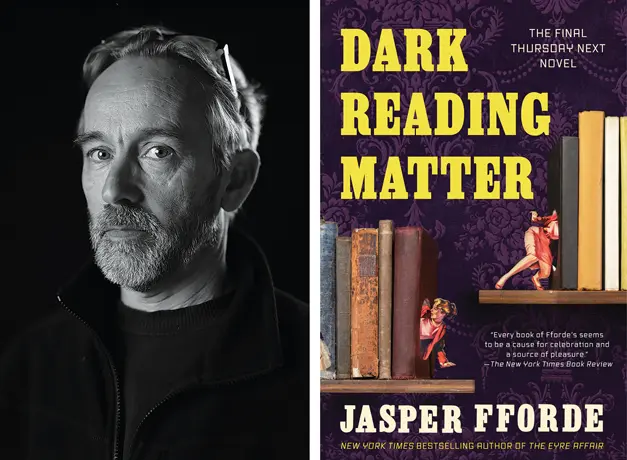
For a quarter of a century, British author Jasper Fforde has invited readers into a sprawling, multidimensional literary universe where characters from classic fiction walk the streets, alternate histories collide, and the very fabric of storytelling is treated as a malleable, high-stakes playground. Since the publication of his critically acclaimed debut novel, The Eyre Affair, in 2001, Fforde has remained a singular voice in contemporary speculative fiction. Blending satire, crime, sci-fi, and metafiction, his works have captivated millions of readers across the globe, translated into 19 languages, and accumulated over three million copies sold.
Now, as autumn approaches, that illustrious era reaches its grand finale. This October, Soho Press will publish Dark Reading Matter, the eighth and final installment in the iconic Thursday Next series. Concluding a 25-year journey, the novel serves as an “end-of-series party” for literary detective Thursday Next, her dedicated followers, and the entire BookWorld. Yet, even as Fforde prepares to bid farewell to his most enduring creation, his critique of modern literary trends, his concerns regarding artificial intelligence, and his relentless pursuit of the “narrative dare” remain as sharp as ever.
This profile explores the remarkable career of a self-taught visionary, examining the unique creative philosophy that built his alternate-reality empires, the personal and professional hurdles he overcame, and what lies ahead as he steps away from his signature franchise to explore new horizons in standalone fiction.
Read Also
Detailed Chronology: From Film Sets to Literary Stardom
Jasper Fforde’s path to becoming one of speculative fiction’s most inventive architects was neither direct nor conventional. Born in London in 1961 and raised largely in Wales, Fforde navigated a childhood complicated by undiagnosed dyslexia. Labelled as incompetent by educators who failed to recognize his learning differences, he developed a profound, lifelong drive to prove his intellectual capability and overcome the stigma of his early academic struggles—a personal history that would later fuel his relentless work ethic.
Leaving school at the age of 18, Fforde entered the film industry, spending two decades working behind the scenes primarily as a focus puller. His technical acumen contributed to major cinematic productions, including GoldenEye and The Mask of Zorro. However, his true passion lay in narrative composition. In the late 1980s, while still working in film, he sat down in front of a typewriter and taught himself how to write fiction.
This marked the birth of Fforde’s signature methodology: the “narrative dare.” He would conceive an intentionally outlandish, high-concept premise and challenge himself to transform it into a functioning, commercially viable novel.
"Having ideas on their own is a kind of exercise in empty cleverness," Fforde reflects. "The interesting thing about doing a dare is that you can’t not do it. And because of that, you have to rummage deeper in that authorial toolbox. You’ve got to make it work somehow. No surrender."
The early years of this experiment were marked by quiet rejection. Fforde produced six complete novels, all of which were rejected by traditional publishers. Undeterred by the mounting rejections, he relied on the stubborn resilience forged during his dyslexia-plagued school years.
That perseverance paid off spectacularly with the 2001 release of The Eyre Affair. Set in an alternate version of England where literary detection is a serious profession, the mind-bending adventure introduced Thursday Next, a literary detective tasked with rescuing Jane Eyre from a villain who had kidnapped her from the pages of Charlotte Brontë’s classic novel. The book was an instant sensation, launching the bestselling Thursday Next series and permanently altering the landscape of genre-bending fiction.
Over the subsequent two decades, Fforde expanded his literary footprint with 18 novels spanning multiple universes, including the Nursery Crime series, the Shades of Grey series, the Last Dragonslayer young adult fantasy series, and acclaimed standalone works such as Easy Riser (2019) and The Constant Rabbit (2020).
Supporting Context & Metrics: The Scale of Fforde’s Literary Empire
Fforde’s impact on contemporary publishing extends far beyond critical acclaim; the quantitative metrics of his career underscore a rare, enduring commercial viability in speculative and metafictional literature.
- Global Reach: According to his agency, Janklow & Nesbit U.K., Fforde’s books have sold more than three million copies worldwide.
- International Translation: His inventive narratives have broken language barriers, appearing in 19 languages across various continents.
- Literary Accolades: His contributions to comic and speculative fiction have been recognized with prestigious honors, including the Bollinger Everyman Wodehouse Prize for comic fiction, the Dilys Award, and the William L. Crawford Award.
- Dedicated Fandom: The connection between Fforde and his readership is uniquely tight-knit. Fans regularly gather for a biennial festival known as the "Fforde Ffiesta," held in Swindon, England, to celebrate his contributions to literature.
The final installment of the Thursday Next series, Dark Reading Matter, represents a masterclass in structural innovation. Set in 2004—years after the events of 2012’s The Woman Who Died a Lot—the novel finds Thursday and her husband Landen attempting to take a romantic holiday, only to be drawn into Wantage, a town featuring a declining Shakespeare theme park called Shakesmania and a mysterious new attraction known as the Gateway.
There, Thursday discovers that Shakesmania has been acquired by a private equity firm intending to rebrand it around Francis Bacon, the historical figure often championed by conspiracy theorists as the true author of Shakespeare’s plays. As murderous forces attempt to alter the plot of the novel itself, Thursday must navigate the BookWorld—a multidimensional realm housing characters from literature like The War of the Worlds and The Great Gatsby—to protect the "Dark Reading Matter," a repository where early drafts and rejected ideas are stored. To mirror this chaotic, dimensional instability, Fforde pushes the boundaries of physical book design, incorporating footnotes, blank pages, multiple fonts, and a false ending into the text.
Official Statements and Industry Perspectives
The distinct brilliance of Fforde’s creative process has earned him the deep admiration of both his publishing partners and industry colleagues.
Juliet Grames, Fforde’s editor since 2023 and a self-professed Fforde superfan of two decades, describes the author’s creative architecture with vivid imagery:
"I adore Jasper, he’s madcap and one of a kind. They say don’t meet your heroes, but Jasper is delightful. The way his brain works—it’s like splatter paint. There’s so many ideas."
Will Francis, Fforde’s U.K. agent, highlights the author’s pioneering role in redefining the boundaries of genre fiction:
"Jasper has one of these brains that’s just relentlessly restless and original. He was one of the early writers who challenged what genre writing can do and laid a path in some ways for other writers who’ve written books that deal with dystopias or alternate worlds."
Despite his success, Fforde maintains a critical eye toward the broader literary landscape, expressing skepticism regarding both uninspired literary fiction and the encroachment of automated technology.
"I find literary fiction rather worrying," Fforde remarks. "There’s a lot of people who think they can write literary fiction, and they can’t. They’re not really writers. They’re people who want to define themselves as writers. Sometimes I read literary fiction and think, This has no soul. It’s an idea covered in glue with pretty sentences thrown at it."
On the topic of artificial intelligence, Fforde issues a stern warning to tech conglomerates attempting to infiltrate the creative arts:
"Big Tech will try and take over publishing because they don’t understand novels. They think they’ll be able to churn them out. But you’ll not be able to emulate speculative and fantasy novels that push at the boundaries of imagination."
Future Outlook: Beyond Thursday Next
With Dark Reading Matter hitting bookshelves this October via Soho Press, Fforde is officially closing the chapter on his defining 25-year saga. Yet, far from slowing down, the author views the retirement of Thursday Next as an open door to new creative frontiers.
Fforde believes that the literary climate is ripe for a renaissance in speculative fiction, largely driven by the limitations of automated systems.
"We have to up our game to stay ahead," he notes. "These AI engines can’t innovate; they can only copy. Speculative writing may be in a golden age. And it might herald the end to formulaic writing, which, perhaps, we’ve come to tolerate more than we should."
Moving forward, Fforde plans to focus exclusively on standalone fiction, unmoored from the structural demands of a long-running series. Armed with an imagination that refuses to stagnate and a philosophy centered entirely on narrative audacity, he remains committed to taking risks where others choose safety. For Jasper Fforde, the only unpardonable sin in storytelling is predictability—and as he embarks on this next chapter, his readers can rest assured that dull narratives will remain strictly outside his domain.




Comments
Facebook App ID not configured. Please add it in the Customizer.