

In the literary landscape of contemporary American poetry, the pursuit of reinvention often begins with a simple, resonant constraint. For the week of August 17, 2026, the spotlight shines brightly on Appalachian writer Amanda Gaines, whose poem “In Another Life” has been officially named the Poem of the Week. Selected for its uncanny balance of visceral imagery, deadpan humor, and profound existential vulnerability, Gaines’s work offers a masterclass in the art of the anaphoric list poem. Built entirely around the recurring refrain “I found,” the piece takes readers on a surreal, deeply human odyssey through highway debris, emotional archaeology, domestic absurdities, and unexpected epiphanies.
Beyond its immediate literary impact, the publication of “In Another Life” arrives at a pivotal juncture in Gaines’s burgeoning career. Currently serving as a postdoctoral fellow and teaching assistant professor at the University of Tennessee—having earned her PhD in creative writing from Oklahoma State University—Gaines has steadily cultivated a reputation as one of the most distinctive voices of her generation. Her poetry and prose have graced the pages of premier literary publications ranging from The Southern Review and Pleiades to Passages North and SmokeLong Quarterly.
This feature explores the anatomy of Gaines’s celebrated poem, contextualizes its genesis within the broader framework of her writing life, and examines how a simple creative experiment designed to break a dry spell evolved into a profound meditation on human endurance, speculative desire, and the unyielding persistence of hope.
Read Also
Detailed Chronology & Literary Genesis
To understand the weight and resonance of “In Another Life,” one must trace the winding path of its creation. Every significant work of art bears a history of resistance—a period where the machinery of language stalls, leaving the creator stranded in what poets commonly refer to as a dry spell. For Gaines, this particular drought was marked by a distinct sense of being unmoored and bored.
Breaking the Dry Spell: The Anatomy of an Experiment
Facing a temporary stagnation in her creative output, Gaines turned to constraint as a therapeutic and generative tool. She began experimenting with revisionist histories and speculative desire, asking herself what it means to inventory the self when the self feels fragmented or repetitive.
The breakthrough came through the strategic deployment of anaphora—the deliberate repetition of the phrase “I found” at the beginning of consecutive lines. This structural choice acted as a metronome, guiding the poet through the chaotic attic of memory, imagination, and domestic reality. Rather than approaching the writing process with resignation, Gaines used the phrase to re-engage with the world through a lens of radical wonder.
The Evolution of the Refrain
As the poem unspooled, the items encountered by the speaker escalated from the macabre to the mundane, from the surreal to the deeply intimate.
- Phase One (The Oddities): The poem opens with stark, tactile imagery—“I found a fox skull on the highway and kept it in my freezer” and “I found a private school to send my stretch marks.” These early lines establish a tone of eccentric survivalism, where the discarded and the damaged are housed with careful preservation.
- Phase Two (The Existential Incongruities): As the sequence progresses, the speaker navigates modern absurdities, losing God at a Sam’s Club, finding a bottomless lake in a closet, and tattooing the word prodigal across her knuckles. Each “find” serves as a miniature narrative arc, compressing years of emotional seeking into a single line.
- Phase Three (The Resolutions of Grace): In its closing movements, the poem pivots toward quiet, disarming clarity. Whether discovering peace while unpeeling an orange or staying open-mouthed under the mistletoe all night, the poem resolves not with a grand cosmic revelation, but with the quiet realization that survival is often found in sensory details.
Supporting Context & Textual Analysis: “In Another Life”
To fully appreciate the cultural and artistic weight of Gaines’s selection, it is necessary to examine the complete text of the poem that captured the literary community’s attention:
In Another Life
I found a fox skull on the highway and kept it in my freezer.
I found a private school to send my stretch marks.
I found a vacuum cleaner on sale and couldn’t afford it.
I found you can get around guilt with an oyster fork.
I found a letter in my mailbox addressed to a version of me I’d never met and got embarrassed.
I found my G-spot hiding behind my ears.
I found a receipt showing I bought all this self-esteem but can’t remember where I put it.
I found a teacup full of wine and fell in.
I found that tearing velvet from antlers isn’t all that painful.
I found God but lost Him at Sam’s Club.
I found a bottomless lake in my closet, grew gills, and was very proud of my adaptability.
I found my knuckles tattooed with the word prodigal.
I found Atlantis and wasn’t impressed.
I found it within myself to say I hope you’re happy and mean it.
I found a dollar on the side of the road and spent the next seven years searching for its owner.
I found a fortune teller who said she’d refer me to a psychologist.
I found a strand of yarn sticking out of my rug, and I’m still pulling.
I found a way to get with the program already.
I found the fève in a king cake, but nobody would acknowledge my sovereignty.
I found my mind at the pound and bought a shock collar.
I found revenge tastes fine regardless of its preparation.
I found the perfect ant colony to join, and no, we’re not a cult.
I found coal in a river and didn’t tell anyone.
I found a treasure map, but didn’t feel up for a challenge.
I found the right words to say to you.
I found a parasitic wasp cracking a chrysalis and didn’t make it about me.
I found a tooth beneath my pillow and didn’t ask questions.
I found time and applied for an apartment in her belly.
I found out after a lot of fucking around.
I found peace while unpeeling an orange and couldn’t believe my luck.
I found the mistletoe at a Christmas party and stayed there all night, open-mouthed.
The Thematic Architecture of the Poem
Literary critics examining Gaines’s work frequently highlight her ability to balance dark humor with profound emotional stakes. “In Another Life” operates as a catalogue of alternate timelines, where every line represents a life not entirely lived, but certainly imagined.
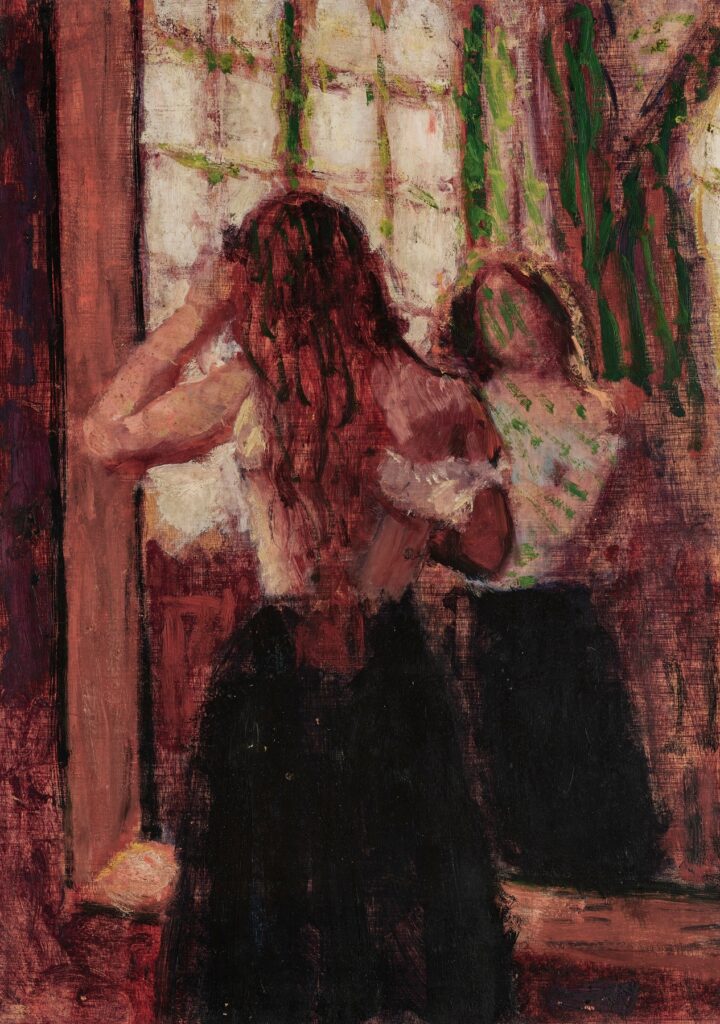
The tension in the poem derives from the friction between grand mythological or surreal concepts (Atlantis, God, a bottomless lake) and petty, domestic realities (a vacuum cleaner on sale, a lost receipt for self-esteem, a fortune teller recommending a psychologist). This juxtaposition prevents the poem from sliding into mere whimsical escapism. Instead, it grounds the speaker’s interiority in the chaotic, messy reality of modern life.
Furthermore, the poem addresses the vulnerability of fantasy. As Gaines herself notes, our fantasies are often just as disappointing or embarrassing as our lived realities. Confessing to a dream self—whether one is joining an ant colony or searching for the owner of a stray dollar for seven years—is ultimately an act of radical self-exposure. It lays bare the human desire to matter, to adapt, and to find grace in unexpected places, such as the skin of an orange or the belly of time itself.
Official Statements & Author’s Reflections
In conjunction with the Poem of the Week feature, Amanda Gaines shared rare insight into the philosophical and psychological underpinnings of her creative process. Speaking on the origins of “In Another Life,” Gaines reflected on the necessity of acknowledging the messier sides of human vulnerability:
"This poem began as a kind of thought experiment—one I hoped would pull me out from a writing dry spell," Gaines explained in her official author’s note. "Back then, I felt unmoored. Bored. I spent a lot of time thinking about revisionist histories, the allure of speculation, and the ways in which, if we are honest with ourselves, our fantasies can be pretty embarrassing or just as disappointing as our lived lives."
Elaborating on the technical mechanics of the piece, Gaines emphasized how the repetitive structure served as an emotional anchor:
"The anaphora of I found allowed me to consider the repetitive act of being in the world with wonder rather than resignation. What possibilities open up when we allow ourselves to play or get real with the stickier aspects of our humanity? Conceding a dream self—even ones that are messy or silly—is to confess the most vulnerable of feelings: hope."
Gaines concluded with a statement that encapsulates the broader cultural mission of her work:
"This poem is an exercise in hopefulness that I, we, you, whoever, can still be surprised when tracing the worn grooves of our interior lives."
This perspective resonates deeply within contemporary poetry circles, where readers and writers alike constantly seek ways to break through the burnout of daily existence and reconnect with authentic emotional registers.
Future Outlook & Literary Impact
As Amanda Gaines continues her tenure as a postdoctoral fellow and teaching assistant professor at the University of Tennessee, the reception of “In Another Life” signals an exciting trajectory for her career. Having established an extensive publishing footprint in venerated literary journals—including Cleaver, Potomac Review, Barrelhouse, Fugue, december, Witness, Southern Humanities Review, American Literary Review, Willow Springs, Redivider, New Orleans Review, Southeast Review, Juked, Rattle, Pleiades, SmokeLong Quarterly, and Ninth Letter—Gaines stands as a formidable force in Appalachian literature and contemporary American verse.
What Lies Ahead
- Expanded Pedagogical Influence: Through her university teaching and mentorship, Gaines is actively shaping the next generation of creative writers, imparting the very lessons of constraint, experimentation, and emotional honesty that birthed “In Another Life.”
- Upcoming Manuscript Development: While details regarding a full-length poetry collection remain under wraps, pieces of this caliber suggest that readers can anticipate a major book-length project that synthesizes narrative wit with lyrical depth.
- The Ongoing Exploration of Regional and Universal Themes: As an Appalachian writer with a doctorate from Oklahoma State University, Gaines bridges rural sensibilities with academic rigor, creating a unique poetic idiom that speaks to both localized heritage and universal human experiences.
Ultimately, “In Another Life” serves as a reminder that poetry does not always require grand gestures or distant landscapes to achieve greatness. Sometimes, it simply requires looking closely at the strange inventory of our own minds, accepting our embarrassments, and remaining open-mouthed under the mistletoe, waiting to be surprised by grace.

Comments
Facebook App ID not configured. Please add it in the Customizer.