
Executive Overview
In what is poised to become one of the most significant overarching auction events of the cultural calendar, auction house heavyweight Christie’s has announced the forthcoming dispersal of nearly 600 works of modernist art. Titled “Radiant Modernism,” this monumental multi-part sale draws entirely from a single, anonymous private European collection. Industry analysts estimate that the cache of works will collectively haul in between $40 million and $60 million, injecting a massive wave of high-grade inventory into a cautious yet hungry global art market.
The rollout of the collection is strategically engineered to capture the maximum attention of international collectors, curators, and investors. The campaign kicks off this October in London to coincide with the high-society frenzy of Frieze London, before moving across the Atlantic for marquee autumn sales series in New York later this year.
At the vanguard of this massive assembly of modernist treasures are museum-tier works by Paul Signac, the legendary French Neo-Impressionist who, alongside Georges Seurat, revolutionized visual art through the invention of Pointillism. Flanked by stellar examples from other titans of late 19th- and early 20th-century modernism—including Josef Albers, Henri de Toulouse-Lautrec, Odilon Redon, and Lyonel Feininger—“Radiant Modernism” is not merely a commercial auction series; it is a major cultural event functioning as a secondary-market museum exhibition.
Read Also
Detailed Chronology: The Rollout of ‘Radiant Modernism’
The strategic deployment of nearly 600 artworks requires a meticulously planned, multi-city timeline. Christie’s has structured the sale across several dates and venues, maximizing geographic reach and tapping into distinct collector demographics in Europe and North America.
Phase One: The London Debut (October)
The first wave of works from the “Radiant Modernism” collection will hit the auction block in London on October 14, directly aligning with the vibrant energy of Frieze London week. This autumn window traditionally draws heavy-hitting European collectors, institutional directors, and billionaire advisors to the British capital.
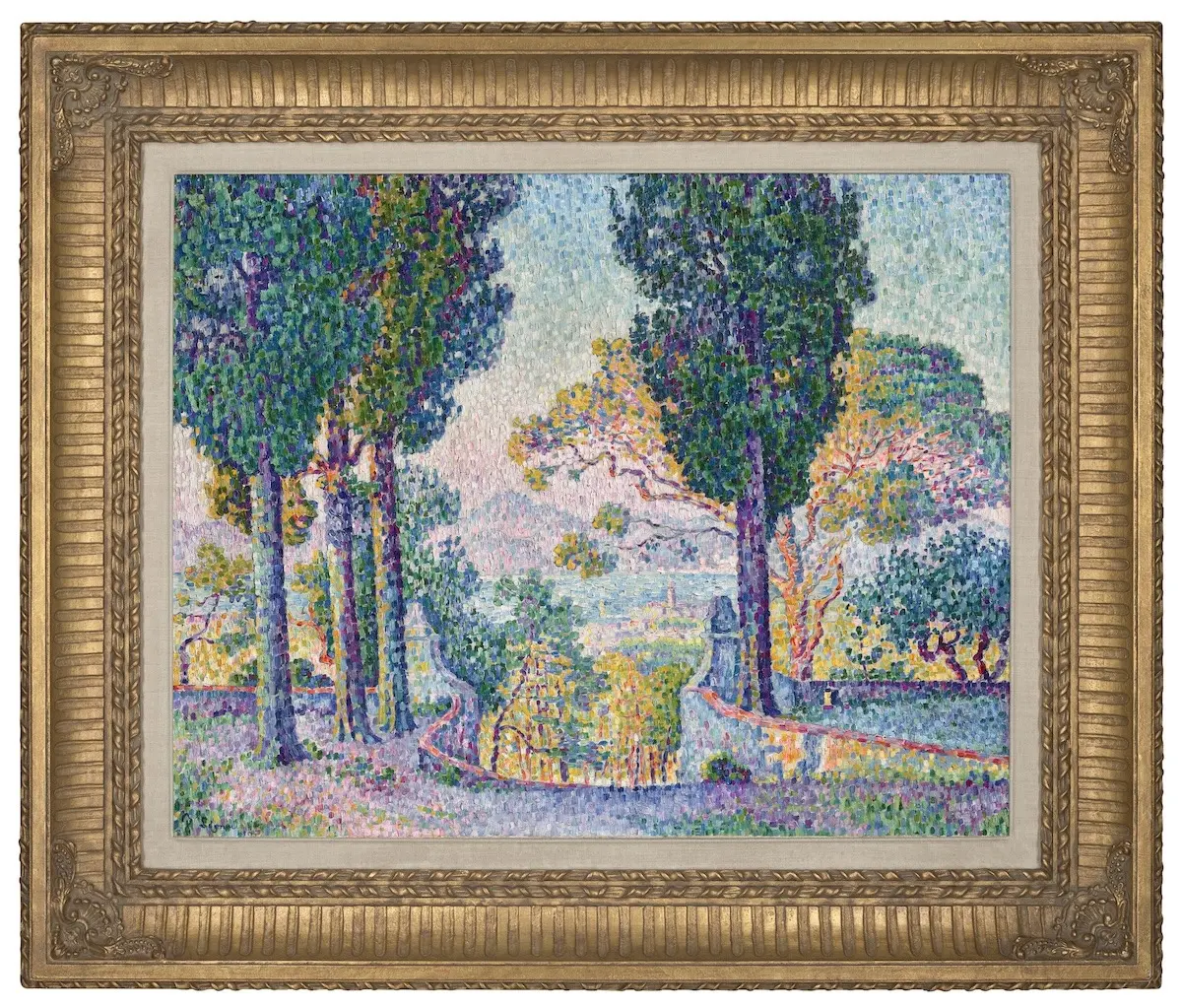
The crown jewel of this London installment is Paul Signac’s luminous 1905 canvas, Sainte-Anne (Saint-Tropez). Portraying the sun-drenched French port town on the Riviera, this coastal landscape carries a pre-sale high estimate of £6.5 million (approximately $8.8 million). While substantial, this valuation sits comfortably below Signac’s absolute auction record, potentially setting the stage for competitive, multi-bidder enthusiasm in the salesroom.
Furthermore, the London offering will be bolstered by carefully curated pairings of works from the broader European collection, capitalizing on the city’s status as a historic hub for premier secondary-market trading of early 20th-century European avant-garde movements.
Phase Two: The New York Marquee Series (November)
Following the autumn European kickoff, the focus will pivot westward to Manhattan. During New York’s high-stakes November marquee auction series, Christie’s will offer the second major tranche of “Radiant Modernism.”
This leg will feature another masterwork by Paul Signac: Saint-Briac, les balises (1890). Uniquely, Christie’s has chosen to withhold a public pre-sale estimate for this quaint, optically arresting seascape. In the rarefied ecosystem of top-tier auction houses, a withheld estimate is rarely a sign of hesitation; rather, it is a deliberate psychological tactic deployed when specialists believe a work possesses the explosive potential to shatter expectations, ignite bidding wars, and eclipse conservative valuations.
Supporting Context & Metrics: Provenance, Pedigree, and Market Dynamics
To understand the immense valuation and institutional weight of “Radiant Modernism,” one must examine the provenance and art-historical ecosystems surrounding its headline pieces.
The Signac Factor and Museum Synergy
Paul Signac’s place in the art historical canon is foundational. Working alongside Georges Seurat in the late 1880s, Signac abandoned the instinctive, blended brushstrokes of traditional Impressionism in favor of systematic optical mixing. By placing tiny, precise dots or dashes of pure, unblended color side-by-side, these artists allowed the human eye and mind to optically blend the pigments from a distance. The resulting luminosity transformed how generations viewed light, atmosphere, and landscape.
The two marquee Signac paintings anchoring the Christie’s sale arrive with exceptional institutional tailwinds that significantly amplify their market desirability:
- Sainte-Anne (Saint-Tropez) (1905): Beyond its visual appeal, this canvas benefits from extraordinary historical provenance. The painting was previously owned by Gustave Fayet, an iconic early-20th-century collector whose visionary patronage is currently the subject of a major survey at the Fondation Louis Vuitton in Paris. Furthermore, the timing of the sale intersects seamlessly with a blockbuster autumn exhibition at London’s Royal Academy of Arts, which explores the profound, formative influence of the French Riviera on modern art-making. This convergence of museum exhibitions ensures maximum scholarly and public visibility for the work just as it goes under the hammer.
- Saint-Briac, les balises (1890): Painted during Signac’s earlier, deeply experimental phase, this seascape captures the rugged charm of the Brittany coast. Its withheld estimate has already set tongues wagging among market makers who are quietly calculating whether it might challenge Signac’s all-time auction record of $39.3 million.
The Broader Pantheon of Modernism
While Signac provides the monetary and historical anchor, the nearly 600-work collection is expansive in its aesthetic scope. Christie’s has confirmed that the multi-part sale will feature masterworks by a diverse roster of pioneering modernists:
- Josef Albers: Bringing the rigorous, color-theory-driven geometry of his famous Homage to the Square series to the table, representing the mid-century evolution of abstract modernism.
- Henri de Toulouse-Lautrec: Infusing the collection with the bohemian grit, theatrical flair, and sharp psychological portraiture of late-19th-century Montmartre.
- Odilon Redon: Introducing symbolist mysticism, dreamlike palettes, and ethereal figuration that bridge the gap between Impressionism and Surrealism.
- Lyonel Feininger: Showcasing precisionist architectural abstraction and crystalline planes of light that reflect his time with the Bauhaus movement.
Official Statements and Industry Insights
Christie’s has remained tight-lipped regarding the identity of the consignor, maintaining the strict confidentiality expected when handling private European collections of this magnitude. However, senior leadership has spoken candidly about the strategic positioning and ambitions for the sale.
Speaking to Artnet News regarding whether Saint-Briac, les balises could threaten Signac’s $39.3 million benchmark, Giovanna Bertazzoni, Chairman of European Operations at Christie’s, offered a knowing and optimistic appraisal:
"We always hope, don’t we?"
Bertazzoni’s statement encapsulates the delicate balance of confidence and cautious optimism currently defining the upper echelons of the art market. By offering an unestimated work of this caliber, Christie’s is signaling to the global collector base that the appetite for top-tier, museum-quality Impressionist and Modern art remains robust, even as macroeconomic pressures prompt greater selectivity among high-net-worth buyers.
Future Outlook: Implications for the Global Art Market
The launch of “Radiant Modernism” serves as a crucial barometer for the secondary art market heading into the final quarters of the year. Following a period of market normalization characterized by conservative consignments and tempered guarantees, the injection of a $40 million to $60 million private collection acts as a stress test for institutional and private wealth.
Key Trends to Watch:
- The Flight to Quality: In uncertain economic climates, collectors increasingly gravitate toward blue-chip, historically secure assets. Signac, Toulouse-Lautrec, and Albers represent canonical art history with proven long-term value retention.
- Synergy Between Museums and Markets: The alignment of Christie’s sales with major museum exhibitions—such as the Royal Academy’s French Riviera showcase and the Fondation Louis Vuitton’s Gustave Fayet survey—demonstrates a sophisticated modern playbook. Market value is increasingly reinforced, if not directly catalyzed, by institutional validation.
- Single-Owner Collections as Curated Statements: Modern buyers prefer the narrative cohesion of single-owner collections. The “Radiant Modernism” cache offers buyers a rare opportunity to acquire works that have lived together in a harmonious European domestic environment for decades, preserving a distinct curatorial vision.
As the gavel prepares to fall this October in London and continues through November in New York, the international art world will be watching closely. Whether “Radiant Modernism” merely meets its projected $40 million to $60 million bounds or shatters them through aggressive bidding on landmark lots like Signac’s Saint-Briac, the event promises to set the tone for modernist acquisitions for seasons to come.



Comments
Facebook App ID not configured. Please add it in the Customizer.