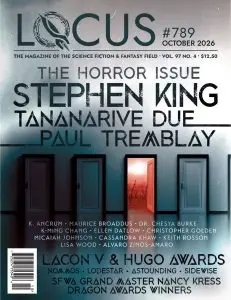
The publication of Locus magazine’s October 2026 issue (Issue #789, Vol. 97, No. 4) arrives at a critical juncture for the speculative fiction publishing industry. Celebrating its 59th year of publication and boasting 30 Hugo Awards, the magazine serves as both an industry ledger and a cultural barometer. The October 2026 edition, featuring cover and interview design by Francesca Myman, captures a genre landscape undergoing profound structural, geopolitical, and thematic transitions.
This issue is anchored by three major pillars:
Institutional Accountability & Geopolitics: The formal banning of Chengdu Worldcon officials by the World Science Fiction Society (WSFS), alongside the complete voting breakdowns from LAcon V (Worldcon 2026), signaling a push for transparency following years of administrative controversies.
The New Horror Renaissance: A comprehensive horror feature headlined by exclusive interviews with Stephen King, Tananarive Due, and Paul Tremblay, exploring the psychological, cultural, and political dimensions of modern dark fiction.
Editorial and Organizational Shifts: Critical leadership transitions across premier speculative fiction markets, including Nightmare, Lightspeed, and Asimov’s Science Fiction, coupled with institutional upheavals within the Horror Writers Association (HWA).
As independent publishing faces mounting economic pressures, this landmark issue of Locus underscores the resilience of speculative fiction while documenting the systemic changes defining its future.
Detailed Chronology of Major Events & Editorial Dispatches
[August 2026: LAcon V / Worldcon 2026]
       │
       ├─► Hugo Awards Winners Announced
       ├─► WSFS Bans Chengdu Worldcon Officials
       └─► Brisbane Selected for Worldcon 2028
       │
[September 2026: Industry Transitions]
       │
       ├─► SFWA Names Nancy Kress Grand Master
       ├─► HWA Board Experiences Governance Upheaval
       └─► Sheila Williams (Asimov's) Transitions to Assisted Care
       │
[October 2026: Locus Issue #789 Published]
       │
       ├─► Horror Feature: King, Due, & Tremblay Interviews
       └─► Comprehensive SFF Critical Review Rollout
The Post-LAcon V Landscape and Worldcon Geopolitics
The shadow of the 2023 Chengdu Worldcon voting manipulation scandal continues to influence the governance of the World Science Fiction Society (WSFS). At the 2026 WSFS Business Meeting held during LAcon V in Los Angeles, the general assembly enacted unprecedented disciplinary measures, officially banning several key Chengdu Worldcon officials from future event administration. This decisive action represents a major step toward restoring institutional trust in the Hugo Awards.
Concurrently, the site selection for Worldcon 2028 has been awarded to Brisbane, Australia, marking a significant return of the convention to the Southern Hemisphere. Looking further ahead, Montréal 2027 has expanded its leadership and programming profile, adding acclaimed authors Katherine Addison and Cory Doctorow as Guests of Honor.
The Horror Renaissance: King, Due, Tremblay, and the New Canon
The central editorial focus of Issue #789 is an in-depth examination of contemporary horror. This focus is highlighted by three major interviews:
Stephen King ("Idea of Echoes"): The legendary author reflects on the cyclical nature of fear, the persistence of narrative hauntings, and how contemporary anxieties mirror the classic gothic tropes of the 20th century.
Tananarive Due ("Doorway to the Supernatural"): Discussing her new novel Mazywood, Due explores the intersection of historical trauma, ancestral memory, and the supernatural. Her work continues to establish Black horror as a vital site of cultural critique.
Paul Tremblay ("Rupture Point"): Tremblay discusses the mechanics of psychological dread and societal collapse, analyzing how modern horror serves as a realism-adjacent reflection of late-stage capitalism and environmental anxiety.
Complementing these interviews is a curated horror spotlight featuring essays and commentaries from prominent voices in the field:
Cassandra Khaw ("Monsters are Hot") and Micaiah Johnson ("The Perfect Horror") dissect the evolving aesthetics of monster theory and the changing nature of what terrifies modern readers.
Maurice Broaddus & Dr. Chesya Burke contribute a seminal piece, "Black Horror: Why Canonical Voices From Then to Now," tracing the lineage of Black speculative dark fiction and its role in challenging systemic erasure.
K-Ming Chang ("Disrupt and Intervene") and Keith Rosson ("Breathing Room") examine the stylistic boundaries of the genre, while Lisa Wood addresses the structural state of the Horror Writers Association (HWA).
Institutional Transitions and Industry Upheavals
The speculative fiction community is experiencing a significant shift in its leadership. In major industry news:
Nancy Kress has been named the Science Fiction and Fantasy Writers Association (SFWA) Damon Knight Memorial Grand Master, honoring her decades of contribution to hard science fiction and genetic-engineering narratives.
Editorial Realignments: Major leadership transitions are underway at sister publications Nightmare and Lightspeed, signaling a broader evolution in short-fiction curation.
Sheila Williams, the long-serving editor of Asimov’s Science Fiction, is transitioning to an assisted living facility. Williams’ tenure has shaped the careers of generations of writers, and this transition marks the end of an era for one of the field’s most influential editorial chairs.
The Horror Writers Association (HWA) has experienced sudden board upheaval, prompting discussions regarding governance, transparency, and the future direction of the Bram Stoker Awards.
Rare Book Security: The antiquarian book community was alarmed by a significant book theft at Lloyd Currey Booksellers, a premier dealer of rare speculative fiction, highlighting the vulnerability of physical archives in the digital age.
Supporting Context & Critical Metrics
Transparency in SFF Awards: Hugo vs. Dragon
The publication of the complete 2026 Hugo voting breakdown in this issue provides critical data for analyzing voting behavior, nomination concentrations, and the impact of the WSFS’s recent constitutional reforms.
In contrast to the juried and member-voted Hugo Awards, the 2026 Dragon Awards winners—also announced in this issue—reveal the ongoing divergence between fan-driven, high-volume popular fiction and the critical, literary-focused consensus of the Hugos. This bifurcation highlights the complex, multi-tiered nature of modern speculative fiction fandom.
Award Platform
Primary Voting Demographic
Focus / Aesthetic
Key 2026 Milestone
Hugo Awards (WSFS)
Supporting/Attending Worldcon Members
Literary, Progressive, International
Implementation of Chengdu-related bans; full transparency report published.
Dragon Awards (Dragon Con)
Open Public Online Vote
Commercial, High-Action, Popular Genre
Continued consolidation of military SF and space opera fandoms.
Nommo Awards (ASFS)
African Speculative Fiction Society Members
African Speculative Fiction
Release of the 2026 Shortlist, highlighting regional growth.
Locus #789 features a comprehensive review section, analyzing an expansive list of new releases across science fiction, fantasy, and horror. This collective critical output illustrates the aesthetic trends dominating the latter half of 2026.
                  ┌── Gary K. Wolfe (Annalee Newitz, Nghi Vo, Daryl Gregory)
                  ├── Alexandra Pierce (Becky Chambers, Claire North, Freya Marske)
                  ├── Ian Mond (Tananarive Due, Matt Hill, Haralambi Markov)
*Locus* Reviews ──┼── Abigail Nussbaum (Naomi Alderman, Robert G. Penner)
                  ├── Niall Harrison (Karen Lord, Adam Roberts, Caskey Russell)
                  ├── Colleen Mondor (Shaun Tan, Sophia Hannah, H.G. Parry)
                  └── Gabino Iglesias (Cassandra Khaw, Hannah Whitten, Kim Bo-Young)
Gary K. Wolfe reviews Annalee Newitz’s A Wall Is Also a Road, Nghi Vo’s The Scarlet Ball, and Daryl Gregory’s The Porcelain Sisters, identifying a shared thematic interest in the mutability of physical and social structures.
Alexandra Pierce evaluates Becky Chambers’ As You Wake, Break the Shell and Claire North’s As We Fall Through Time, alongside anthology work such as Allan Kaster’s The Year’s Top Hard Science Fiction Stories 10 and Jonathan Strahan’s Revolution in the Heart.
Ian Mond tackles the dark, atmospheric landscapes of Tananarive Due’s Mazywood, Matt Hill’s Wrecks, and Haralambi Markov’s The Language of Knives.
Abigail Nussbaum provides critical analysis of Naomi Alderman’s The Strangers, Robert G. Penner’s Notes on a Colonial Situation in Hell, and Kuzhali Manickavel’s surrealist A Compendium of Supernatural Entities Found in the Government Girls Higher Secondary School.
Niall Harrison reviews Karen Lord’s The Angel at the Gates, Margrét Helgadóttir’s edited anthology Nordic Nightmares, and Adam Roberts’ speculative satire Frankenstein Rex.
Colleen Mondor examines Shaun Tan’s illustrated work Hometown, Sophia Hannah’s We Were Never Here, and H.G. Parry’s The Witch Below the Dreaming Wood.
Gabino Iglesias reviews international and dark genre offerings, including Hannah Whitten’s Reliquary, Cassandra Khaw’s Find Me Where It Ends, Kim Boyhun’s Mothersucker (translated by Archana Madhavan), and Kim Bo-Young’s A Plagued Sea (translated by Sophie Bowman).
Official Statements and Community Perspectives
In Memoriam: David Kopaska-Merkel
The speculative fiction community mourns the passing of David Kopaska-Merkel, a seminal figure in speculative poetry, editing, and small-press publishing. As the long-time editor of StarLine* (the journal of the Science Fiction & Fantasy Poetry Association) and a prolific author, Kopaska-Merkel was a cornerstone of the genre’s poetry community.
In an official obituary, colleagues remembered him not only for his creative work but also for his mentorship of emerging writers and his scientific contributions as a geologist, which frequently informed his imaginative landscapes.
The Financial Realities of Genre Journalism
As part of its monthly dispatch, the Locus editorial board issued a statement on the financial sustainability of independent genre reporting:
"While we continue to publish hundreds of reviews, deep-dive interviews, and comprehensive news stories each year, the economic landscape for independent print and digital media remains challenging. We rely heavily on reader donations, subscriptions, and community support to maintain our role as the archive of record for the speculative fiction community."
This appeal highlights the broader challenges facing specialized arts journalism in an era of shifting digital algorithms and rising print production costs.
Future Outlook: The Trajectory of Speculative Fiction
As the industry looks toward 2027 and 2028, the reports compiled in Locus Issue #789 point to several key trends:
The Localization of Global SFF: The selection of Brisbane for Worldcon 2028, the rising prominence of the Nommo Awards, and the steady stream of high-profile translations (such as the works of Kim Bo-Young and Kim Boyhun) indicate a permanent shift away from Anglo-American hegemony toward a more globally distributed speculative canon.
Hybridization of Genre: The boundaries between literary fiction, political critique, and extreme horror continue to blur. The prominence of authors like Tananarive Due, Cassandra Khaw, and Naomi Alderman suggests that the most critically acclaimed speculative fiction of the late 2020s will continue to use dark, speculative elements to address real-world socio-political anxieties.
Institutional Reform: The disciplinary actions taken at LAcon V regarding past Worldcon administrations suggest that the community is prioritizing structural accountability. The success of upcoming conventions, such as Montréal 2027, will likely depend on their ability to maintain these standards of transparency and inclusion.
Through its balanced coverage of artistic achievement and administrative challenges, Locus Issue #789 remains an essential resource for understanding the evolution of modern speculative fiction.









Comments
Facebook App ID not configured. Please add it in the Customizer.