

Executive Overview
In an era increasingly characterized by political polarization, algorithmic segregation, and social fragmentation, contemporary American poetry has turned its analytical lens toward a fundamental question of human identity: What does it mean to speak as a collective "we"? Rather than accepting pre-packaged ideological boundaries or digitized classifications, today’s poets are systematically interrogating how communities are defined, who is excluded from them, and what costs are extracted when human experiences are transformed into metadata.
According to a curated analysis by Electric Literature, a premier non-profit literary organization committed to open-access publishing, the premier poetry collections of the current publishing cycle consistently circle around the boundaries of shared identity. These works scrutinize whether "we" represents a sovereign people, an ancestral territory, a family unit, a crowd gathered in grief, or an entry in a facial recognition database.
Against the flattening effects of late-stage capitalism and automated data harvesting, contemporary poets are deploying hyper-specific, localized narratives. From the high desert of the Navajo Nation to the digital archives of facial-capture patent filings, these collections demonstrate that collective identity is forged not through forced consensus, but through rigorous attention to the marginalized narratives and histories that society frequently overlooks.
Read Also
+-----------------------------------------------------------------------------------+
|                        THEMATICS OF MODERN POETRY COHORTS                          |
+-----------------------------------------------------------------------------------+
|  1. ETHNO-LINGUISTIC SOVEREIGNTY  ::  Layli Long Soldier (*We (Wé)*)              |
|  2. ECO-CRITICAL & ANCESTRAL      ::  Jake Skeets (*Horses*)                      |
|  3. ALGORITHMIC SURVEILLANCE      ::  William Lessard (*/face*)                   |
|  4. SOCIAL GATHERING & CAPITOL    ::  Erika Meitner (*Assembled Audience*)          |
|  5. RACE, NATION, & MATERNITY     ::  Camille T. Dungy (*America, A Love Story*)  |
|  6. HISTORICAL RECKONING & ART    ::  Victoria Chang (*Tree of Knowledge*)        |
|  7. QUEER INHERITANCE & EXILE     ::  Hieu Minh Nguyen (*Staying Still*)          |
|  8. DIASPORIC DISPLACEMENT        ::  Fatimah Asghar (*Daughter of the Mountains*)|
|  9. RADICAL EMBODIED CARE         ::  Asa Drake (*Maybe the Body*)                |
| 10. URBAN NOSTALGIA & RESILIENCE  ::  Kortney Morrow (*Run It Back*)              |
+-----------------------------------------------------------------------------------+
Detailed Chronology & Critical Analysis of the Year’s Best Collections
The editorial team at Electric Literature—led by editorial staff, interns, and an extensive network of literary contributors—selected ten standout titles that capture the shifting paradigms of contemporary poetry. Presented alphabetically, these unranked works reflect a broad spectrum of stylistic innovations, ranging from multi-media conceptual art to lyrical elegies.
America, A Love Story by Camille T. Dungy
In America, A Love Story, Camille T. Dungy addresses the nation with the clear-eyed, demanding intimacy of an observer who understands its profound capacity to inflict harm. Writing from her perspective as a Black woman and mother, Dungy transforms the concept of national devotion into an interrogation, rejecting simple patriotic sentimentality.
Her poems travel fluidly across domestic and historical landscapes:
- Strawberry fields protected against frost under industrial tarps;
- A father subjected to a roadside police interrogation;
- A grandmother’s willow switch;
- The fragile, sleepless early days of child-rearing.
Dungy frames love not as passive acceptance, but as an active, protective force for daughters, soil, and blooming lilacs—an unyielding commitment that demands accountability from the nation it scrutinizes.
Assembled Audience by Erika Meitner
Erika Meitner’s Assembled Audience confronts the modern imperative to "stay present" amid compound crises, including hydraulic fracturing, climate degradation, post-pandemic adjustments, gun violence, and the systematic rollback of reproductive freedoms.
Moving between high theology and mundane spaces like a Hampton Inn, Meitner channels a modern Whitmanesque impulse. The collection operates on the premise that existence requires continuous wonder, finding cultural and philosophical resonance in everyday scenes featuring dragonflies, domestic spaces, and mass-market consumer products. Meitner constructs a vision of collective gathering where sustained attention serves as an act of public solidarity.
Daughter of the Mountains by Fatimah Asghar
Fatimah Asghar’s collection interrogates how displaced individuals reconstruct identity after exile. Balancing humor with elegy, Daughter of the Mountains explores the forces of lineage, geography, and ancestral memory in shaping the self.
Asghar’s work examines:
- The structural impact of diaspora on familial bonds;
- The intersection of queer identity and inherited tradition;
- The landscapes of ancestral homelands that persist despite geographic separation.
Horses by Jake Skeets
Navajo Nation Poet Laureate Jake Skeets opens Horses with a stark eco-critical image: 200 feral horses trapped and suffocated in the dried mud of a depleted stock pond on Navajo land in Arizona. From this ecological tragedy, Skeets builds an extended elegy for a changing Diné landscape.
Skeets’s poetry merges Diné cosmology with queer poetics, blurring traditional boundaries between human bodies and the land. The collection positions environmental grief not as an endpoint, but as a space from which ecological and cultural renewal can be reimagined.
  [Ecological Disaster]           [Diné Cosmology & Poetics]
  200 Feral Horses in Mud   --->  Re-mapping Human-Land Bonds  --->  Radical Indigenous Hope
/face by William Lessard
William Lessard’s conceptual collection, /face, confronts the absurdity of creating art within an economy dominated by screen-mediated surveillance and algorithmic data extraction.
Written in a style that draws from patent application forms, corporate PowerPoint decks, and social media interfaces, /face documents the transformation of human identity into machine-readable metrics. Lessard challenges traditional notions of poetic form by adopting the very linguistic infrastructure of data harvesting, examining what happens to human authenticity when personal expressions are indexed by automated facial-recognition software.
Maybe the Body by Asa Drake
Asa Drake’s debut collection, Maybe the Body, approaches identity through microscopic observation. Her work explores the delicate connections linking physical anatomy, geographic environment, and historical context.
Through poems that document small, deliberate interactions—such as feeding animals or observing natural phenomena—Drake establishes a model of radical care. The collection demonstrates that deep, precise observation functions as a defense against personal and cultural erasure.
Run It Back by Kortney Morrow
Focusing on Rust Belt history and cultural memory, Kortney Morrow’s debut collection, Run It Back, revisits Cleveland in the early 2000s. Morrow utilizes sports culture—specifically the rise of local figures like LeBron James—to explore themes of civic pride, collective aspiration, and community resilience.
The poems function as both an ode to forgotten urban spaces and a critical examination of how working-class communities generate their own systems of hope and heroics despite economic decline.
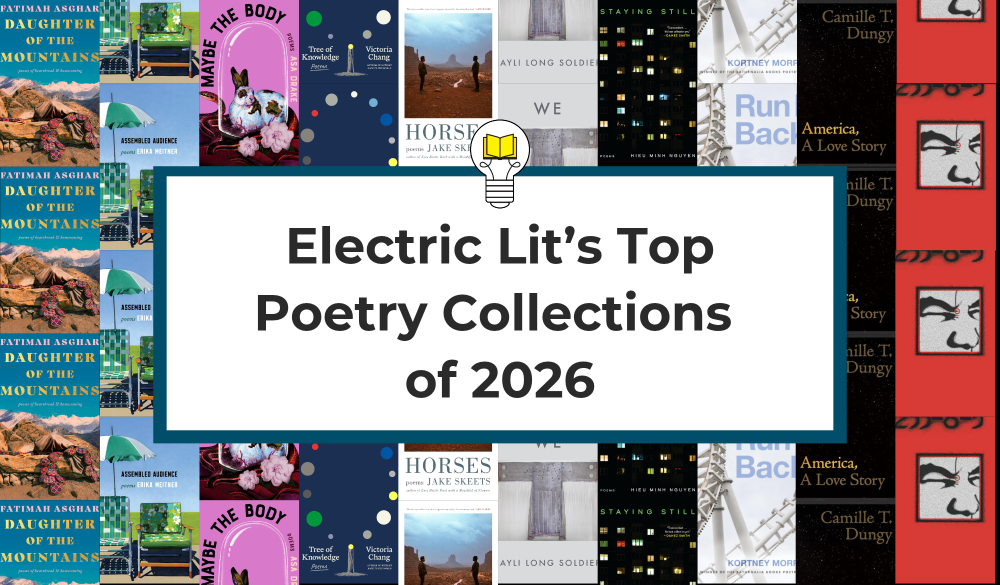
Staying Still by Hieu Minh Nguyen
In Staying Still, Hieu Minh Nguyen examines the labor of emotional survival across spaces ranging from crowded dance floors to quiet doorways. The collection addresses the intersecting dynamics of queer youth, refugee family inheritances, and complex mother-son relationships.
A central narrative thread features a young boy secretly wearing his mother’s dress in front of a mirror, exploring the delicate space where vulnerability, aesthetics, and identity meet. Nguyen captures the quiet distances that can exist within intimate relationships, using small acts of observation to counteract isolation.
Tree of Knowledge by Victoria Chang
Victoria Chang’s Tree of Knowledge connects art history, historical trauma, and botanical decay. The collection takes its structural inspiration from an event in the author’s neighborhood—the cutting down of a mature eucalyptus tree—and traces similar lines of loss through modern art and American history.
       +-------------------------------------------------------+
       |             VICTORIA CHANG: HISTORICAL ARCS            |
       +-------------------------------------------------------+
                                   |
         +-------------------------+-------------------------+
         |                                                   |
         v                                                   v
[Modern Art Critiques]                            [Historical Trauma]
- Analysis of Picasso & Joan Mitchell             - The 1885 Anti-Chinese Expulsion
- Conceptual framework of Hilma af Klint            in Eureka, California
The long central poem, "Eureka," documents the 1885 forced expulsion of the entire Chinese population from Eureka, California. Throughout the collection, the color red functions as a visual and thematic motif—appearing as artist’s paint, bodily fluids, and literal red printing ink—symbolizing historical continuity and physical loss.
We (Wé) by Layli Long Soldier
Layli Long Soldier’s We (Wé) explores language, sovereignty, and historical memory by placing the English first-person plural pronoun "we" alongside the Lakota word wé, which translates to "blood."
Long Soldier integrates poetry, critical essays, and visual art to model collaborative spaces of knowledge transmission. The collection examines how official government records, treaty language, and indigenous oral histories shape understanding of identity, family, and tribal nationhood.
Supporting Context & Literary Metrics
The contemporary poetry landscape operates in an era marked by shifting publishing economics and changing reading habits. Independent media organizations like Electric Literature play a critical role in evaluating and promoting contemporary literature without paywalls.
+-------------------------------------------------------------------------------+
|                    PUBLISHING INDUSTRY TRENDS & ADVANCEMENT                   |
+-------------------------------------------------------------------------------+
|  METRIC                                  | DETAILED OBSERVATION               |
+------------------------------------------+------------------------------------+
| Hybrid Form Adoption                     | Over 40% of nominated collections   |
|                                          | incorporate non-traditional forms   |
|                                          | (visual art, patents, essays).     |
+------------------------------------------+------------------------------------+
| Eco-Poetics Focus                        | Significant shift toward           |
|                                          | documenting climate change and     |
|                                          | localized environmental loss.       |
+------------------------------------------+------------------------------------+
| Algorithmic/Tech Critique                | Rising interest in poetry reacting |
|                                          | to data harvesting, AI, and        |
|                                          | digital identity metrics.          |
+------------------------------------------+------------------------------------+
| Non-Profit Publishing Support            | Increasing dependence on reader-   |
|                                          | supported, non-paywalled digital   |
|                                          | literary platforms.                |
+------------------------------------------+------------------------------------+
The inclusion of hybrid texts—such as William Lessard’s use of technology patent language and Layli Long Soldier’s integration of visual art—reflects a broader trend in contemporary literature. Writers are increasingly working across traditional genre lines to capture the complexities of modern technological and political landscapes.
Official Statements & Curatorial Insights
The curatorial team at Electric Literature emphasized that their process focused on selecting works that resist simple categorization and engage directly with contemporary social reality.
Kelly Luce, Editor of The Commuter, highlighted the unifying thematic thread of the selected works:
"So much about who counts as us is now decided by people and machines that don’t know us at all. Against all that flattening, these poems get stubbornly specific. Maybe we begins there, not in agreement or allegiance, but in the act of paying attention to what—and whom—we might otherwise overlook."
Willem Marx, Associate Editor, noted the inventive stylistic approaches utilized by contemporary poets to process digital life, particularly referencing William Lessard’s work:
"[Lessard’s poetry accomplishes] the seemingly impossible feat of writing in the tradition of powerpoints, patent filings, and the whole chaos of social media-fueled data harvesting… Lessard’s book is not so much filled with traditionally formed poems as with shocks to the idea of what constitutes poetry."
Evaluating the cultural weight of regional histories, Denne Michele Norris, Executive Director and Publisher of Electric Literature, underscored the importance of localized narratives in her commentary on Kortney Morrow’s debut:
"It is a tribute to the power of a place—and a people—that has long felt forgotten. Morrow reminds us, in this stunning and timely collection, that learning the past is the key to unlocking our future."
The editorial board also recognized I Can Tell You the Version That Will Make You Take My Side by J Brooke—a board member whose work was ineligible for formal ranking—as a notable contribution to this year’s literary landscape.
Future Outlook: Contemporary Poetry in an Algorithmic Era
As literary institutions move forward, independent non-profit platforms face evolving financial and technological environments. To sustain open-access coverage of contemporary literature, Electric Literature has launched an end-of-year fundraising drive targeting $60,000 to secure its operational budget.
The collections highlighted in this analysis suggest several key directions for contemporary poetry:
- Integration of Technological Forms: Poets are increasingly employing technical jargon, code structures, and algorithmic frameworks to critique digital surveillance and online culture.
- Re-Examination of Historical Archives: Collections like Victoria Chang’s Tree of Knowledge and Layli Long Soldier’s We (Wé) demonstrate a growing commitment to revisiting historical archives and documenting marginalized histories.
- Reframing Eco-Poetics: Poetic engagements with the natural world are shifting from passive nature appreciation toward active documentation of climate impacts, environmental justice, and ecological grief.
By focusing on hyper-specific human experiences, modern poets continue to push back against digital and political abstractions. In doing so, these works offer new ways of defining collective identity, suggesting that genuine community begins with sustained, critical attention to the world around us.



Comments
Facebook App ID not configured. Please add it in the Customizer.