
Executive Overview
For centuries, the traditional architecture of philosophical inquiry has been defined by ivory towers, austere university lecture halls, peer-reviewed journals, and hushed academic symposia. But in the heart of Cambridge, Massachusetts, a quiet cultural shift is underway—one fueled by the clink of glassware, the murmur of lively conversation, and the comforting hum of a neighborhood gathering space.
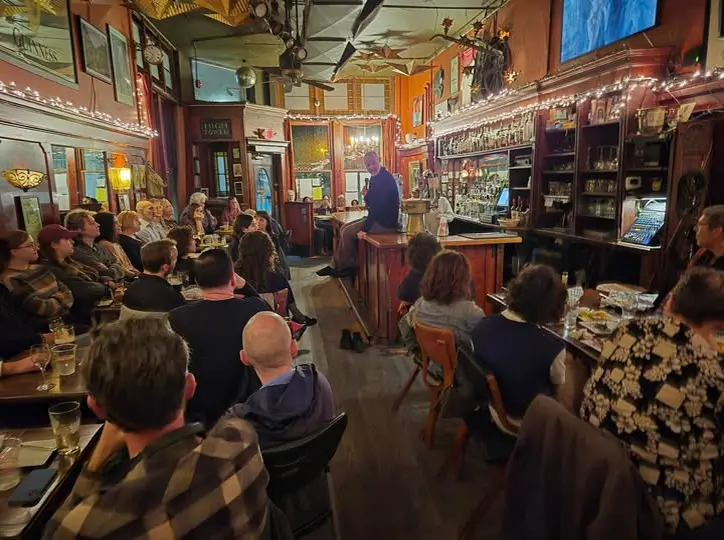
The Plough and Stars, a beloved local institution situated in Cambridge, has recently introduced a series of public events known simply as “Philosophy Nights.” Far from being an eccentric niche offering, these gatherings have transformed into an overwhelming public sensation. The concept is disarmingly straightforward: combine classic pub culture—food, drink, and community—with rigorous, accessible academic philosophy.
Last month, patrons packed the venue to capacity for an engaging, deeply intellectual talk by renowned Massachusetts Institute of Technology (MIT) professor Agustín Rayo, who unpacked complex questions surrounding mathematics and the nature of certainty. The event proved that deep thought does not require a dry academic theater to thrive; it can flourish just as easily over a pint of stout and a plate of pub fare.
Read Also
The momentum shows no signs of slowing down. Later this month, Wellesley College philosopher Helena de Bres is scheduled to take the floor to tackle one of humanity’s most enduring existential dilemmas: "What is meaning in life?" The response has been staggering, with reports indicating that approximately 120 eager would-be attendees are currently languishing on a sprawling waitlist just to secure a seat.
While the Greater Boston area boasts an exceptionally high density of academic minds and intellectual seekers, the phenomenon points to a broader, global hunger for community-based public philosophy. Across the globe, similar culinary and social establishments are discovering that modern patrons are hungry for more than just physical nourishment—they are yearning for intellectual stimulation.
This report investigates the explosive rise of the Plough and Stars’ philosophy series, examines the broader movement of public philosophy in local watering holes, and calls upon global observers to share how public philosophy is taking shape in their own neighborhoods.
Detailed Chronology
The Genesis of an Intellectual Pub Culture
The story of the Plough and Stars’ philosophy nights did not happen overnight. Rooted in the rich cultural tapestry of Cambridge—a city globally synonymous with higher education and intellectual exploration—the pub has long served as a casual meeting ground for students, professors, local residents, and wandering thinkers. However, bridging the gap between elite institutional academia and the casual tavern patron required intentional curation.
The initiative began as an experiment: could complex philosophical concepts be stripped of their dense jargon and presented in a format that resonates with an audience enjoying a Friday night out? The answer was a resounding yes. The organizers recognized that while universities offer structured learning, they often erect psychological and physical walls between the academic elite and the general public. By removing these barriers and embedding the lecture within a familiar, unpretentious pub environment, the organizers tapped into a deep, latent demand for accessible discourse.
The Inaugural Success: Agustín Rayo on Math and Certainty
The turning point for the series arrived last month when MIT philosopher Agustín Rayo stepped up to lead the inaugural major session. Known for his work in philosophy of language, metaphysics, and philosophy of mathematics, Rayo faced the challenge of translating abstract theoretical frameworks into a digestible evening discussion.
The event surpassed all expectations. Patrons piled into the Plough and Stars well before the talk began, transforming the venue from a standard dining establishment into a vibrant salon reminiscent of 18th-century European coffeehouses. Rayo’s lecture—focusing on the concepts of mathematics and certainty—sparked animated debates across tables. Attendees who might never set foot in an MIT lecture hall found themselves passionately discussing the foundations of mathematical truth while sharing appetizers and drinks. The evening established a high watermark for the series, proving that the public is not intimidated by rigorous thought when it is delivered with passion and accessibility.
The Phenomenal Demand: Helena de Bres and the 120-Person Waitlist
Building upon the success of the inaugural night, the organizers immediately planned their next major installment, featuring Wellesley College philosopher Helena de Bres. Set to speak on the timeless and deeply personal question, "What is meaning in life?", de Bres’s upcoming appearance has generated unprecedented levels of local interest.
According to organizers, the event hit maximum venue capacity almost instantaneously. As word spread through word-of-mouth, social media, and academic networks, the demand skyrocketed. Currently, an astonishing 120 people are trapped on the waitlist, hoping for a last-minute cancellation to secure entry. This bottleneck highlights a clear market inefficiency: public philosophical events are severely undersupplied relative to the immense public appetite for them.
Supporting Context & Metrics
The Greater Boston Intellectual Ecosystem
To understand why the Plough and Stars philosophy nights have achieved such explosive success, one must examine the unique demographic and cultural landscape of the Greater Boston area. Home to world-class institutions such as Harvard University, MIT, Tufts, Boston University, and Wellesley College, the region is saturated with academic talent.
However, this high concentration of intellectuals often exists in a bubble, separated from the broader working community. Programs like the philosophy nights act as a vital osmotic membrane, allowing ideas trapped within campus walls to spill out into the wider community. While Boston-area residents may be uniquely primed for this type of programming due to proximity, the hunger for shared, meaningful conversation is by no means geographically exclusive.
Quantifying the Public Philosophy Boom
While exact global metrics for "pub philosophy" are difficult to track uniformly, qualitative indicators point to a massive resurgence in public philosophy movements worldwide:
- Capacity and Attendance: Venues hosting public philosophy events regularly report over-subscription, with waitlists frequently exceeding double the maximum physical capacity of the host rooms.
- Demographic Diversity: Unlike university seminars dominated by undergraduate and graduate degree-seekers, pub philosophy nights attract a remarkably broad demographic cross-section—spanning blue-collar workers, tech professionals, retirees, artists, and academics alike.
- Economic Impact for Hospitality Venues: Participating pubs and restaurants report significant boosts in food and beverage sales during these events, demonstrating that intellectual programming can be a viable, profitable business model for the hospitality industry.
Official Statements & Expert Perspectives
The intersection of philosophy and public life has long been championed by contemporary scholars who argue that philosophy loses its vitality when confined strictly to academic journals.
"Philosophy was never meant to be locked away in university vaults. When we bring these questions out into the open air—or into the warm, buzzing environment of a neighborhood pub—we are returning philosophy to its ancient roots as a communal, lived practice."
While formal statements from participating speakers emphasize the therapeutic and connective power of shared inquiry, the real testimony comes from the attendees themselves. Patrons frequently remark on the unique psychological safety of the pub environment. Free from the grading pressures of a classroom or the professional anxieties of a conference, participants feel liberated to ask "naive" questions, challenge foundational assumptions, and engage in genuine, open-ended dialogue.
Furthermore, participating academics have noted that public lectures radically sharpen their own communicative skills. Explaining the complexities of mathematical certainty or existential meaning to an audience holding a pint requires shedding academic armor, forcing scholars to distill their life’s work down to its most resonant, human components.
Future Outlook: A Global Movement in the Making
The resounding triumph of the Plough and Stars’ philosophy series raises an exciting question for the future of public discourse: Where else is this happening, and how can the model be scaled?
While Cambridge serves as a shining example, there are numerous dining establishments, cafes, taverns, and restaurants scattered across the globe where intrepid thinkers gather to debate ethics, metaphysics, epistemology, and the human condition. However, comprehensive data on these global pockets of public philosophy remains scarce.
Call to Action: Mapping Public Philosophy
To better understand this burgeoning cultural phenomenon, we turn our gaze outward. We want to hear from you—our readers, thinkers, and local patrons.
- Are you aware of public philosophy initiatives operating in the bars, pubs, cafes, and restaurants in your neck of the woods?
- What do these gatherings look like, who leads them, and what kinds of topics draw the crowds?
- How are these community spaces managing the delicate balance between lively tavern socialization and deep intellectual engagement?
As modern society grows increasingly fragmented by digital screens and polarized discourse, physical spaces that foster thoughtful, civil, and intellectually stimulating face-to-face conversation are more precious than ever. The Plough and Stars has demonstrated that people are desperately seeking spaces not just to drink, but to think—together.
Tell us about the public philosophy happening in your community in the comments below, and help us map the global renaissance of the neighborhood philosophical salon.





Comments
Facebook App ID not configured. Please add it in the Customizer.