
Executive Overview
The peer review system—the foundational bedrock of academic validation and scholarly trust—is facing an unprecedented identity crisis. For centuries, the gold standard of scientific and humanistic research relied on a fundamental social contract: human experts, driven by domain knowledge and intellectual rigor, would evaluate the work of their peers, offering constructive critique and safeguarding the integrity of the published literature. Today, that contract is rapidly fracturing.
As generative artificial intelligence tools become more sophisticated, accessible, and integrated into daily workflows, academic publishers find themselves deeply divided over a contentious question: Should peer reviewers be allowed to use AI when evaluating manuscripts?
The answers emerging across the academic publishing landscape are as varied as they are consequential. Publishing giants like Springer Nature and Wiley are cautiously opening the door to AI utilization, implementing risk-assessment frameworks and urging "responsible" disclosure. Conversely, institutions like the University of Chicago Press and specialized publications like the philosophy journal Ergo are drawing a hard line, strictly forbidding any use of generative tools to protect author intellectual property and ensure human-centric evaluations. Meanwhile, a vast silent majority of academic journals maintain complete policy vacuums, leaving authors in the dark about whether the critique shaping their academic futures came from a seasoned professor or a large language model.
Read Also
This article provides an in-depth investigation into the shifting policies of major academic publishers, the severe confidentiality risks associated with uploading unpublished manuscripts to AI platforms, the enforcement challenges plaguing editorial boards, and the systemic questions facing a scholarly community hurtling toward a future where machine-generated text may be indistinguishable from human thought.
Detailed Chronology: The Rapid Evolution of AI Policies in Publishing
To understand how the academic publishing industry arrived at its current fragmented state, it is necessary to trace the timeline of artificial intelligence integration from a novelty into an existential governance challenge.
Phase 1: The Emergence of Generative AI (Late 2022 – 2023)
When consumer-facing generative AI tools first captured global attention, the immediate panic across academia centered on authorship. Universities and publishers scrambled to issue guidelines on whether researchers could use tools like ChatGPT to write manuscripts, generate data, or assist with literature reviews. During this initial wave, the primary focus was on stopping "AI-generated papers" and fraudulent submissions. The question of what referees were doing behind closed doors during the peer review process was largely overlooked or assumed to be restricted by traditional confidentiality agreements.
Phase 2: The Crackdown on Confidentiality (2024)
As academics began quietly experimenting with AI to summarize long PDFs, polish prose, or brainstorm critiques, publishers realized that sensitive, unpublished manuscripts were being uploaded to third-party servers. This realization triggered the first major wave of defensive policy updates. Publishers emphasized that manuscripts under review are strictly confidential intellectual property. Early edicts made it clear that dumping a paper into an LLM violated data privacy, yet many guidelines remained vague regarding whether AI could be used strictly as an "intellectual sounding board" without inputting the raw text.
Phase 3: The Divergence and Formal Frameworks (2025 – Present)
By 2025 and moving into 2026, the industry split into two distinct philosophies.
- The Pragmatic Adaptation Model: Publishers like Springer Nature and Wiley acknowledged that banning AI entirely was both unenforceable and counterproductive. Instead, they pivoted toward managed integration. Springer Nature introduced an explicit "risk-assessment framework" to guide referees on low-risk versus high-risk AI applications, while Wiley began exploring custom, secure technological solutions that could expand AI capabilities while maintaining confidentiality.
- The Absolute Prohibition Model: In contrast, university presses and niche humanities journals doubled down on human exclusivity. Pressured by concerns over bias, compromised data security, and the erosion of human scholarly dialogue, entities like the University of Chicago Press and Ergo implemented outright bans on AI-assisted report writing.
Supporting Context & Metrics: The Landscape of Publisher Policies
The current policy ecosystem reveals a stark contrast in how different publishing houses view the role of automation in scholarly evaluation.
Springer Nature: Managed Risk and Disclosure
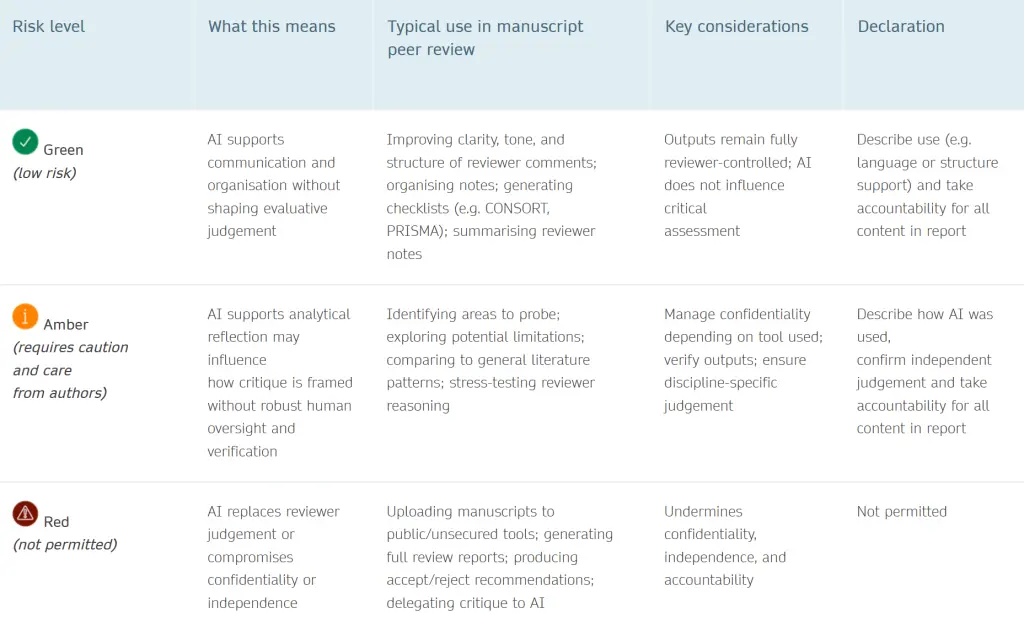
Springer Nature has adopted one of the most prominent stances, encapsulated by their guiding principle: "The key question is not whether AI is used, but how it is used." Rather than pretending referees will not use technological aids, Springer has attempted to regulate the practice through a structured risk-assessment framework. Referees are permitted to leverage AI tools under specific conditions, provided they maintain transparency, ensure data privacy, and retain ultimate responsibility for the intellectual content of their review.
Wiley: Balancing Caution with Innovation
Wiley’s guidelines lean heavily on responsible stewardship, instructing journal referees to: "Use AI responsibly: Apply best practices and properly disclose AI use in manuscripts and peer review." However, Wiley simultaneously recognizes the inherent security paradox: "Manuscripts under review are confidential and must not be uploaded to AI Technologies, whether in full or in part." Recognizing that this restriction clashes with the reality of modern workflows, Wiley has signaled that it is actively developing proprietary technological approaches to expand what referees can do safely without violating confidentiality.
Oxford University Press (OUP): The Expert Judgment Mandate
Oxford University Press maintains a much stricter boundary, anchoring its policy in the sanctity of human expertise. OUP’s guidelines state:
"OUP selects peer reviewers for their expertise in the field and requires them to evaluate content based on their expert judgement alone. It is prohibited to upload project proposals and manuscripts, in part or in whole, into a Gen AI tool for any purpose."
University of Chicago Press: Zero-Tolerance Intellectual Property Protection
Taking an even harder stance, the University of Chicago Press explicitly outlaws the outsourcing of cognitive labor in peer review. Their policy reads:
"In peer review, we require unassisted evaluations and expressly prohibit the use of AI tools in writing readers’ reports. Out of respect for the author’s intellectual property, peer reviewers should not copy any portion of a manuscript or a proposal, nor the reader’s report itself, into an AI tool, even one that promises not to retain data."
Specialized and Independent Journals
The divergence becomes even more pronounced at the granular journal level. For instance, the philosophy journal Ergo enforces a strict zero-tolerance policy:
"We require our referees not to use AI in any form for reviewing of articles. In particular, referees must not enter any article text into AI systems, including AI checking tools such as Pangram. If referees have concerns about the use of AI in submitted articles, they should instead raise these concerns directly with the area editor."
Despite these explicit rules, thousands of independent journals—including some of the most prestigious and selective publications in philosophy, the humanities, and the hard sciences—remain entirely silent on the matter. Their submission portals and reviewer guidelines offer no mention of artificial intelligence, creating a wild-west environment where norms are left to individual discretion.
Official Statements and Policy Breakdown
| Publisher / Organization | Stance on AI in Peer Review | Key Restrictions / Frameworks |
|---|---|---|
| Springer Nature | Permissive (Regulated) | Uses a "risk-assessment framework" for AI use; focuses on how AI is applied rather than banning it outright. |
| Wiley | Conditional / Evolving | Urges responsible use and disclosure, but bans uploading confidential manuscripts to external AI technologies while developing proprietary tools. |
| Oxford University Press | Strict Prohibition on Uploads | Requires evaluations based purely on human expert judgment; strictly prohibits uploading proposals or manuscripts to Gen AI tools. |
| University of Chicago Press | Total Ban | Requires unassisted evaluations; forbids copying manuscript text or reader reports into any AI tool, regardless of data retention policies. |
| Ergo (Journal) | Absolute Ban | Prohibits AI use in any form during review, including plagiarism or AI-checking tools; mandates direct communication with editors. |
| Many Elite Journals | Policy Vacuum | Silent on the issue; lacks explicit guidance or communication regarding referee use of artificial intelligence. |
Future Outlook: The Challenges Ahead
As the academic publishing industry looks toward the horizon, several profound challenges threaten to destabilize the peer review ecosystem. These issues demand immediate attention from editors, publishers, and the academic community at large.
1. The Enforcement Crisis
Even the strictest anti-AI policies suffer from a fatal flaw: enforcement. How can an editorial board realistically prove that a referee used an LLM to polish their critique, summarize a manuscript, or draft the entirety of a reader report? With modern AI models capable of mimicking sophisticated academic writing styles and adopting specialized disciplinary tones, detection mechanisms are notoriously unreliable. When policies rely entirely on the honor system without auditing capabilities, they risk penalizing honest reviewers while rewarding those who covertly automate their labor.
2. Author Recourse and Editorial Finality
What happens when an author receives a glowing or scathing peer review and strongly suspects—or has technical proof—that the report was machine-generated? Currently, most academic journals maintain strict doctrines of editorial finality. For example, the prestigious journal Mind explicitly notes in its general instructions:
"The decision of the Editors on the acceptability of any manuscript is final. The Editors will not enter into correspondence with authors on any submission that is not accepted for publication."
This traditional rigidity leaves authors in an uncomfortable limbo. If a submission is rejected based on a superficial, AI-generated referee report, does the author have any legitimate recourse? Should publishers be forced to establish appeals mechanisms specifically tailored to algorithmic malpractice in human evaluation?
3. The Threat of the Information Loop
As more reviewers utilize AI tools and more authors utilize AI writing assistants, academic publishing risks entering a dystopian feedback loop. If AI-generated manuscripts are evaluated by AI-generated peer reviews, the entire enterprise of scholarly inquiry becomes decoupled from human thought. The unique insights, lateral leaps of intuition, and profound contextual understanding that define human peer review could be replaced by homogenized, algorithmic consensus.
4. Bridging the Policy Gap
The immediate takeaway for the academic community is clear: policy gaps—be they in formal rules or in the transparent communication of those rules—must be fixed immediately. Publishers can no longer afford to remain silent while their review pools experiment with unvetted technologies.
Academic publishers must establish clear, unified standards regarding data confidentiality, acceptable assistive tasks, mandatory disclosures, and transparent appeal processes. As we rush headlong into a future where machine-written text is increasingly indiscernible from human scholarship, the preservation of intellectual rigor depends entirely on our willingness to draw explicit boundaries today.



Comments
Facebook App ID not configured. Please add it in the Customizer.