
Executive Overview
In an era defined by digital fragmentation, algorithmic echo chambers, and the steady retreat of civic life into private digital spaces, an unlikely renaissance is quietly unfolding over pints of stout and plates of pub fare in Cambridge, Massachusetts. The Plough and Stars—a storied, unpretentious neighborhood pub nestled in the heart of academia-adjacent Kendall and Harvard squares—has stumbled upon a cultural lightning rod. It has begun hosting a series of public "philosophy nights," and the events are an unequivocal, runaway hit.
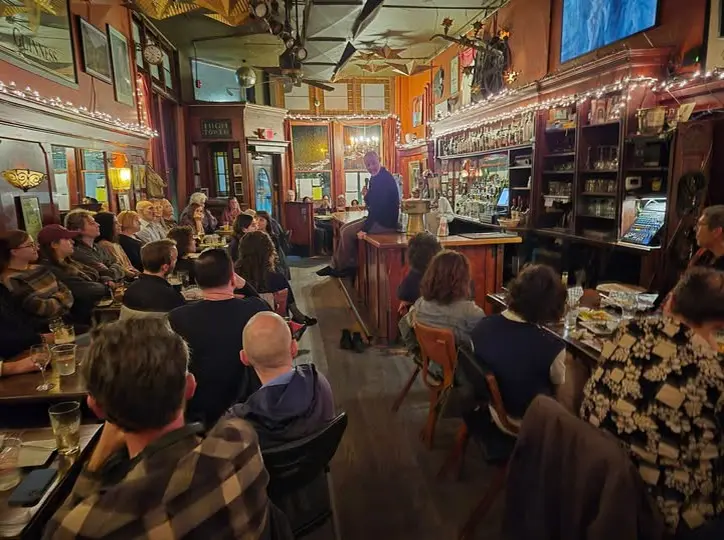
What began as an experimental gathering place for intellectual curiosity has rapidly evolved into a packed-house cultural phenomenon. Last month, patrons piled into the establishment shoulder-to-shoulder, trading the ambient clatter of cutlery and conversation for deep-dive intellectual inquiry. They came not just for food and drink, but to hear Agustín Rayo, Dean of the School of Humanities, Arts, and Social Sciences (SHASS) and professor of philosophy at the Massachusetts Institute of Technology (MIT), deliver a gripping, accessible lecture on the nature of mathematics and certainty.
The momentum shows no signs of slowing. Later this month, the pub is scheduled to host Helena de Bres, a prominent professor of philosophy from neighboring Wellesley College, who will tackle one of humanity’s most perennial inquiries: "What is meaning in life?" The public response has overwhelmed the venue’s capacity; reports indicate that roughly 120 eager participants are currently languishing on the waitlist just for a chance to squeeze into the room.
Read Also
This dazzling convergence of high-brow metaphysics and low-brow tavern comfort raises profound questions about the modern appetite for communal intellectual engagement. While the Boston-Cambridge metropolitan area boasts a uniquely dense concentration of academic institutions, scholars, and intellectually curious laypeople, the phenomenon points to a broader, global hunger for spaces where abstract ideas can be wrestled with in the open air. This article investigates the mechanics of The Plough and Stars’ success, the broader landscape of public philosophy in watering holes around the world, and what this trend reveals about the evolving role of the third place in contemporary society.
Detailed Chronology: From Academic Halls to Barstools
To understand how a neighborhood pub became a crucible for epistemological debate, one must trace the trajectory of how these events materialized, scaled, and captured the public imagination.
The Spark: Fusing Academia with the Public Sphere
For decades, academic philosophy has fought an uphill battle against the perception of being locked inside an ivory tower—impenetrable, hyper-specialized, and sequestered within peer-reviewed journals read only by a handful of tenured specialists. While movements like Café Philo in Europe and various "Philosophy in the Pub" chapters in Australia and the United Kingdom have long attempted to bridge this gap, the American context has often struggled to sustain institutionalized, mainstream public philosophy outside of university lecture halls or formal continuing-education programs.
The Plough and Stars initiative disrupted this paradigm through organic curation. Rather than attempting to dumb down complex philosophical problems, the organizers operated on a counter-intuitive hypothesis: everyday people crave rigorous intellectual stimulation, provided it is delivered in an environment that encourages approachability, warmth, and social lubrication.
The Inaugural Triumph: Rayo on Math and Certainty
Last month’s inaugural flagship event set a high-water mark for the series. Featuring MIT’s Agustín Rayo, the evening tackled an ostensibly dry and forbidding topic: the philosophical foundations of mathematics and the elusive nature of human certainty.
Instead of a dry recitation of proofs or formal logic, Rayo’s presentation leaned into the existential vertigo of math. How is it that mathematical truths seem to hold true across all possible universes, independent of human psychology, yet rely entirely on human minds to conceptualize them?
Patrons seated across worn wooden tables—graduate students rubbing elbows with local retirees, tech workers from nearby startups, and lifelong Cambridge residents—engaged in vibrant back-and-forth dialogue. The traditional hierarchy of the university lecture hall dissolved. There was no podium, no mandatory attendance sheet, and no grade at stake. There was only the shared, egalitarian pursuit of truth, lubricated by the amber glow of draft beer and the shared rhythm of public discourse.
The Looming Squeeze: De Bres and the 120-Person Waitlist
The success of the inaugural night transformed what might have been a one-off cultural experiment into a hot-ticket event. When the pub announced its follow-up session featuring Wellesley College’s Helena de Bres speaking on "What is meaning in life?", the local response overwhelmed logistical capacities.
Within hours of the announcement, seating capacity was maxed out. As of this writing, venue managers report an astonishing backlog of approximately 120 individuals trapped on the waitlist. This bottleneck highlights both the triumphs and the structural limitations of bringing high-level philosophy into small-scale commercial establishments. The intimate charm that makes a pub an ideal venue for discourse also imposes strict fire-code limits on public participation, creating a high-demand, low-supply economic reality for public enlightenment.
Supporting Context & Metrics: The Anatomy of Modern Public Philosophy
While the Boston-Cambridge corridor represents an extreme outlier in terms of intellectual capital—housing dozens of universities and a massive concentration of doctoral researchers—the Plough and Stars phenomenon is part of a larger, decentralized wave of public philosophy initiatives reclaiming commercial spaces.
The "Third Place" Renaissance
Sociologists have long lamented the decline of Ray Oldenburg’s concept of the "third place"—social surroundings separate from the two usual environments of home ("first place") and the workplace ("second place"). Pubs, cafes, and community halls historically served as these vital civic incubators.
However, over the last three decades, economic pressures, the digitalization of leisure, and public health disruptions have severely eroded these physical spaces. The resurgence of pub philosophy represents a counter-offensive. It revitalizes the tavern not merely as a site for liquid consumption, but as a modern-day Greek agora or Enlightenment-era coffeehouse.
Global Comparators: Where Else Do We Do Philosophy?
The phenomenon in Cambridge invites a comparative look at international efforts to bring philosophy out of the faculty lounge and into the public sphere:
- The UK and Australia ("Philosophy in the Pub"): Originating largely in British and Australian cities during the late 1990s and 2000s, these regular meetups rely on self-selecting groups of citizens discussing ethics, politics, and metaphysics over pints. While historically grassroots and occasionally lacking formal academic backing, they have proven remarkably resilient.
- European Cafés Philosophiques: Inspired by the French tradition of intellectual conversation in cafes (tracing lineages back to Jean-Paul Sartre and Simone de Beauvoir at Café de Flore), French public philosophy events often prioritize moderation and structured open dialogue among everyday citizens rather than a top-down lecture format.
- The US Landscape: Beyond Cambridge, pockets of public philosophy thrive in cities like New York, Chicago, and Portland, often organized by non-profits such as "Philosophy in the City" or university outreach initiatives. Yet, capturing the lightning-in-a-bottle cultural cachet of an establishment like The Plough and Stars remains rare.
Official Statements & Academic Perspectives
The intersection of academic rigor and pub culture has generated significant commentary from the scholars involved, highlighting a profound shift in how intellectuals view their responsibilities to the broader public.
Reflecting on the cultural shift, organizers and participating academics emphasize that public philosophy is not a dilution of their discipline, but a return to its historical roots. Philosophy, after all, was born in the open-air marketplaces of Athens through Socrates buttonholing passersby—not in isolated basement archives.
"There is an immense, unexpressed hunger in the community for spaces where deep, difficult questions can be asked without irony or cynicism," notes a local observer close to the Cambridge academic scene. "When you strip away the tuition fees, the grading rubrics, and the intimidation factor of the university gatekeepers, ordinary people prove remarkably eager to grapple with foundational ideas about existence, meaning, and truth."
Scholars participating in the series have similarly remarked on the distinct energy of the tavern crowd. Unlike undergraduate students fulfilling general education requirements, pub audiences consist entirely of volunteers who chose to spend their leisure hours contemplating the nature of certainty or the definition of a meaningful life. The level of active listening, nuanced questioning, and intellectual hospitality found in these rooms frequently rivals—and occasionally surpasses—graduate-level seminar rooms.
Future Outlook: Can the Pint-Sized Academy Scale?
As The Plough and Stars prepares for its upcoming events amid unprecedented local demand, the natural question facing organizers, pub owners, and academics alike is: What comes next?
Scaling Challenges and Opportunities
The immediate challenge is logistical. A pub cannot easily expand its physical footprint to accommodate a surging waitlist of 120 people without sacrificing the cozy, conversational intimacy that makes the format work in the first place. If an event scales up to a larger auditorium or a hotel conference room, it risks losing the very "third place" alchemy that transformed a routine night out into a salon-style experience.
Potential pathways forward include:
- Replication across multiple venues: Rather than packing a single pub to dangerous capacity, organizers might franchise the model across multiple neighborhood bars throughout the Greater Boston area, turning different pubs into specialized hubs for ethics, aesthetics, and political philosophy.
- Hybrid and digital integration: While livestreaming or recording sessions risks breaking the intimate spell of the room, curated audio podcasts or localized community discussion groups spawned from the primary lectures could broaden the impact.
- Deepening institutional partnerships: Universities such as MIT and Wellesley may find new incentives to formalize community outreach grants, funding public-facing intellectual programming as a core pillar of institutional civic engagement.
A Beacon for a Disconnected Age
Ultimately, the triumph of philosophy nights at The Plough and Stars transcends the specific brilliance of any single speaker or the local quirks of the Cambridge intellectual ecosystem. It speaks to a profound, collective yearning for meaning, connection, and slow, deliberate thought in a fast-paced world.
In an era dominated by soundbites, online polarization, and transactional relationships, the image of over a hundred people crammed into a neighborhood pub, quietly captivated by a discourse on mathematical certainty or the meaning of life, offers a powerful counter-narrative. It proves that human curiosity remains unquenched, and that sometimes, the best place to find timeless wisdom is precisely where people have gathered for centuries to share a story, a laugh, and a pint.




Comments
Facebook App ID not configured. Please add it in the Customizer.