
Executive Overview
In an era increasingly dominated by digital fragmentation, algorithmic echo chambers, and the quiet death of the traditional third place, a spirited renaissance of human connection is quietly brewing in the heart of Cambridge, Massachusetts. The Plough and Stars—a storied, unpretentious neighborhood pub renowned for its decades-long embrace of live music, literary gatherings, and spirited conversation—has struck a cultural nerve with its latest offering: "Philosophy Nights."
What began as an experimental divergence from the standard pub trivia and acoustic sets has rapidly evolved into one of the most sought-after tickets in Greater Boston’s intellectual ecosystem. Pairing pints of stout and plates of pub fare with deep ontological inquiries, these events demonstrate a profound, albeit perhaps unsurprising, public hunger for substantive discourse. The phenomenon bridges the gap between the ivory tower and Main Street, proving that complex philosophical inquiry does not require a university lecture hall to thrive.
This report investigates the mechanics, cultural impact, and burgeoning popularity of the Plough and Stars’ philosophical experiment. By examining recent events, upcoming schedules, institutional reactions, and the broader global movement of public philosophy in watering holes, we explore how the ancient art of questioning is finding a vibrant, modern home across the sticky-topped tables of the world’s pubs.
Read Also
Detailed Chronology: From Concept to Cultural Phenomenon
To understand the sudden gravitational pull of the Plough and Stars’ philosophy initiative, one must trace its recent trajectory, marked by packed houses, fervent waiting lists, and an unexpected convergence of town and gown.
The Inaugural Spark: Math, Certainty, and Pints
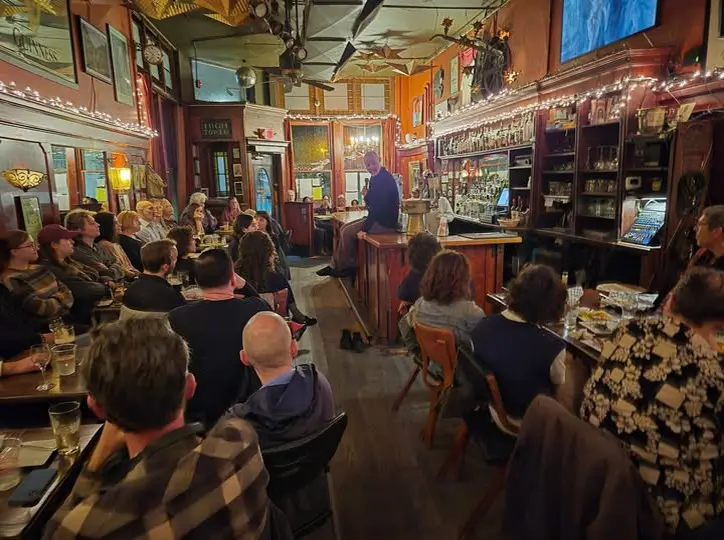
The series kicked off in earnest last month, transforming the cozy confines of the Cambridge institution into a modern-day Lyceum. The inaugural keynote speaker was Agustín Rayo, a prominent philosopher and professor from the neighboring Massachusetts Institute of Technology (MIT). Rayo stepped up to address an audience that had piled into the venue well before opening remarks, seeking not just the comfort of food and drink, but mental stimulation.
Rayo’s lecture tackled the weighty, abstract themes of mathematics and certainty—concepts that might typically induce glazed eyes in a casual social setting. Yet, framed by the warm lighting and ambient murmur of a working pub, the discourse crackled with life. Attendees, ranging from MIT and Harvard graduate students to local blue-collar workers, retirees, and curious tech professionals, engaged in a dynamic Q&A session that blurred the lines between academic rigor and accessible public dialogue. The success of the opening night laid down an immediate marker: this was not a fleeting gimmick, but a resonant cultural offering.
The Waiting List Tsunami: Helena de Bres and the Search for Meaning
Building on the momentum of the inaugural event, organizers wasted no time curating the next installment. Later this month, the pub is scheduled to host Helena de Bres, an esteemed philosopher and writer from nearby Wellesley College. De Bres is slated to deliver a talk addressing arguably the most enduring and universally human question of all: "What is meaning in life?"
If the initial event proved the concept, the response to de Bres’s upcoming appearance has proven its explosive demand. According to organizers, the event generated immediate, overwhelming interest, resulting in an astonishing 120 people currently languishing on the waitlist just to secure a spot within the venue’s modest fire-code capacity. This bottleneck highlights a glaring operational success and a logistical paradox: how does a neighborhood pub accommodate a public thirst for philosophy that vastly outstrips its physical boundaries?
Supporting Context & Metrics: The Boston Intellectual Climate and Global Public Philosophy
The Academic Density Factor
Skeptics might argue that Cambridge, Massachusetts—home to the highest concentration of brainpower per square mile in the Western Hemisphere—is an unfair testing ground for public philosophy. With Harvard and MIT anchoring the local economy, and dozens of other colleges dotting the Charles River basin, the region boasts an unusually high concentration of academic and academic-friendly residents.
However, reducing the success of the Plough and Stars to mere geographic demographic fortune misses a more profound cultural shift. While Bostonians may be pre-disposed to intellectualism, the appetite for philosophy in non-traditional spaces is experiencing an international resurgence. Across the globe, people are actively seeking alternatives to screen-based socialization. The pub offers an egalitarian leveling field: stripped of academic titles, tuition fees, and grading criteria, the philosopher and the plumber sit shoulder-to-shoulder, debating ethics over identical glassware.
The Global Landscape of Public Philosophy in Watering Holes
The Plough and Stars does not operate in a vacuum. It is part of a broader, decentralized movement reconnecting philosophy with its historical roots in public spaces—much like the ancient Greek agoras or Enlightenment-era coffeehouses of London and Paris.
- Café Philo (France): Originating in Paris in the early 1990s, the Café Philosophique movement saw philosophers retreating from university lecture halls to neighborhood cafes, inviting ordinary citizens to debate existential and ethical topics over morning espresso or evening wine.
- Philosophy in Pubs (UK & Australia): Grassroots organizations have spent decades hosting regular sessions in British and Australian pubs, utilizing structured, moderated dialogue to make philosophy accessible to the working class.
- Death Cafes and Stoic Salons: Across North America, specialized meetups in restaurants and bars have cropped up, focusing on niche philosophical lenses to help modern urbanites navigate contemporary anxiety, burnout, and political polarization.
The quantitative metrics driving these spaces—evidenced by packed rooms, burgeoning mailing lists, and viral social media engagement—point to a clear conclusion: modern populations are suffering from a deficit of deep, unhurried conversation, and the neighborhood pub is uniquely positioned to cure it.
Official Statements and Perspectives
The synergy between the academic elite and the local pub culture has generated fascinating commentary from both sides of the intellectual divide.
Agustín Rayo reflected on the unique energy of presenting complex theoretical concepts outside the traditional lecture hall:
"When you stand in a university auditorium, the power dynamic is already established by the architecture. The students are there because they are paying tuition or fulfilling degree requirements. At the Plough and Stars, everyone is there by pure, unadulterated choice. The energy is entirely different—it is raw, curious, and profoundly democratic. People aren’t worried about midterms; they are wrestling with ideas because they genuinely want to understand the world better."
Pub management and local community stakeholders have similarly marveled at the transformation of their evening crowds. While traditional bars often rely on high-decibel sports broadcasts or loud musical acts to drive midweek traffic, the philosophy nights have proven that silence—or at least, the hushed, rapt attention of a crowd hanging on every word of an argument—can be equally profitable.
A spokesperson for the venue noted:
"We’ve always prided ourselves on being a gathering place for stories, music, and debate. Hosting these philosophy nights feels less like a pivot and more like a return to the foundational roots of what a pub is supposed to be: the living room of the community. Seeing a packed house lean in collectively to contemplate the nature of certainty or the meaning of life, pint in hand, reminds us why we do what we do."
Future Outlook: The Next Frontier of Public Discourse
As the Plough and Stars prepares for its upcoming events and looks toward the horizon of 2026 and beyond, the central question is no longer whether philosophy nights can survive, but how they can scale without losing their intimate, conversational soul.
Addressing the Capacity Crunch
With triple-digit waiting lists becoming the norm rather than the exception, organizers face pleasant yet challenging logistical hurdles. Expanding into larger spaces risks diluting the cozy, subversive charm of a pub talk. Conversely, turning away dozens of eager community members contradicts the populist spirit of public philosophy. Potential solutions being discussed include live-streaming sessions to overflow rooms, partnering with neighboring establishments, or increasing the frequency of events from monthly to bi-weekly cadences.
A Call to Action for the Global Community
The phenomenon unfolding at the Plough and Stars serves as a clarion call. The organizers behind this initiative are extending an invitation far beyond the borders of Cambridge, Massachusetts. They are actively seeking to map the broader ecosystem of public philosophy occurring in bars, cafes, and restaurants worldwide.
What is happening in your neck of the woods? Are local watering holes in your city hosting scientific debates, ethical salons, or philosophical pints? The hunger for meaning is universal, but its local manifestations are wonderfully unique.
As the world navigates complex technological revolutions, political shifts, and existential uncertainties, the revival of the tavern as a temple of thought offers a beacon of hope. It reminds us that humanity’s oldest questions—and our collective capacity to ponder them together—are as vital today as they were in the shadow of the Parthenon. All you need is an open mind, a curious neighbor, and a round of drinks.

Comments
Facebook App ID not configured. Please add it in the Customizer.