
Executive Overview
The landscape of short-form speculative fiction experienced a notable stylistic shift in September 2026, characterized by an increased gravitation toward non-traditional narrative frameworks. Rather than relying solely on linear exposition, authors across the science fiction, fantasy, and horror genres experimented with procedural formats, structural lists, instructional guides, and stylistic mimicry such as academic literature reviews.
This editorial overview examines the ten most compelling short stories reviewed during September 2026. Curated from a diverse array of established digital periodicals and emerging literary magazines—including several notable discoveries for contemporary reviewers—these selections highlight how experimental forms can enhance thematic depth. From modern retellings of folklore to deeply personal explorations of queer identity, climate grief, and the systemic policing of narrative expression, these works demonstrate the vitality and evolving sophistication of contemporary speculative short fiction.
Detailed Chronology of Selected Works
1. "Bahiyyah and the Brass Lamp" by Rozalija Grace
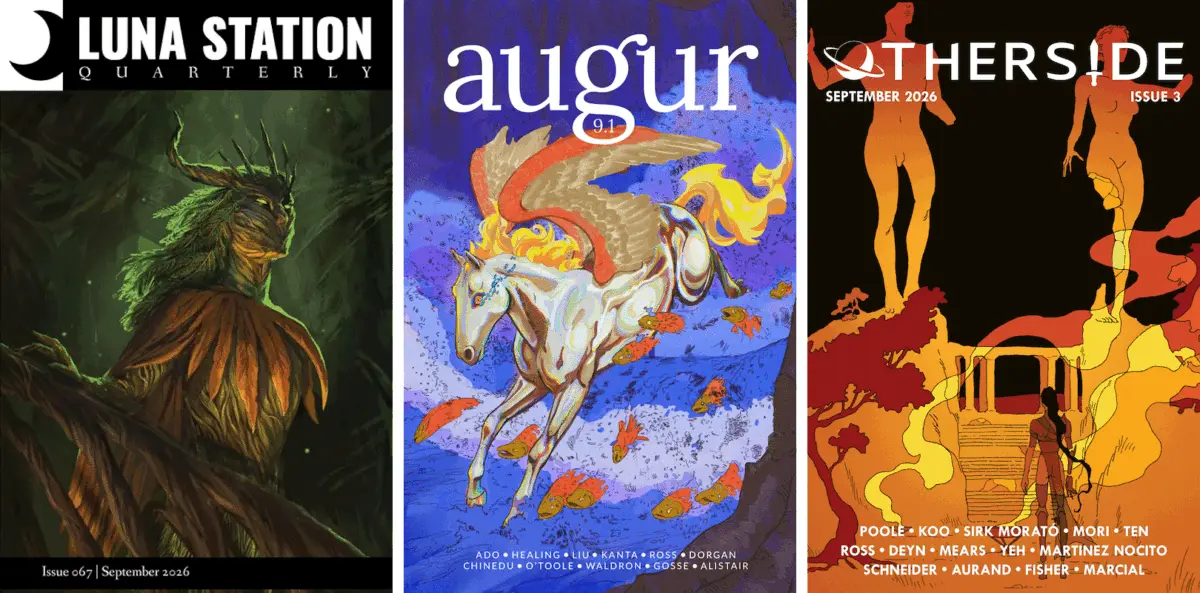
- Publication: Luna Station Quarterly (Issue 67, September 2026)
- Narrative Structure: Folkloric narrative
Evoking the timeless cadence of traditional oral literature, Rozalija Grace’s "Bahiyyah and the Brass Lamp" centers on Bahiyyah, the intellectually voracious daughter of a wealthy physician who spends her life accumulating global knowledge. Returning home for the winter, she dedicates herself to completing her magnum opus: a comprehensive biography of the warrior queen Šamī.
Read Also
When her household lamp fails, she acquires an antique replacement from a local bazaar, inadvertently unleashing Shaulah, a jinniyya trapped within the vessel in the guise of a scorpion. Grace crafts a complex, emotionally resonant romance that avoids easy resolutions, balancing classical mythic resonance with rich character development.
2. "Boys of Teeth, Men of Slime" by Benjamin Larned
- Publication: Salon Sinister (Issue 2, June 2026; reviewed September 2026)
- Narrative Structure: Psychological horror narrative
Published in Salon Sinister—a journal dedicated to documenting the 2SLGBTQIA+ experience through the lens of horror—Benjamin Larned’s story serves as a visceral exploration of queer desperation and vulnerability. The narrative follows Tyrell, a high school student drawn into a feral pack of youths roaming the nocturnal streets of Los Angeles.
During an excursion to the Griffith Observatory, the group encounters predatory men. Larned investigates the acute psychological tension familiar to many marginalized individuals: the perilous impulse to seek community within dangerous environments, while simultaneously interrogating the destructive mechanics of toxic masculinity and the patriarchy from the unique perspective of a queer adolescent.
3. "Children of Calliope" by Seanan McGuire
- Publication: Uncanny Magazine (Issue 72, September/October 2026)
- Narrative Structure: Speculative essay format
Seanan McGuire employs a deceptive essayistic format in "Children of Calliope," initially reading as contemporary nonfiction before revealing its true near-future speculative setting. The text chronicles a societal collapse catalyzed by the unchecked proliferation of systemic book bans.
McGuire’s core argument cuts to the essence of censorship: the targeted material is rarely objectionable for its own sake, but rather for the independent ideas and alternative perspectives it affords readers. Furthermore, the narrative offers a scathing critique of well-meaning political moderates who inadvertently accelerate systemic oppression by mirroring the authoritarian tactics of ideological extremists rather than mounting principled resistance.
4. "Growing Life" by Annie ZH Sun
- Publication: PseudoPod (Episode 1047, September 11, 2026)
- Narrative Structure: Psychological body horror
Blending domestic tragedy with visceral body horror, Annie ZH Sun’s "Growing Life" introduces Lucy, a nine-year-old girl confronting surreal fractures appearing across her physical environment—the concrete pavement, her dinnerware, and the stone marker of her mother’s grave.
As these structural fissures multiply, organic horrors emerge that evoke memories of her deceased mother. The narrative gradually unveils the tragic circumstances of the mother’s death and the complicity of Lucy’s father. Culminating in the manifestation of vengeful entities crawling from the cracks in her world, Sun delivers an unsettling meditation on trauma and unresolved grief.
5. "A Guide on How to Repay Your Vow to the Deity of Many Faces" by Oyedotun Damilola Muees
- Publication: Lightspeed Magazine (Issue 196, September 2026)
- Narrative Structure: Instructional manual format
Presented as a fourteen-step instructional directive, Oyedotun Damilola Muees’s story outlines the precise protocols required to appease a protective household deity. Following the death of his wife, a widower must assume the domestic ritual labors previously managed entirely by her in exchange for their daughter’s ongoing health.
The piece functions as a poignant social commentary on the invisible, uncompensated domestic labor traditionally shouldered by women. Muees illustrates the profound disparity in emotional and domestic investment: the late wife sustained the household effortlessly, while her surviving partner remains entirely ignorant of the labor required until forced to shoulder its weight.
6. "Memoirs of the Spontaneous Combustion Marching Band" by Jamie Lackey
- Publication: Flashpoint SF (Issue 4, August 2026; reviewed September 2026)
- Narrative Structure: Retrospective memoir
"Sometimes you just want to be a part of something. Something bigger than yourself, something that matters." Jamie Lackey’s "Memoirs of the Spontaneous Combustion Marching Band" follows a narrator who insists on joining their school marching band despite parental warnings and the scientifically documented hazard of spontaneous combustion.
Read through a metaphorical lens, the narrative functions as a brilliant allegory for the coming-out process within the queer community. The perceived perils and parental anxieties surrounding open identity mirror the literal combustion risks of the band; the narrative argues that while visibility carries undeniable hazards, the alternative—suppression of authentic identity—is equally destructive.
7. "One Floor, One Phoenix" by Crystal Koo
- Publication: OTHERSIDE (Issue 3, September 2026)
- Narrative Structure: Speculative psychological drama
Set against the industrial backdrop of the Kwun Tong waterfront in Hong Kong, Crystal Koo’s story introduces Wing, a socially isolated young woman struggling with bodily dysphoria and interpersonal insecurity. Within the Horsepaint Chemicals Building, specifically inside Unit 1805, she discovers a device capable of materializing her idealized romantic partners.
When relationships inevitably fracture, Wing simply generates a replacement or resets the dynamic. Koo constructs an uncompromising character study examining emotional recklessness, avoidance, and the psychological collateral damage left by individuals unwilling to engage in genuine self-reflection.
8. "A Rényú-Hunter’s Guide to Playing Go Fish" by Adeline Wong
- Publication: Translunar Travelers Lounge (Issue 15, August 2026; reviewed September 2026)
- Narrative Structure: Instructional field guide
Adeline Wong’s "A Rényú-Hunter’s Guide to Playing Go Fish" adopts the guise of a manual detailing the capture of a rényú, a mythical fish-person derived from Chinese folklore. The protagonist, Jess Yifei, navigates her skiff onto the San Francisco Bay alongside Chloe, a longtime friend and the object of her unspoken romantic affection.
While the text ostensibly focuses on the complex, protracted rules of a specialized card game, Wong subtly interweaves character insights. By the conclusion of the excursion, readers understand the precise motivations driving Jess to hunt mythical marine life and the emotional stakes underlying her vulnerability.
9. "Salt Water in Their Veins" by Sam Baxter
- Publication: The Future Fire (Issue 2026.77, September 2026)
- Narrative Structure: Ecological horror / realist drama
"Sunset is a town on the southernmost coast of New Jersey, and it is sinking into the sea." Sam Baxter centers the narrative on Anna Wright, an elderly resident witnessing the literal and metaphorical erosion of her coastal hometown alongside local myths concerning the Deep Ones.
With her adult daughter having abandoned both Sunset and her familial heritage, Anna assumes the responsibility of educating her granddaughters about their ancestry and an impending, inevitable choice. The story acquires a sharp resonance against contemporary climate crises, illustrating the psychological weight of ecological collapse where speculative fiction mirrors real-world devastation.
10. "To Carry the Future" by Aishatu Ado
- Publication: Augur (Issue 9.1, September 2026)
- Narrative Structure: Academic literature review
Opening with the striking line, "The synthetic surrogate carrying my child arrived in November 2053, her face an algorithm’s best guess at mine," Aishatu Ado structures her narrative as a formal academic literature review evaluating near-future robotic surrogacy technology.
The protagonist—referred to as the Intended Mother—utilizes a surrogate unit styled after her own physical likeness following repeated miscarriages. Ado bridges futuristic biotechnology with Yoruba cosmology, drawing parallels between synthetic surrogate anomalies and traditional abíkú beliefs concerning cyclical infant mortality. The result is an emotionally heavy, conceptually rigorous narrative that hooks the reader from its initial sentence.
Supporting Context & Metrics
The literary trends observed in September 2026 underscore a broader structural evolution within digital speculative fiction publishing. An analysis of the ten featured works reveals distinct quantitative and qualitative patterns across the genre:
- Format Diversification: Approximately 60% of the reviewed titles abandoned traditional linear narratives in favor of alternative formats, including instructional guides (Muees, Wong), mock academic reviews (Ado), and retrospective essays (McGuire).
- Thematic Focus: Issues of bodily autonomy, ecological grief, and systemic marginalization featured prominently in over 70% of the selections, reflecting an ongoing dialogue between speculative world-building and contemporary socio-political realities.
- Independent and Emerging Venues: Publications such as Salon Sinister and OTHERSIDE continue to provide vital platforms for marginalized authors, demonstrating that smaller, niche-focused independent digital magazines are driving formal experimentation within the genre.
Official Statements & Editorial Insights
Reflecting on the curatorial process for September 2026, genre critics and editors have noted a growing appetite for stories that challenge traditional narrative boundaries.
"When contemporary writers utilize structural conceits like field guides, literature reviews, or instructional manuals, they aren’t just playing stylistic games," notes an editorial commentary from the speculative reviewing community. "These formats create an immediate layer of verisimilitude, forcing the reader to engage with emotional truths through an intellectual distance that ultimately makes the emotional impact far more devastating."
Furthermore, publishers of emerging venues emphasized the necessity of centering diverse perspectives within speculative horror and fantasy. The critical reception of works like Benjamin Larned’s "Boys of Teeth, Men of Slime" and Crystal Koo’s "One Floor, One Phoenix" points to an increasing literary demand for morally complex, imperfect protagonists navigating intersectional realities without didactic hand-holding.
Future Outlook
As the speculative fiction market moves toward the final quarter of 2026 and into 2027, several clear trajectories are emerging within the short story ecosystem:
- Continued Structural Hybridization: Authors will likely continue blurring the lines between fiction and non-fiction documentation, utilizing bureaucratic, academic, and procedural texts as stealth vehicles for deeply personal or fantastical narratives.
- Climate Realism Integration: As ecological displacement accelerates globally, speculative fiction is moving away from abstract apocalyptic tropes toward grounded, localized accounts of environmental loss, exemplified by Sam Baxter’s coastal narratives.
- Expansion of Digital Micro-Presses: The financial and operational sustainability of niche digital literary magazines remains a critical engine for risk-taking fiction, ensuring that experimental and marginalized voices continue to find dedicated platforms outside mainstream commercial publishing houses.


Comments
Facebook App ID not configured. Please add it in the Customizer.