
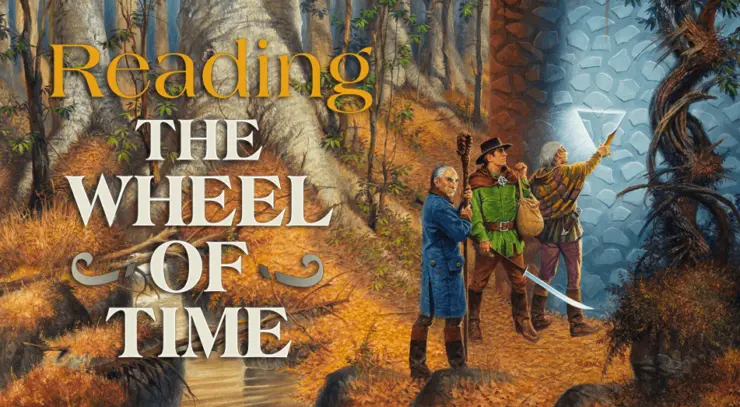
In the latest installment of the literary retrospective series Reading The Wheel of Time, analysts and dedicated readers have turned their critical lens toward a seemingly quiet, action-averse chapter that packs a profound psychological and cultural wallop. Centered primarily on the complex interpersonal dynamics between Perrin Aybara and his wife, Faile ni Bashere t’Aybara, the chapter serves as a masterclass in character development, the burden of leadership, and the grinding friction of disparate cultures colliding under the apocalyptic shadow of Tarmon Gai’don (the Last Battle).
While large-scale military maneuvers and magical cataclysms often dominate Robert Jordan’s epic fantasy tapestry, this specific narrative beat focuses on the micro-level anxieties of two individuals trying to forge a marriage—and a new sociopolitical order—amidst unprecedented geopolitical chaos. The return of the Dragon Reborn has acted as a catalyst, shaking the cultural snow globe of the world and forcing historically insular societies into abrupt, often jarring proximity. Through a meticulous examination of Faile’s administrative evolution, Perrin’s crippling self-doubt and fear of his inner wolf, and their eventual emotional reconciliation, this review unpacks how personal intimacy serves as the ultimate bulwark against existential despair.
Detailed Chronology of Events
The narrative progression of the chapter unfolds through a dual perspective, meticulously tracking Faile’s strategic maneuvering across the camp and Perrin’s brooding isolation on a nearby hilltop before their converging arcs culminate in a pivotal heart-to-heart.
Faile’s Administrative Mastery and Self-Realization
The chapter opens with Faile patrolling the encampment, her mind sharp and laser-focused on her husband’s mounting friction with the Children of the Light (Whitecloaks). Recognizing the suffocating weight of guilt and inner turmoil plaguing Perrin, she formulates a calculated, empathetic intervention strategy.
As she inspects the camp’s logistics, Faile experiences a sudden, wry epiphany: she is actively utilizing every rigorous lesson on estate management and governance instilled by her Saldaean upbringing. Ironically, she has become the very embodiment of the aristocratic responsibility she originally fled. Reflecting on her departure from Saldaea, she admits:
"She hadn’t run because she’d hated the work; indeed, she’d proven adept at everything required of her. So why had she gone? In part for adventure. But in part—she admitted to herself only now—because of all the assumptions. In Saldaea, you always did what was expected of you."
Rather than feeling trapped by these duties, Faile finds a strange sense of liberation; the context has changed, and Perrin makes the execution of these responsibilities worthwhile. Her administrative acumen is immediately put to the test when she investigates the camp quartermaster, swiftly rectifying a corruption scheme involving bribes for preferential supply distribution to select nobles. Crediting her mother for the foundational education that keeps both her and Perrin afloat, she prepares for the evening’s primary objective: confronting her husband.
The Hilltop Summit: Confronting Imposter Syndrome
At dusk, Perrin stands vigil on a designated hilltop, ignorant of Faile’s hidden entourage stationed securely at the base. Observing the deep lines of concern etched onto his face, Faile presses him regarding his anxieties over Gil and his wider circle of followers.
Perrin makes a raw, self-deprecating confession: he firmly believes he is an inadequate leader because he lacks the willingness to sacrifice himself for his followers in the unconditional manner he once offered to the people of the Two Rivers. Faile immediately dismantles this logic, pointing out the inherent unsustainability of such a metric:
"She points out that it would be ridiculous for a leader to give himself up for his people, because then you could unseat every lord and every ruler simply by kidnapping a random subject."
The conversation pivots to Perrin’s persistent desire to abdicate his lordship and retreat into obscurity within the Two Rivers. Faile counters that a vacuum of power cannot simply be wished away; if Perrin abandons his post, the populace will inevitably install a successor—potentially someone dangerously unqualified, such as Lord Luc, or a tyrant seizing unauthorized control.
The Shanna’har Picnic and the Confession of the Wolf
Breaking the heavy tension, Faile introduces a custom native to Saldaea known as shanna’har—a tradition where newlywed couples celebrate surviving their first year together through a month of dedicated gift-giving and shared presence. Discovering no equivalent in the Two Rivers, she took the initiative to curate an outdoor picnic, drawing inspiration from a domestic anecdote shared by Tam al’Thor regarding his own late wife.
Initially reluctant given the looming apocalypse, Perrin is gently persuaded that moments of gratitude are precisely what safeguard humanity during times of crisis. As they share their meal, Faile observes that "there is much of the wolf" in him. This observation unlocks a floodgate, prompting Perrin to confess the harrowing reality of his internal battles:
- The Whitecloak Encampment: He details the animalistic frenzy of combat, the terrifying taste of blood, and the primal fear of losing his humanity, drawing a dark parallel to Noam—a fellow wolfbrother who permanently lost his human mind.
- The Burden of Weakness: Perrin expresses his deep-seated conviction that his profound love for Faile constitutes a fatal weakness in a leader. Faile forcefully rejects this, arguing that every exceptional ruler carries vulnerabilities. She invokes a classic Borderland proverb: "A polished sword reflects the truth. A man can claim to be diligent in his duties, but if his sword isn’t polished, you know that he’s been idle."
- The Loss of Hopper: In a deeply emotional cadence, Perrin finally speaks of Hopper, his guiding mentor in the Wolf Dream, integrating his spiritual grief into the narrative of his trauma.
Reconciliation and Mutual Adaptation
In return, Faile offers a sanitized, carefully edited account of her harrowing imprisonment in Malden. Though Perrin recognizes she is withholding certain grim details, he respects her boundaries, recognizing that secrecy is an immutable component of her complex identity.
The emotional climax of the chapter arrives when Perrin acknowledges his past tendency to charge into situations blindly, while Faile concedes a groundbreaking point: recognizing how uncomfortable Perrin is with loud, aggressive arguments, she consciously chose to adapt to his preferred mode of communication rather than forcing him into the combative Saldaean norm. Through a tender, restorative kiss, the psychological distance forged by the trials of Malden and subsequent command stress evaporates entirely.
Supporting Context & Metrics
To fully appreciate the narrative weight of this chapter, one must examine the broader thematic architecture of Robert Jordan’s universe, particularly regarding cultural integration and the psychological toll of leadership transitions.
Cultural Friction in an Age of Upheaval
The macro-level framing of The Wheel of Time relies heavily on the prophecy that the Dragon Reborn will "break all binding ties," shattering established geopolitical boundaries and forcing a global reckoning. This systemic disruption has triggered unprecedented cross-cultural migrations:
- The Hunt for the Horn: Mobilizing diverse populations from borderland realms to river valleys.
- Refugee Crises & Factions: The displacement of populations fleeing Seanchan expansion, Whitecloak purges, and Shaido aggression.
- Ideological Clashes: The stark contrast between Two Rivers egalitarian pragmatism, Saldaean martial aristocracy, and Aiel martial honor codes.
| Cultural Group | Core Societal Norm | Primary Conflict Point with Outsiders |
|---|---|---|
| Two Rivers | Consensus, communal duty, quiet stoicism | Discomfort with formal aristocracy, titles, and aggressive public arguments. |
| Saldaea | Direct confrontation, public passion, rigid martial expectations | Viewed as overly abrasive or domineering by more reserved cultures. |
| Aiel | Ji’e’pahl (honor and obligation), strict communal laws | Refusal to compromise on perceived slights; alien perspective on civilized governance. |
Comparative Leadership Arcs: Rand al’Thor vs. Perrin Aybara
Literary analysts frequently draw parallels between the psychological trajectories of the series’ primary male leads:
- Rand al’Thor (The Shepherd to Messiah): Encounters absolute systemic destruction, struggles with the dehumanizing requirements of salvation, experiences a psychological "Dark Night of the Soul" on Dragonmount, and is ultimately redeemed and grounded through the memory of human emotion, laughter, and love.
- Perrin Aybara (The Blacksmith to Lord): Navigates localized governance, battles severe imposter syndrome, grapples with the duality of his human and wolf nature (analogous to Rand’s handling of Lews Therin’s voice), undergoes trauma via Faile’s captivity, and is similarly salvaged from nihilistic isolation by the reaffirmation of marital devotion.
Official Statements and Critical Commentary
In evaluating the fan community’s reception and the literary mechanics of this sequence, several critical perspectives emerge regarding the evolution of Jordan’s narrative style and Brandon Sanderson’s execution of character arcs during the concluding volumes.
Scholars of the series have noted that while the Perrin-Faile courtship and early marriage arcs frequently polarized the readership due to pacing issues—specifically the protracted misunderstandings surrounding Saldaean gender roles—the underlying thematic conflict remains remarkably robust.
"The conflict between Perrin and Faile is not merely marital filler; it is an anthropological microcosm of what happens when the entire world is violently compressed into a single staging ground for the Last Battle," notes one prominent literary archivist specializing in high fantasy structures.
Furthermore, commentary surrounding Faile’s character growth highlights a deliberate subversion of the "reluctant noble" trope. Rather than being a passive damsel or an unyielding aristocrat, Faile’s journey through captivity in Malden and subsequent integration into the Two Rivers military-political apparatus transforms her into an indispensable co-regent. Her conscious choice to bridge the cultural divide—meeting Perrin at his psychological speed rather than demanding immediate compliance—signals a maturing partnership that elevates the fantasy romance genre beyond simplistic tropes.
Future Outlook
As the retrospective series Reading The Wheel of Time prepares for its next installment, attention shifts immediately toward the ensuing chapters involving Mat Cauthon and the much-anticipated, high-stakes confrontation between Faile and Berelain paish Tandred.
- Chapter 17-18 Trajectory: Mat’s upcoming transitional movements will provide a necessary tonal palate cleanser before plunging back into the volatile political ecosystem surrounding Perrin’s camp.
- The Faile-Berelain Dynamic: Readers remain cautiously optimistic yet intensely curious regarding how the long-simmering rivalry between Faile and the charismatic First of Mayene will resolve, especially given Faile’s newly minted resolve to assert administrative dominance without resorting to uncalculated emotional outbursts.
- The Long-Term Prognosis for the Two Rivers: With Perrin beginning to accept the mantle of leadership—not through forced submission to peer pressure, but through a synthesized understanding of his human and wolf identities—the regional stability of the Two Rivers appears increasingly secure as the drumbeat of Tarmon Gai’don grows deafening.
Ultimately, this chapter stands as a vital reminder that epic fantasy is sustained not merely by the clash of magic and steel, but by the quiet, agonizing, and ultimately triumphant work of human connection.



Comments
Facebook App ID not configured. Please add it in the Customizer.