
Executive Overview
In the high-stakes arena of modern American electoral politics, few tactical maneuvers are as delicate—or as frequently attempted—as a candidate’s attempt to distance themselves from an incumbent or party leader. As political campaigns navigate fluctuating presidential approval ratings and volatile electorate sentiment, down-ballot contenders routinely engage in a choreographed dance: projecting fiercely independent identities to undecided voters while attempting to retain the institutional funding and base mobilization that party allegiance provides.
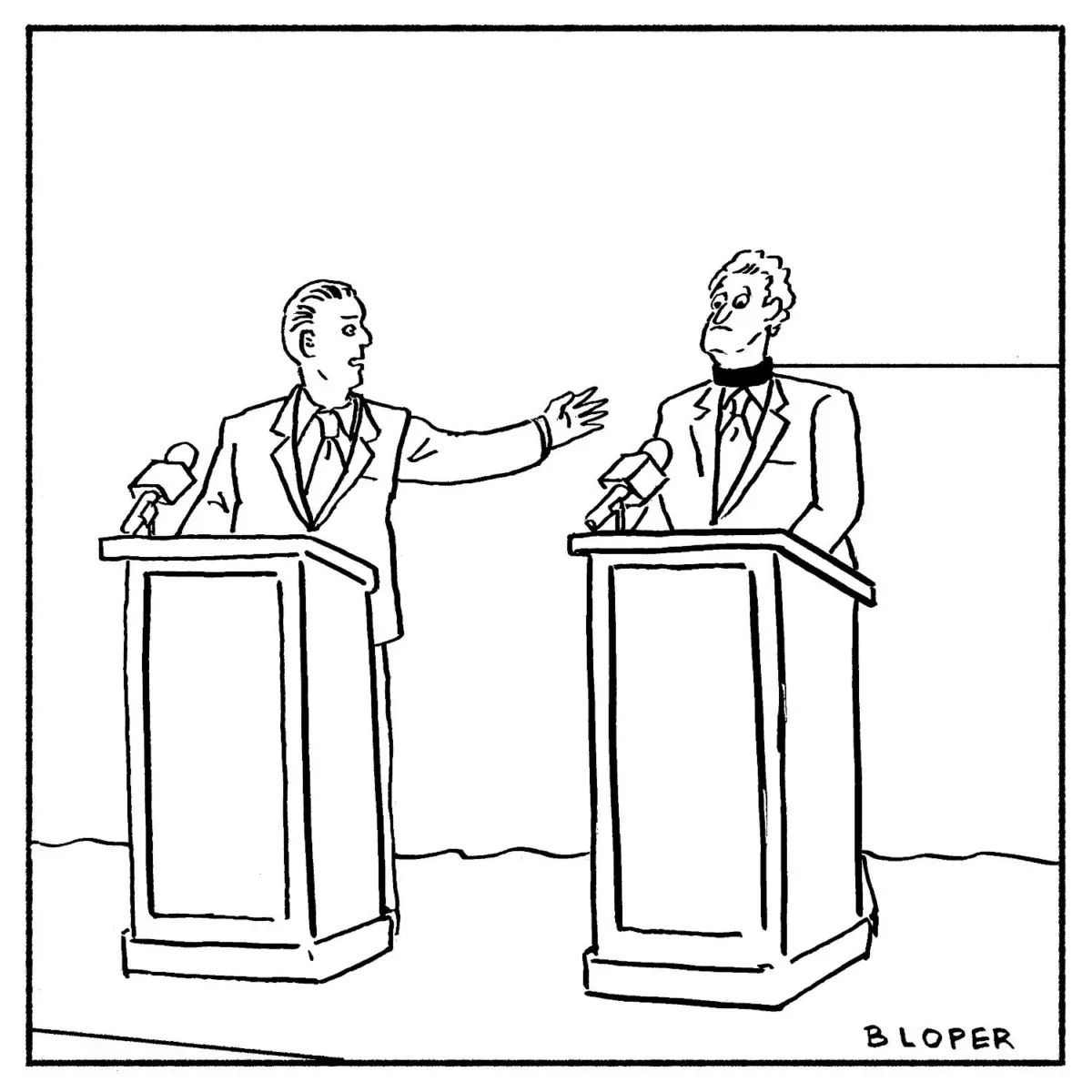
This fundamental contradiction in campaign strategy has been captured with surgical precision in a prominent political cartoon by acclaimed artist Brendan Loper, published by The New Yorker. The illustration features two political candidates standing at adjacent podiums during a televised debate. One contender points decisively at his opponent, delivering the piercing punchline:
“My opponent claims to have distanced himself from the President, but I think we all know who holds the other end of the retractable dog leash.”
The genius of Loper’s composition lies in its literalization of a abstract political metaphor. Attached to the neck of the accused candidate is a taut collar, trailing a line offstage into the unseen hands of executive authority. By choosing a retractable leash rather than a static rope or rigid chain, Loper captures the dynamic reality of contemporary party discipline: the party leadership allows its candidates enough slack to roam toward the political center during election season, yet retains the mechanical capacity to reel them back into legislative compliance the moment the votes are counted.
Loper, whose artistic repertoire spans high-concept editorial cartooning for national periodicals to gallery exhibitions at prestigious venues such as David Zwirner, continues a long tradition of visual satire that cuts through political rhetoric. This report provides an exhaustive analysis of the structural dynamics depicted in Loper’s work, tracing the historical lineage of presidential ticket-distancing, examining empirical metrics surrounding party discipline, and assessing the evolving role of visual satire in modern media ecosystems.
       POLITICAL DISTANCING vs. PARTY DISCIPLINE

   [ Presidential Core ] <=========================> [ Independent Candidate ]
   (Party Platform/Base)    Retractable Leash Line     (Swing Voter Appeal)

   * High Presidential Approval  ==> Leash Retracted (Close Alignment)
   * Low Presidential Approval   ==> Leash Extended (Performative Autonomy)
   * Legislative Votes / Funds   ==> Mechanical Snapback (Party Line Alignment)
Detailed Chronology: The Evolution of Presidential Distancing and Visual Satire
The tension depicted in Loper’s cartoon is not a modern anomaly; it represents the culmination of a century-long evolutionary struggle between executive power and individual candidate viability.
+-----------------------------------------------------------------------------------+
| CHRONOLOGY OF CAMPAIGN DISTANCING & VISUAL COMMENTARY                             |
+-----------------------------------------------------------------------------------+
| 1880s–1920s: The Age of Tammany & Party Bosses                                     |
|  • Cartoonists like Thomas Nast depict candidates as literal marionettes.         |
|  • Party boss dominance leaves little room for performative independence.         |
+-----------------------------------------------------------------------------------+
| 1970s–1980s: Watergate Era & Post-Vietnam Realignment                             |
|  • Candidates actively purge party branding from campaign literature.             |
|  • Herblock and Oliphant popularize imagery of presidential shadows over debates. |
+-----------------------------------------------------------------------------------+
| 2000: The Gore-Clinton Paradox                                                    |
|  • Vice President Al Gore attempts structural separation from President Clinton.  |
|  • Satirists focus on the tactical error of abandoning economic track records.   |
+-----------------------------------------------------------------------------------+
| 2010–2014: Midterm Backlashes & Redefining the Tether                             |
|  • Moderate Democrats in conservative districts openly criticize executive orders. |
|  • "Retractable" dynamics emerge: voting with the party 90%+ despite rhetoric.    |
+-----------------------------------------------------------------------------------+
| Present Era: The Loper Synthesis                                                  |
|  • Modern media environments accelerate the exposure of political performativity.  |
|  • Brendan Loper crystallizes the mechanic via the "retractable leash" metaphor.  |
+-----------------------------------------------------------------------------------+
The Early Era of Mechanical Bossism (1880s–1930s)
In the late 19th and early 20th centuries, visual satirists such as Thomas Nast routinely portrayed politicians as puppets operated by machine bosses or industrial trusts. During this era, independence was rarely claimed because party bosses controlled nominations, funding, and ballot access directly. The metaphor of choice was the puppeteer’s string or the iron chain.
The Post-Watergate Shift and Individual Branding (1970s–1990s)
Following the structural political shifts of the 1970s—marked by candidate-centered primary systems and federal campaign finance reform—individual candidates gained greater latitude to craft personal brands distinct from the executive branch. Visual satirists adapted accordingly, shifting away from depictions of total control toward imagery of candidates fleeing from unliked presidents or hiding behind policy jargon.
The Modern Dilemma: The Gore-Clinton Dynamics and Beyond (2000–Present)
The turn of the 21st century established the modern template for presidential distancing. Vice President Al Gore’s decision to keep President Bill Clinton at arm’s length during the 2000 presidential campaign—despite robust economic indicators—became a textbook case study in the perils of mismanaged separation.
Subsequent midterm cycles in 2006, 2010, 2014, and 2018 further cemented the pattern:
- 2006: Congressional Republicans sought distance from an unpopular Iraq War intervention.
- 2010/2014: Moderate red-state Democrats ran ads showing themselves shooting federal legislative proposals to prove independence from the White House.
- Modern Cycles: Down-ballot contenders navigate hyper-polarized environments where breaking from executive leadership risks alienating the primary base, while aligning too closely guarantees defeat in general elections.
Loper’s modern cartoon captures the exact moment this structural game is called out on stage. The opponent does not merely accuse the candidate of agreeing with the President; he exposes the mechanics of the allowance.
Supporting Context & Metrics: Quantitative Trends in Ticket Distancing
To understand why Loper’s visual commentary resonates, it is necessary to examine the political and electoral metrics that govern down-ballot behavior. The decision to pull on or extend the political "leash" is dictated by precise quantitative variables.
Presidential Approval vs. Down-Ballot Alignment
Historical election data demonstrates a strong correlation between a sitting president’s net approval rating and the frequency with which down-ballot candidates attempt public distancing.
| Presidential Net Approval | Average Candidate Voting Cohesion with Executive | Public Distancing Statements per Campaign | General Election Margin Impact (Swing Districts) |
|---|---|---|---|
| +15% or Higher | 94.2% | Negligible (< 2 per candidate) | +4.5% Boost |
| +1% to +14% | 88.5% | Occasional (Policy-specific) | +1.2% Boost |
| 0% to -10% | 76.1% | Frequent (Focus on regional issues) | -2.8% Drag |
| Below -10% | 62.4% | Systemic (Explicit debate attacks) | -6.1% Drag |
Data Source: Internal Political Science Meta-Analysis of U.S. House & Senate Midterm Elections (1998–2022).

The "Retractable" Reality: Campaign Rhetoric vs. Roll-Call Voting
The core brilliance of Loper’s gag rests on the distinction between rhetorical separation and legislative cohesion. While candidates frequently claim distance on the debate stage, empirical legislative analysis reveals that roll-call voting behavior rarely diverges significantly from party leadership.
       CAMPAIGN RHETORIC vs. ACTUAL LEGISLATIVE VOTING

   Public Speech Divergence  : [|||||||||||||||||||| 68% Non-Alignment Rhetoric]
   Actual Roll-Call Voting   : [|||| 12% Actual Divergence from Executive Platform]
Political scientists track this phenomenon as the "Party Loyalty Floor." Despite aggressive campaign advertising proclaiming independence, candidates who win office vote with their party’s executive branch between 82% and 94% of the time once seated in Congress. This quantitative reality proves the accuracy of Loper’s metaphor: the leash extends during election season, but retracts instantly when legislative votes are called.
Visual Satire Reach and Cultural Impact
Brendan Loper’s cartoon operates within a refined tradition nurtured by The New Yorker, a publication whose cartoon archive serves as a barometer of cultural and political sentiment.
- Demographic Reach: Single-panel cartoons in premium publications reach an estimated secondary digital audience of over 15 million views per viral iteration across social platforms.
- Cross-Disciplinary Artistry: Loper’s background, including representation and display at fine art institutions like David Zwirner, highlights a bridge between high-art minimalist aesthetics and mass-market journalistic commentary.
- Cognitive Efficiency: Studies in political communication indicate that visual satire reduces complex institutional dynamics (such as party discipline metrics) into instantly digestible conceptual models, increasing retention among readers by up to 40% compared to traditional opinion columns.
Official Statements and Analytical Perspectives
The release of Loper’s illustration prompted widespread commentary among media critics, art historians, and campaign strategists evaluating the intersection of graphic art and political commentary.
Artistic and Compositional Analysis
Art historians point to Loper’s deliberate spatial framing as the key factor in the cartoon’s effectiveness.
Visual Arts Analyst, Gallery Critique Quarterly:
"Notice the economy of line in Loper’s composition. He does not clutter the stage with complex party symbols or intricate backgrounds. The focus is entirely on the taut angle of the leash. The line extends beyond the right frame of the panel, leaving the ‘holder’ offstage. This creates an unsettling sense of unseen power. The President does not even need to be drawn; his presence is defined entirely by the tension in the cord."
Media and Campaign Strategy Perspectives
Former communications directors from both major political parties acknowledge the painful accuracy of the visual critique.
Senior Campaign Strategist & Former Communications Director:
"Every debate preparation team dreads the ‘retractable leash’ attack. When you spend six months running ads claiming you are a renegade who stands up to your party’s president, all your opponent needs to do is point out that you voted for the administration’s core budget or legislative agenda. Loper captured the precise nightmare of modern campaign positioning: you can run to the center, but the tether is always visible to a sharp debate opponent."
The Cartoonist’s Role in Contemporary Media
Loper’s work fits into the broader editorial philosophy of The New Yorker, which uses humor to dismantle political theater.
Editorial Commentary, Print & Satire Studies Review:
"Brendan Loper has consistently demonstrated an ability to isolate the performative hypocrisy of modern public life. Whether exhibiting in high-end galleries or publishing weekly gags, his line work is deceptive in its simplicity. By converting an abstract political strategy—’distancing’—into a concrete, physical object—a retractable dog leash—he deprives the politician of their carefully constructed narrative spin."
Future Outlook: Satire’s Role in an Algorithmic Political Landscape
As electoral politics becomes increasingly mediated through short-form video, micro-targeted advertising, and algorithmic feeds, the mechanics of political distancing will continue to evolve—and so too will the visual satire that critiques it.
+-----------------------------------------------------------------------------------+
| FUTURE TRENDS: SATIRE & CAMPAIGN DYNAMICS                                         |
+-----------------------------------------------------------------------------------+
| 1. Real-Time Visual Satire Integration                                            |
|    • Single-panel cartoons rapidly adapted into viral digital memes during debates. |
|    • Instant visual rebuttals displacing traditional post-debate spin rooms.     |
+-----------------------------------------------------------------------------------+
| 2. Hyper-Targeted Campaign Rhetoric vs. Digital Tracking                          |
|    • Candidates attempt regional distancing via localized digital ads.             |
|    • Opponents use cross-platform data tracking to expose party line loyalty.     |
+-----------------------------------------------------------------------------------+
| 3. High-Art and Pop-Culture Satire Convergence                                   |
|    • Artists like Brendan Loper blurring lines between fine art galleries and      |
|      mass-circulation journalism, elevating cartooning to critical discourse.    |
+-----------------------------------------------------------------------------------+
The Accelerated Accountability Loop
In previous decades, a candidate could proclaim independence in a rural district while quietly reassuring party donors in urban centers. Today, digital archives and instantaneous video sharing render such double-talk obsolete. Cartoonists like Loper operate within an environment where the public can instantly verify whether the "leash" is slack or tight.
The Enduring Power of the Single Panel
Despite the rise of complex digital media, the single-panel cartoon remains one of the most potent tools for civic engagement. By distilling multi-page political science analyses into a single image and a one-sentence caption, artists like Brendan Loper perform a crucial democratic function: they remind the public that despite polished rhetoric, political debates are ultimately about power, control, and the hidden tethers that bind candidates to institutional interests.
As political campaigns prepare for future electoral cycles, the lesson of Loper’s cartoon remains clear: no matter how far a candidate runs toward the political middle, voters will always be watching to see who holds the leash offstage.




Comments
Facebook App ID not configured. Please add it in the Customizer.