
Executive Overview
On the evening of Saturday, 24 October 2026, the cultural heart of London’s Southbank Centre pulsed with anticipation. Inside the iconic Queen Elizabeth Hall, poets, publishers, critics, and enthusiasts gathered for one of the most prestigious events on the international literary calendar: the annual Forward Prizes for Poetry ceremony.
Celebrated as a defining barometer of contemporary verse, the 2026 iteration did not disappoint. Hosted by legendary poet and performer Joelle Taylor, alongside chair of judges Sarah Moss and fellow judge Michael Mullen, the evening was a masterclass in emotional resonance. It honoured works that dug deep into personal grief, sociopolitical upheaval, generational trauma, and the quiet, enduring humours of everyday life.
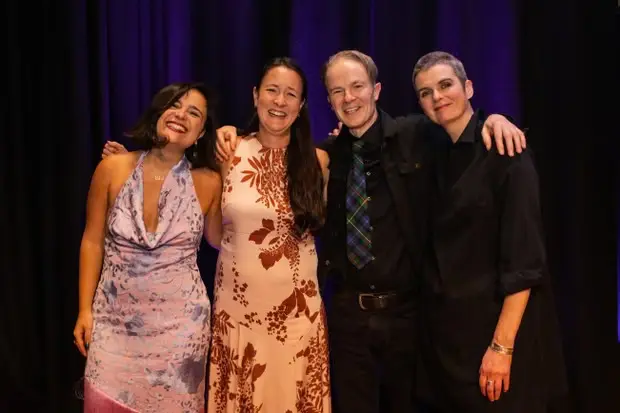
When the dust settled, four distinct voices stood victorious on the stage, arms linked in a broad, celebratory embrace that captured the communal spirit of the contemporary poetry scene. Sarah Howe claimed the evening’s highest honour—the Forward Prize for Best Collection—for her deeply personal and formally exquisite Foretokens. Nur Turkmani captured the Jerwood Prize for Best First Collection with October, a searing exploration of Lebanese history and human resilience. In the single poem categories, Tara Bergin took home the Best Single Poem – Written prize for "The Fear," while Biff Smith clinched the Best Single Poem – Performed category for his philosophical and sharply humorous "Dumbarton East."
Read Also
This comprehensive report examines the winners, the winning texts, the broader literary context of their achievements, and the institutional milestones that made the 2026 Forward Prizes a watershed moment for modern poetry.
Detailed Chronology of the Evening
The atmosphere inside the Queen Elizabeth Hall on 24 October was electric. As audiences settled into their seats, the weight of the evening’s selections hung heavy in the air. The shortlists, announced months prior, had already sparked intense critical debate across literary supplements and digital forums. The 2026 judging panel—comprising novelist and academic Sarah Moss as chair, alongside poet Michael Mullen and a panel of esteemed peers—faced the unenviable task of narrowing down hundreds of submissions into a handful of defining accolades.
The proceedings opened with a rousing address from host Joelle Taylor, whose own dynamic presence set a standard of theatricality and reverence for the spoken and written word. Taylor emphasized the vital role poetry plays in an increasingly fractured geopolitical landscape, framing the art form not as a luxury, but as an essential human survival mechanism.
The Category Breakdowns and Winners
-
The Jerwood Prize for Best First Collection:
The night’s first major award set an emotional and political tone. Nur Turkmani was announced as the winner for her debut collection, October, published by Hajar Press. Spanning multiple turbulent Lebanese Octobers, the collection acts as a lyrical and archival meditation on rupture, systemic transformation, and the fragile, quiet processes of undoing and remaking relationships amidst collective catastrophe. Turkmani’s win was greeted with widespread acclaim, marking the arrival of a major new voice in transnational poetry. -
The Forward Prize for Best Single Poem – Written:
Judges turned next to the short-form written categories. Tara Bergin claimed the prize for her devastatingly prescient poem "The Fear," originally published in The Stinging Fly. Praised by the judges for its cross-generational transmission of anxiety and legacy, "The Fear" was lauded as a rare piece of art that bridges personal memory and universal dread. The panel remarked, “[The poem] transmits across the generations and across experience, and that collective fear we all share about its legacy for those that follow. It’s a simple poem and yet it does so much. It’s not only timely; it’s timeless.” -
The Forward Prize for Best Single Poem – Performed:
Shifting from page to stage, the award for Best Single Poem – Performed went to Biff Smith for "Dumbarton East," released via Loud Poets. Judging performance poetry presents a unique critical challenge: balancing the structural integrity of the text with the dynamic charisma of live delivery. Smith navigated this tightrope brilliantly. The judges noted that the shortlist was filled with phenomenal performances, but Smith ultimately triumphed due to his poem’s “philosophical and subtle” nature, praising the “humour” with which he addressed universally recognizable themes of place, origin, and memory. -
The Forward Prize for Best Collection:
The climax of the evening arrived with the announcement of the Best Collection winner. Sarah Howe claimed the £10,000 prize for Foretokens (published by Chatto & Windus). The win cements Howe’s status as a towering figure in contemporary British letters, more than a decade after her groundbreaking debut.
As the four winners gathered on stage for photographs—smiling broadly, arms around each other’s shoulders—the image encapsulated a night that celebrated poetry not as a solitary pursuit, but as a deeply interconnected human endeavor.
Supporting Context & Metrics: The Weight of Foretokens and the Nominated Works
To truly understand the significance of the 2026 Forward Prizes, one must examine the literary pedigree and thematic landscapes of the winning volumes, particularly Sarah Howe’s Foretokens.
Sarah Howe and the Legacy of Foretokens
Howe’s victory with Foretokens is a historic milestone. Her previous collection, Loop of Jade (2015), made literary history by becoming the first debut collection to win the prestigious T.S. Eliot Prize, alongside winning the Sunday Times Young Writer of the Year Award and being shortlisted for the Forward Prize for Best First Collection.
Where Loop of Jade explored cultural identity, transculturality, and her mother’s migration from Hong Kong to the UK, Foretokens turns its lens inward while maintaining a panoramic historical and emotional sweep. The collection navigates three monumental life-altering experiences:
- The terrain of new parenthood: Capturing the vulnerability, exhaustion, and ontological shock of bringing new life into the world.
- Mourning the death of her father: Processing grief through precise, elegiac language.
- Her mother’s early life in Hong Kong: Continuing her lifelong interrogation of diaspora, colonial history, and matrilineal inheritance.
A striking example of Howe’s method within the collection is her poem "A History of My Relationship with My Mother in Twenty-three Arguments about the Laundry," which was first published in The Poetry Review in Autumn 2023. The poem transforms domestic friction into a profound archive of generational negotiation.
Furthermore, Howe’s creative footprint extends far beyond the printed page. Her collaborative ventures—such as her work with poet Fred D’Aguiar on the TIDE (Travel, Transculturality and Identity in England, 1550–1700) project, producing filmpoems with Oxford University and poetrycinema, and her ekphrastic commissions with the National Portrait Gallery (responding to Pierre Mignard’s 1682 painting Louise de Kéroualle, Duchess of Portsmouth with an unknown girl)—demonstrate her commitment to pushing poetry into dialogue with history, visual art, and digital media.
Nur Turkmani and October
Nur Turkmani’s October represents a vital counterweight to British-centric publishing narratives. Published by Hajar Press, an independent publisher dedicated to amplifying marginalized voices and radical histories, October engages directly with the political trauma of Lebanon. By structuring the collection around multiple historical Octobers marked by uprising, economic collapse, and state violence, Turkmani avoids simplistic political sloganeering. Instead, she maps the micro-physics of survival: how friendships strain under national pressure, how language breaks down when institutions fail, and how love is quietly reconstructed in the rubble of collective catastrophe.
Tara Bergin and Biff Smith: The Power of Short-Form Verse
While collections command large advances and critical essays, the single poem categories at the Forward Prizes highlight the immediate cultural pulse of the art form.
- Tara Bergin’s "The Fear," published in the renowned Irish literary journal The Stinging Fly, uses deceptively simple diction to unpack the psychological transmission of historical trauma. Bergin, known for her uncanny ability to subvert traditional forms, creates a space where personal anxiety mirrors civilizational dread.
- Biff Smith’s "Dumbarton East," championed by Scotland’s Loud Poets, proves that performance poetry can be intellectually rigorous without sacrificing accessibility. By anchoring his philosophical musings in the specific geography of a Scottish railway station, Smith taps into universal themes of transit, belonging, and the ghosts of our younger selves.
Official Statements and Critical Reception
The reaction from the literary establishment was swift and overwhelmingly positive, highlighting the Forward Prizes’ continued commitment to artistic excellence and ideological diversity.
Sarah Moss, chair of the 2026 judging panel, spoke passionately about the deliberative process during the gala:
"Judging the Forward Prizes is an exercise in listening to the ghosts, the living, and the unborn. This year’s shortlists demanded a reckoning with how we inhabit our histories. In Sarah Howe’s collections, we found a technical mastery that leaves the reader breathless, balancing private grief with vast cultural memory. In Nur Turkmani, we discovered an unflinching witness to geopolitical fracture. Tara Bergin and Biff Smith reminded us, respectively, that a single poem can hold centuries of fear or seconds of communal laughter."
The Forward Arts Foundation, the charity behind the prizes, emphasized the record-breaking public engagement seen throughout the 2026 season. With poetry sales continuing to defy broader publishing trends—driven largely by younger readers engaging with verse via digital platforms and live performance nights—the prizes remain a crucial validation engine for the industry.
Publishers also shared in the triumph. Chatto & Windus celebrated Howe’s win as a testament to the enduring power of long-form editorial commitment, while Hajar Press hailed Nur Turkmani’s Jerwood Prize victory as a historic milestone for independent, radical publishing in the UK.
Future Outlook: Whither Contemporary Poetry?
As the lights went down at the Queen Elizabeth Hall and the 2026 Forward Prizes officially passed into literary history, industry observers were left to ponder what these results signal for the future trajectory of poetry.
Several key trends emerged from the 2026 cycle:
- The Maturation of Cross-Cultural Poetics: Winners like Sarah Howe and Nur Turkmani demonstrate that contemporary poetry in the UK is increasingly borderless. Writers are refusing to choose between personal autobiography and geopolitical analysis, instead weaving diasporic heritage directly into the fabric of domestic and lyric verse.
- The Eradication of the Page vs. Stage Divide: By celebrating both deeply archival, text-heavy collections like Foretokens and kinetic performance pieces like Biff Smith’s "Dumbarton East," the Forward Prizes reaffirmed that poetry is a pluralistic medium. The artificial wall separating "academic page poetry" from "live performance poetry" continues to crumble, to the benefit of both artistic camps.
- The Rise of Independent Presses: With Hajar Press claiming the Jerwood Prize, the dominance of major commercial houses is increasingly challenged by agile, mission-driven independent publishers who are willing to take risks on politically urgent and formally daring debuts.
Looking ahead, the 2026 Forward Prize winners will embark on national tours, university residencies, and international festival circuits, bringing their winning works to new audiences. For Sarah Howe, Nur Turkmani, Tara Bergin, and Biff Smith, the recognition at the Southbank Centre is not a culmination, but a springboard—a moment where their distinct, necessary voices were amplified on one of the grandest stages in world literature.
Reported from the Southbank Centre, London.
Sunday, 25 October 2026.


Comments
Facebook App ID not configured. Please add it in the Customizer.