
Executive Overview
In an era defined by fractured digital discourse, algorithmic echo chambers, and a widespread cultural retreat into partisan corners, a traditional neighborhood tavern in Cambridge, Massachusetts, has struck a remarkably resonant chord. The Plough and Stars—a storied local pub long known for its hearty fare, spirited conversation, and neighborhood charm—has unexpectedly transformed into a vibrant epicenter for rigorous intellectual inquiry.
By launching a series of informal yet deeply substantive "philosophy nights," the establishment has tapped into an unquenchable public thirst for deep thought paired with creature comforts. The formula is disarmingly simple: take heavy, abstract academic concepts, strip away the impenetrable jargon of the ivory tower, and serve them alongside pints of stout and plates of pub food.
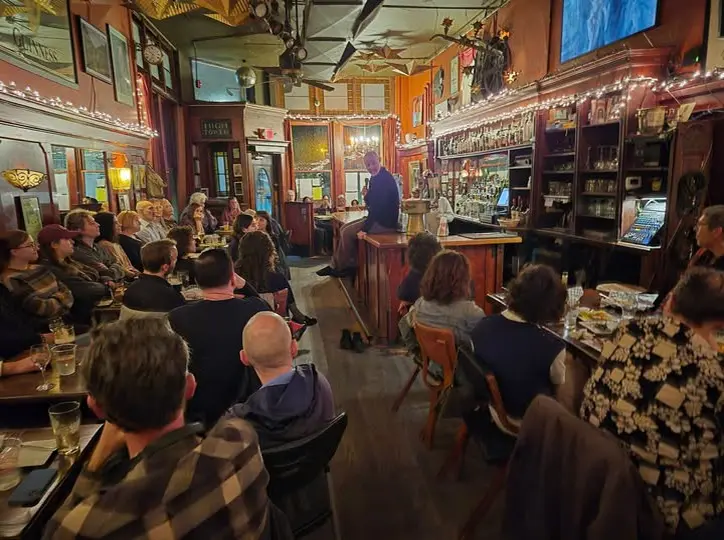
Yet, the results have far exceeded the wildest expectations of both the pub’s organizers and the academic community. When MIT philosopher Agustín Rayo took the floor last month to dissect the intricate nuances of mathematics and human certainty, patrons packed the house to capacity, spilling over tables and straining the venue’s spatial limits. The momentum shows no signs of slowing down. As anticipation builds for Wellesley College professor Helena de Bres’s upcoming keynote on the age-old conundrum—“What is meaning in life?”—organizers report a staggering backlog of approximately 120 eager would-be attendees trapped on the waitlist.
Read Also
This phenomenon is much more than a localized novelty or a clever marketing gimmick for a Wednesday night slow period. It represents a living, breathing revival of the classical tradition of public philosophy—taking rigorous ideas out of sequestered university lecture halls and thrusting them back into the noisy, democratic crucible of the public square (or, in this case, the corner tavern). As universities face increasing financial pressures, skepticism over the value of humanities, and calls for greater community engagement, the unexpected success of the Plough and Stars offers an instructive blueprint. It proves that ordinary citizens are not allergic to complexity; rather, they are profoundly hungry for spaces where they can grapple with profound questions in an atmosphere of shared humanity and convivial debate.
Detailed Chronology: From Concept to Cultural Phenomenon
To understand how a beloved watering hole in the heart of Cambridge became an unlikely salon for epistemological debate, one must trace the deliberate, step-by-step evolution of the initiative. The project did not materialize overnight; rather, it was born out of a post-pandemic yearning for physical spaces that foster genuine, unmediated human connection and intellectual stimulation.
Phase One: Conceived in the Margins of Academia
For years, local academics had searched for viable conduits to bridge the widening chasm between institutional research and public consciousness. While scholarly journals and academic conferences serve vital disciplinary functions, they inherently wall off the general public behind paywalls and dense terminological barriers. The initial conversations between local Boston-area philosophy faculty and hospitality entrepreneurs centered on a radical hypothesis: that adults outside of university settings genuinely miss the intellectual friction and discovery characteristic of undergraduate seminars.
Phase Two: The Inaugural Gathering and the Rayo Lecture
The hypothesis was put to a definitive test last month when the Plough and Stars hosted its maiden voyage into public philosophy. The organizers selected Agustín Rayo, a prominent professor of philosophy at the Massachusetts Institute of Technology (MIT), whose research deeply engages with the philosophy of language, logic, and mathematics.
Rayo’s chosen topic—an exploration of mathematics and certainty—might initially have sounded dry or overly academic to the casual observer. Yet, the reality on the ground defied all expectations. Patrons arrived early to secure optimal seating, ordering meals and drinks as the ambient noise of clinking glasses gradually yielded to rapt silence. Rayo delivered a masterclass in accessibility, transforming abstruse mathematical concepts into intuitive puzzles that engaged both seasoned academics and local patrons who had not set foot in a math classroom in decades. The subsequent Q&A session stretched far beyond its scheduled terminus, characterized by sharp, probing questions from an audience clearly energized by the exercise.
Phase Three: The De Bres Phenomenon and the Waitlist Surge
Buoyed by the undeniable triumph of the inaugural night, organizers immediately began planning the second installment, tapping Helena de Bres, a distinguished philosophy professor from nearby Wellesley College. De Bres, known widely for her sharp wit, literary sensibilities, and profound inquiries into ethics and the human condition, chose a universally magnetic theme: “What is meaning in life?”
The response was immediate and overwhelming. Word of mouth, amplified by local social media channels and academic networks, triggered a tidal wave of interest. Within days of the event being announced, the venue’s reservation capacity was entirely exhausted. As of this writing, the waitlist has bloated to an astonishing 120 individuals clamoring for a sliver of standing room. This bottleneck has created an unexpected logistical challenge for the pub, highlighting a massive imbalance between supply and demand for accessible, high-level public discourse in the greater Boston metropolitan area.
Supporting Context & Metrics: The Demographic and Geographic Landscape
The phenomenon unfolding at the Plough and Stars does not occur in a vacuum. To fully appreciate its significance, one must examine the unique socio-cultural ecosystem of Cambridge and the broader Boston metropolitan area, while also casting a comparative glance at the global landscape of public philosophy.
The Brain Trust: Cambridge’s Unique Demographic Advantage
Skeptics might argue that a philosophy night could only thrive in a hyper-educated enclave like Cambridge—home to Harvard University, MIT, and a densely packed diaspora of researchers, scientists, students, and intellectuals. Indeed, the region boasts one of the highest per-capita concentrations of academic-friendly demographics in the Western world.
+------------------------------------------------------------+
|        Greater Boston Academic & Intellectual Ecosystem    |
+------------------------------------------------------------+
|  [ Harvard University ]       [ Massachusetts Institute ]  |
|         (Cambridge)                (Technology - MIT)      |
+------------------------------------------------------------+
|  [ Wellesley College ]        [ Boston University / Tufts ]|
|   (Suburban Greater Boston)     (Metropolitan Hubs)        |
+------------------------------------------------------------+
This structural reality undeniably lowers the activation energy required to fill a room with people willing to contemplate the nature of certainty or the meaning of existence over a pint of ale. However, to attribute the success entirely to local demographics would be to severely underestimate the universal human appetite for meaning. The hunger for philosophical discussion is not restricted to Ivy League zip codes; rather, Cambridge simply provides fertile soil where a universally viable seed has found optimal conditions to sprout.
Global Parallels: Philosophy in the Pubs
While Cambridge is currently stealing the spotlight, the Plough and Stars is part of a broader, subterranean renaissance of public philosophy operating within the hospitality sector worldwide. From the legendary "Café Philosophique" movement that swept Parisian coffee houses in the 1990s to contemporary iterations like "Pub Philosophy" chapters operating across the United Kingdom, Australia, and the Pacific Northwest of the United States, dining and drinking establishments have long served as natural incubators for counter-cultural thought.
These venues typically share several defining operational metrics:
- Acoustic and Spatial Intimacy: Unlike sterile lecture halls, pubs offer ambient background noise that strips away academic pretension, forcing speakers to maintain conversational volumes and direct engagement.
- Low Barrier to Entry: The absence of cover charges, ticket fees, or dress codes democratizes the space, welcoming everyone from blue-collar workers to tenured professors.
- Economic Symbiosis: Participating dining establishments report significant upturns in food and beverage sales during off-peak nights (such as early-week evenings), proving that intellectual programming can be a sound commercial strategy.
Official Statements & Academic Perspectives
The intersection of rigorous philosophy and casual pub culture has elicited profound reflections from the scholars driving the movement, as well as cultural commentators observing the trend.
Dr. Agustín Rayo reflected on the stark contrast between lecturing inside an MIT auditorium and addressing an engaged crowd over dinner and drinks:
"When you stand at the front of a university lecture hall, there is an inherent hierarchy. The students are there because they are earning credits or satisfying degree requirements. But at the Plough and Stars, everyone in that room chose to be there voluntarily, abandoning their cozy couches on a weeknight simply out of raw curiosity. The energy is entirely different—it is electric, deeply humbling, and infinitely more alive."
Similarly, Dr. Helena de Bres, looking ahead to her upcoming address on the meaning of life, emphasized the therapeutic and communal necessity of philosophy in contemporary society:
"We live in profoundly anxious, highly polarized times. People are desperately searching for frameworks to make sense of their lives, their values, and their communities. Philosophy was never meant to be locked away in scholarly journals; it was born in the public agora, designed to help us navigate the human condition together. Bringing these questions into a pub doesn’t trivialize them—it honors their original, deeply social purpose."
Local patrons have echoed these sentiments with equal enthusiasm. Mark Henderson, a software engineer living in Cambridge who attended Rayo’s lecture, captured the popular mood: "Where else can you debate the foundations of mathematical certainty while eating fish and chips and sipping a Guinness? It cures the isolation of modern life. You realize your neighbors are wrestling with the exact same existential questions you are."
Future Outlook: Scaling the Public Philosophy Movement
As the Plough and Stars navigates its current logistical bottlenecks—most notably figuring out how to accommodate a staggering 120-person waitlist without compromising the intimate, conversational atmosphere of the pub—the broader implications for public philosophy are coming into sharp focus.
1. Expanding the Venue Footprint
Organizers are currently exploring ways to scale the initiative without losing its soul. Discussions are underway regarding potential partnerships with other local establishments throughout the Boston and Somerville areas, effectively creating a decentralized network of intellectual pubs. This expansion could help distribute the overwhelming demand currently bottlenecked at the Plough and Stars.
2. Digital Hybrids and Livestreaming
While the magic of these events lies fundamentally in physical co-presence—the shared air, the clinking glasses, the spontaneous murmur of agreement or dissent—organizers are weighing the implementation of closed-circuit or livestream options for overflow crowds. However, extreme care is being taken to ensure that technological integration does not sterilize the raw, organic feel that made the initial nights so successful.
3. A Blueprint for Nationwide Revival
The ultimate legacy of the Cambridge experiment may well lie in its replicability. In an era where local pubs, independent bookstores, and community gathering spaces are struggling for economic survival against the tides of digital isolation and corporate consolidation, introducing intellectual programming offers a powerful life raft.
By transforming taverns into modern-day salons, communities can simultaneously revitalize local commerce and heal the fraying fabric of public discourse. If the packed houses and overflowing waitlists in Cambridge are any indication, the future of philosophy is not confined to the ivory tower—it is pulling up a stool at the local bar, raising a glass, and asking the questions that matter most.




Comments
Facebook App ID not configured. Please add it in the Customizer.