
Executive Overview
In the high-stakes realm of fine art collecting, the dream of unearthing a lost masterpiece at a garage sale or a provincial estate liquidation is a rare and intoxicating fantasy. Yet, on a quiet summer afternoon in Michigan, that romantic fantasy became a reality for one fortunate art seeker. Tucked away in the dim corner of a heavily picked-over estate sale hallway hung an unassuming, darkly atmospheric still life. Bearing a handwritten price tag of just $30, the canvas appeared to be little more than modest thrift-store decor. However, a closer inspection revealed a nearly overlooked signature in the corner: Abercrombie.
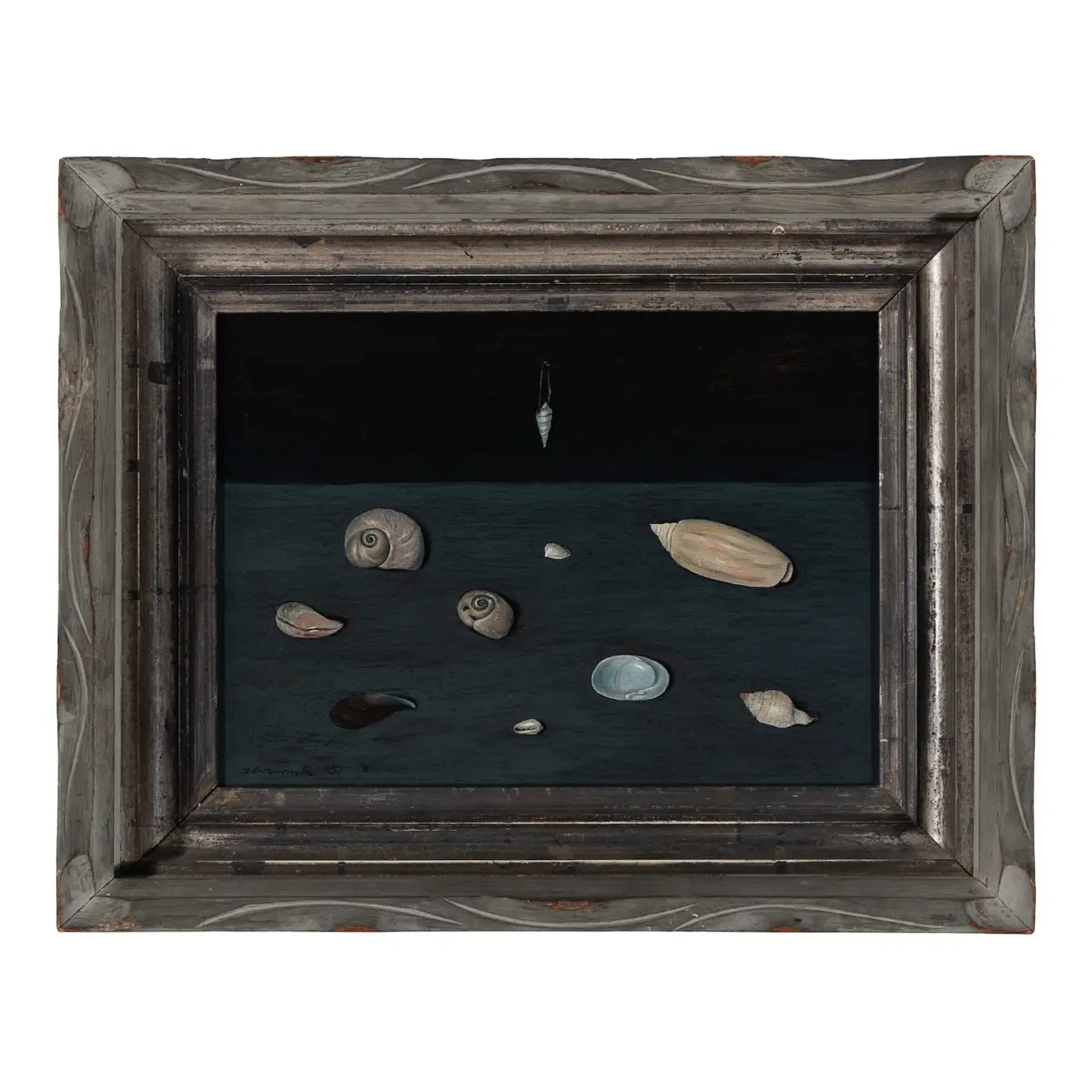
The painting in question was none other than Alderman Merriam’s Shells (1951), a long-lost work by the celebrated, fiercely individualistic Chicago surrealist painter Gertrude Abercrombie. Missing from the public eye for decades, the painting is now poised to transition from a flea-market afterthought to a premier lot at Freeman’s upcoming Post-War and Contemporary Art auction, where it carries a pre-sale estimate of $150,000 to $250,000, with bidding slated to open at $75,000.
This extraordinary discovery is more than just a heartwarming tale of a lucky bargain hunter; it serves as a testament to the surging market demand for female surrealists, the critical importance of regional art scholarship, and the enduring allure of Abercrombie’s uncanny, dreamlike aesthetic. This comprehensive report explores the chronology of the painting’s miraculous rediscovery, the rich historical context of its creation, official commentary from art market leaders, and the broader financial implications this find holds for the burgeoning secondary market of Gertrude Abercrombie’s oeuvre.
Read Also
Detailed Chronology: From Chicago Studio to Michigan Hallway
To fully appreciate the trajectory of Alderman Merriam’s Shells, one must trace a timeline spanning more than seventy years—from the bohemian artistic circles of 1950s Chicago to the fluorescent-lit aisles of a Michigan suburban home, and finally to the polished auction rooms of Freeman’s.
1951–1952: Creation and Initial Documentation
In the early 1950s, Gertrude Abercrombie was a towering figure in Chicago’s vibrant, albeit insular, artistic community. Operating out of her Hyde Park home and studio—a legendary salon space frequently visited by jazz icons such as Dizzy Gillespie, Max Roach, and Sarah Vaughan—Abercrombie cultivated a deeply personal, symbolic visual language.
During this period, she accepted a commission or thematic prompt from Robert Merriam, a prominent alderman representing Chicago’s Hyde Park neighborhood. Merriam possessed a distinct collection of seashells, which served as the literal and figurative foundation for Abercrombie’s composition. The resulting work, completed in 1951, depicted nine meticulously rendered seashells suspended in a characteristically vast, deep void, with one shell delicately tethered by a thread against an inky black background.
Shortly after its completion, the painting captured the attention of the local art scene. In 1952, it was featured prominently in an exhibition at Chicago’s Newman Brown Gallery. To cement its place in art history, the piece was photographed and published that same year in an article within the Chicago Review, a prestigious literary and arts quarterly. Following this exhibition, the painting slipped out of public view, entering private collections and eventually vanishing from the recorded paper trail of art historians for more than half a century.
Summer 2023: The Michigan Estate Sale Discovery
Decades later, the painting found its way to an unassuming residential estate sale in Michigan. Described by the eventual finder as a "picked-over" sale—meaning the most obvious antiques, jewelry, and high-value items had likely already been scavenged by early-bird professional dealers—the canvas remained largely ignored. Hung obscurely in the shadows of a dark hallway, it was priced at a nominal $30.
The buyer, operating on pure intuition and sensing that the work possessed a quality surpassing standard decorative art, noticed the sparse, elegant signature reading "Abercrombie" tucked into the corner. "Uncertain but intrigued," as recounted by representatives of Freeman’s auction house, the buyer purchased the canvas for the cost of a modest dinner, unknowingly acquiring a mid-century American treasure.
The Museum Convergence and Authentication
Recognizing that the name might hold weight, the finder took the canvas to the Milwaukee Art Museum. By an astonishing stroke of serendipitous timing, the museum was concurrently hosting a major retrospective survey dedicated to Gertrude Abercrombie’s life and work.
Staff members and visiting scholars examining the painting immediately recognized its stylistic hallmarks. Upon consulting the exhibition’s comprehensive catalog and archival records, experts matched the physical canvas to the historical photograph published in the 1952 Chicago Review article.
The painting was subsequently brought to Susan Weininger, an art historian and the foremost living authority on Gertrude Abercrombie. Weininger conducted a thorough physical and archival authentication, officially confirming that the canvas was the genuine, long-lost Alderman Merriam’s Shells.
With its authenticity verified, the painting was entrusted to Freeman’s—a proud corporate sponsor of the Milwaukee Art Museum’s Abercrombie exhibition—to be prepared for its high-profile market debut.
Supporting Context & Metrics: The Surging Market for Gertrude Abercrombie
The transformation of Alderman Merriam’s Shells from a $30 garage sale find to a six-century auction highlight reflects broader, powerful shifts within the contemporary art market. Over the past decade, institutional and collector focus has pivoted aggressively toward overlooked historical figures, particularly women artists associated with Surrealism, regional American modernism, and outsider art.
The Artistic Legacy of Gertrude Abercrombie
Often referred to as the "Queen of the Bohemian Artists" in Chicago, Gertrude Abercrombie (1909–1977) lived a life as eccentric and arresting as her canvases. Born in Austin, Texas, but deeply rooted in the Windy City, her work bridges the gap between American regionalism and European surrealism. Influenced heavily by René Magritte and Giorgio de Chirico, Abercrombie developed a deeply introspective style characterized by sparse landscapes, solitary architectural elements, towers, moons, and symbolic objects such as cats, ribbons, and, in this rare instance, seashells.
Despite her localized fame and close associations with Chicago’s jazz royalty—she was an accomplished amateur jazz pianist herself—Abercrombie’s national profile remained modest during her lifetime. Her output was relatively small due to her struggles with alcoholism and health issues, making the appearance of any authenticated oil painting a major market event.
Market Valuation and Auction Metrics
When Alderman Merriam’s Shells was appraised following its authentication, the $30 price tag was swiftly replaced by a professional auction estimate ranging from $150,000 to $250,000, with opening bids scheduled at $75,000.
This pricing is indicative of a dramatic market re-evaluation of Abercrombie’s work. A decade ago, her paintings frequently traded in the low-to-mid five-figure range. However, as institutional collections—such as the Art Institute of Chicago, the Whitney Museum of American Art, and the Smithsonian American Art Museum—increasingly acquire her works, private collector demand has skyrocketed. Recent major sales at top-tier auction houses have seen premier Abercrombie canvases routinely shatter previous records, occasionally eclipsing the $300,000 to $500,000 thresholds.
| Metric / Detail | Description |
|---|---|
| Title | Alderman Merriam’s Shells |
| Year of Creation | 1951 |
| Medium | Oil on canvas |
| Original Purchase Price (2023) | $30.00 USD |
| Auction House | Freeman’s (Post-War and Contemporary Art Department) |
| Pre-Sale Estimate | $150,000 – $250,000 USD |
| Opening Bid | $75,000 USD |
| Key Verifier / Scholar | Susan Weininger |
| Historical Provenance | Commissioned by Robert Merriam (Hyde Park Alderman); exhibited at Newman Brown Gallery (1952); published in Chicago Review (1952). |
Official Statements and Industry Reaction
The unearthing of Alderman Merriam’s Shells sent ripples of excitement through the fine art community, generating widespread commentary from auction executives and curators alike.
Zachary Wirsum, Senior Vice President and Head of Freeman’s Post-War and Contemporary Art Department, expressed utter disbelief at the timing and nature of the discovery. In an official statement released by the auction house, Wirsum reflected on a conversation he had held with visitors just weeks prior to the announcement:
"I was literally telling visitors at the Milwaukee Art Museum exhibition that Gertrude Abercrombie’s paintings still occasionally surface at estate sales across the Midwest. Little did I know that one of those ‘once-in-a-while’ discoveries would occur less than a month later, starring a major, long-lost work with such fantastic provenance."
Wirsum’s astonishment underscores the rarity of finding museum-quality works outside established channels. Estate sales in the American Midwest occasionally yield valuable mid-century items, but unearthing a documented, exhibition-quality surrealist painting with a direct link to Chicago’s political and cultural history is an exceedingly rare phenomenon.
Art historians have likewise lauded the discovery for shedding light on Abercrombie’s collaborative and commissioned works. While the artist is primarily celebrated for her deeply psychological, autobiographical self-portraits and desolate nocturnal landscapes, Alderman Merriam’s Shells provides vital insight into her relationship with civic figures in Hyde Park and her ability to weave personal symbolism into client-requested subjects.
Future Outlook: Implications for Collectors and the Art Market
As Alderman Merriam’s Shells heads to the auction block this October at Freeman’s, the ripple effects of this discovery will likely be felt across the entire art market.
1. Heightened Scrutiny at Estate Sales
The narrative of a $30 painting turning into a quarter-million-dollar asset acts as a modern-day treasure hunt fable. It is guaranteed to drive increased attendance and aggressive looking at regional estate sales, yard sales, and thrift stores across Michigan, Illinois, and the broader Midwest. Amateur pickers and professional dealers alike will be scouring dark hallways and neglected corners for overlooked signatures, scanning canvases for the unmistakable, haunting aesthetics of mid-century American modernism.
2. Furthering the Institutional Recognition of Gertrude Abercrombie
The immense public interest generated by this rediscovery provides additional momentum to the ongoing reassessment of Abercrombie’s legacy. By validating the academic rigor of regional museum surveys—such as the one mounted by the Milwaukee Art Museum—this event proves that public exhibitions play a vital role not only in education, but in unearthing lost chapters of cultural heritage. As more private collectors bring hidden works forward for authentication, the catalogue raisonné of Abercrombie’s work will inevitably grow more robust.
3. A Watershed Moment for Freeman’s
For Freeman’s, securing Alderman Merriam’s Shells serves as a major coup for its Post-War and Contemporary Art department. Positioning such a uniquely storied lot as a centerpiece of their autumn catalog highlights the house’s expertise in handling rediscovered American treasures and positions them competitively against larger international auction houses in New York and London.
Ultimately, Alderman Merriam’s Shells stands as a reminder of the magic inherent in the art world. A canvas once destined for obscurity in a suburban hallway has reclaimed its rightful place in the spotlight, proving that history is never truly lost—it is simply waiting for the right pair of eyes to notice the signature in the dark.



Comments
Facebook App ID not configured. Please add it in the Customizer.