
Executive Overview
In the heart of Albania’s capital, amid the lingering acrid smell of tear gas and charred municipal dumpsters, an inanimate object has emerged as the most eloquent witness to the nation’s deepest socio-political fracture: a single sneaker, abandoned on the blood-slicked cobblestones of Skanderbeg Square.
This solitary shoe—left behind after a brutal police clearance of demonstrators—serves as the emotional anchor for a viral poem titled "I Am a Sneaker Left Behind in the Protest Square," written by dissident Albanian author Arlinda Guma. Read aloud in its stark, unyielding Albanian original and captured on video, the poem has transcended local borders to become an international symbol of the ongoing civil unrest in Tirana.
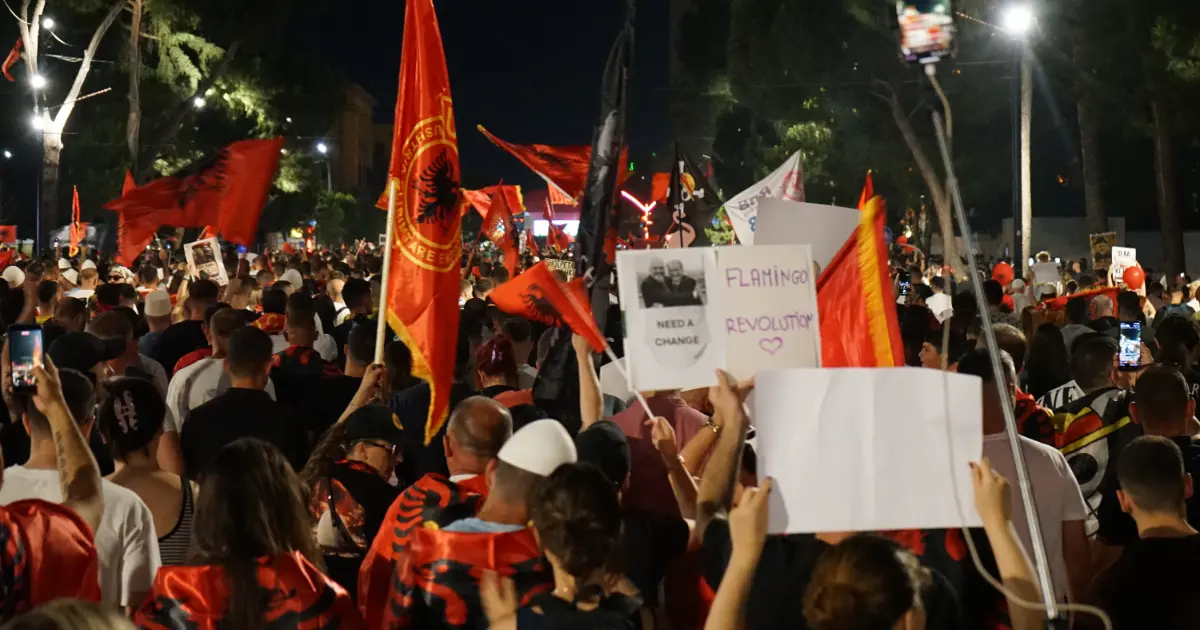
What began months ago as the "Flamingo Revolution"—a peaceful civic mobilization opposing the controversial transfer of protected natural reserves to foreign development interests—has metastasized into a violent, high-stakes confrontation between a cornered citizenry and an increasingly authoritarian state apparatus. Guma’s work, penned from the front lines of the capital’s burning streets, offers an unfiltered, harrowing glimpse into a nation at war with its own future. Blacklisted by the Albanian establishment for her relentless anti-corruption advocacy, Guma has traded traditional essay-writing for direct poetic intervention, hurling her verses—and her defiance—at the global community.
Read Also
This report provides an exhaustive examination of the crisis in Tirana, detailing the chronology of the protests, the flashpoints of state violence, the underlying socioeconomic grievances tied to foreign mega-developments like the Jared Kushner-backed lagoon project, and the broader implications for human rights and democracy in the Western Balkans.
Detailed Chronology of the Crisis
The Genesis: The "Flamingo Revolution"
The roots of the current unrest stretch back several months, culminating in a movement dubbed the "Flamingo Revolution." Citizens mobilized en masse following the government’s secretive decision to hand over a pristine island and lagoon within a protected natural reserve—a vital sanctuary for migratory flamingos—to American investors, notably Jared Kushner, son-in-law to former U.S. President Donald Trump.
For weeks, the protests were characterized by peaceful assemblies, artistic demonstrations, and impassioned speeches outside the Prime Minister’s office. Citizens demanded transparency, ecological preservation, and an end to backroom real estate deals that prioritize foreign capital over public heritage. However, when private security forces physically dragged rightful landowners from their ancestral properties to clear the way for development, public patience fractured. Months of peaceful demonstrations yielded zero concessions from the administration of Prime Minister Edi Rama, pushing a frustrated populace toward a volatile tipping point.
The Shift to Violence: October 2026
By mid-October, the character of the demonstrations shifted dramatically. Frustrated by months of institutional stone-walling, a faction of younger protesters adopted more aggressive tactics. Molotov cocktails were hurled at the heavily fortified Prime Minister’s office, municipal waste bins were set ablaze, and clashes with law enforcement escalated from verbal skirmishes to street battles.
Witnesses on the ground, including Guma, noted that while the overt violence was executed by a minority of radicalized teenagers, the state’s response was indiscriminate and overwhelming. Anti-riot police units, operating under strict directives to clear the square, deployed high concentrations of tear gas, rubber bullets, and physical batons.
The human toll was immediate and severe. Accounts from the square describe demonstrators collapsing from chemical agents, rubber bullets lodging in foreheads and chests, and protestors being dragged away into custody while critically injured. In a grim illustration of the chaos, emergency responders reported instances where injured protesters and wounded police officers—bleeding from reciprocal violence—were loaded into the exact same ambulance, trapped within the collateral damage of a broken social contract.
Supporting Context & Metrics
Socioeconomic Realities and the Anatomy of a Sneaker
Guma’s poem deliberately focuses on the humble origins of the abandoned sneaker to critique the broader economic architecture of modern Albania. The shoe, manufactured by underpaid women working in local sweatshops for daily subsistence wages, represents the commodification of the working class. It traces a direct line from the exploitation of factory labor to seasonal blowout sales inside the gleaming, tax-evading luxury high-rises that now dominate Tirana’s skyline—symbols of an unevenly distributed capitalist "triumph."
[Sweatshop Production]
       ↓ (Daily subsistence wages)
[Boutiques in Tax-Evading Towers]
       ↓ (Seasonal sales)
[The Protest Square]
       ↓ (Police crackdown & Chaos)
[Abandoned Relic / Art Installation]
This trajectory highlights a widening chasm between the ruling elite and ordinary citizens. Albania has long struggled with systemic corruption, capital flight, and economic stagnation, factors that drive high rates of youth emigration. The protest square has thus become a pressure valve for a generation that feels economically disenfranchised and politically voiceless.
The Suppression of Dissent and Cultural Erasure
The crisis in Tirana is not merely political; it is deeply cultural. Author Arlinda Guma embodies the plight of contemporary Albanian intellectuals who dare to challenge the status quo. Blacklisted from official literary directories and denied state platforms due to her vocal opposition, Guma operates in a gray zone of forced invisibility.
Her choice to use poetry as an investigative medium underscores the failure of traditional journalism and bureaucratic oversight in Albania. When institutions are captured by executive overreach, the public square—and the arts—remain the only viable forums for truth-telling. The imagery in her poem—where frightened birds abandon the city sky, replaced by the roar of armored vehicles and ambulance sirens—paints a portrait of an urban ecosystem choked by political violence.
Official Statements and Institutional Responses
Government Silence and Defensive Posturing
As of
late October 2026, the administration of Prime Minister Edi Rama has maintained a defensive posture regarding the escalating violence in Tirana. Official statements from the Ministry of the Interior have characterized the demonstrators not as legitimate citizens exercising constitutional rights, but as "hooligans" and "vandals" orchestrated by opposition political figures seeking to destabilize the state.
The government has vigorously defended its infrastructure and foreign investment policies, arguing that high-profile tourism and real estate projects—such as the contested lagoon development—are vital for modernizing Albania’s economy and integrating the nation into the broader European market. Regarding the use of force, interior officials insist that law enforcement acted with necessary restraint to restore public order and protect critical state infrastructure from destruction.
Opposition and Civil Society Rebukes
Conversely, opposition leaders and domestic civil rights organizations have condemned the police crackdown as disproportionate and authoritarian. Human rights advocates point to the use of rubber bullets and chemical agents against unarmed civilians as clear violations of European human rights standards.
Civil society groups have called for an independent, international investigation into the events of October 2026, demanding accountability for police brutality and transparency regarding the controversial land transfers that sparked the initial unrest. International observers have expressed mounting concern over the erosion of democratic norms in Albania, noting that the suppression of dissenting writers, environmental activists, and protesters signals a dangerous drift toward autocracy in the Western Balkans.
Future Outlook
The Trajectory of the "Flamingo Revolution"
The immediate future of Tirana remains precarious. With the government refusing to halt its disputed development projects and protesters galvanized by recent acts of police violence, the cycle of unrest shows little sign of abating. The streets of the capital have transformed into an open-air installation of grief and resistance, where history acts as the sole impartial curator.
Several critical factors will dictate the evolution of the crisis in the coming months:
- International Pressure: The degree to which Western allies—particularly the European Union and the United States—condemn the suppression of domestic dissent will heavily influence the Rama administration’s calculus. As an EU candidate country, Albania faces pressure to uphold democratic governance and the rule of law.
- Cohesion of the Opposition: Whether the diverse coalition of environmentalists, disaffected youth, workers, and intellectuals can organize a unified, sustained political platform will determine if the street protests translate into structural reform.
- The Role of Independent Voices: Writers like Arlinda Guma demonstrate that cultural resistance cannot be easily legislated out of existence. As long as state crackdowns continue, artistic expression will likely serve as a primary vehicle for anti-establishment sentiment, echoing far beyond the borders of Tirana.
Conclusion: The Poem as a Global Manifesto
In her closing note, Arlinda Guma reflects on her transformation from a peaceful essayist into a participant in a fiery revolution, noting that she does not know how to throw a stone. Instead, she chooses to "throw" her poetry straight at the face of the world.
The abandoned sneaker in Skanderbeg Square remains an enduring symbol of this turbulent era—a silent, stubborn artifact reminding observers that beneath the abstract metrics of economic growth and geopolitical deals lie the shattered bones, lost homes, and silenced voices of ordinary human beings. As the smoke clears over Tirana, the verses written from the flames ensure that the sacrifice etched into the asphalt will not be easily forgotten.




Comments
Facebook App ID not configured. Please add it in the Customizer.