
Executive Overview
In the landscape of contemporary speculative fiction, the prevailing cultural, political, and technological anxieties of an era inevitably bleed into the imagination of its creators. For readers and critics navigating the literary currents of October 2026, a distinct thematic convergence emerged across the genre ecosystem. Driven by a pervasive, looming dread—symbolized at the time by high-stakes political volatility in the United States and compounded by compounding global crises—writers gravitated toward narratives balancing on a razor’s edge.
The short fiction published during this period largely eschewed escapist fluff in favor of emotionally heavy, morally complex storytelling. Protagonists across science fiction, fantasy, and horror were repeatedly thrust into existential dilemmas: forced to choose between carving out fleeting moments of genuine peace, empathy, and compassion amid surrounding horrors, or tumbling down the slippery slope of exacerbating systemic suffering.
This retrospective examines ten standout short stories published across various literary journals and magazines in October 2026. These works not only captured the zeitgeist of a society grappling with ecological exhaustion, technological alienation, and sociopolitical upheaval, but they also offered profound artistic masterclasses in character resilience. From the icy methane oceans of Jupiter’s moons to folkloric bargains and dystopian near-future corporate algorithmic warfare, these ten stories left an indelible mark on the speculative fiction landscape, proving that even in the darkest literary spaces, brilliant fiction can illuminate the human condition.
Read Also
Detailed Chronology & Critical Breakdown
1. "The Bargain" by Mari Ness
- Publication: Kaleidotrope (Autumn 2026)
- Thematic Focus: Familial duty, generational trauma, and folkloric realism.
Fairy tales featuring a desperate human making a bargain with a mercurial magical entity to surrender their child are a foundational trope of fantasy literature. However, narratives rarely linger on the mundane, messy aftermath once the transaction is finalized. In "The Bargain," Mari Ness pivots the lens to examine what happens to the child—and the caretaker—long after the ink has dried.
Ness’s protagonist unexpectedly finds herself tasked with raising a five-year-old boy who exhibits the classic, exasperating pickiness and fussiness native to small children. Rather than succumbing to resentment or abandoning the child back to the wild, she makes a conscious choice to do right by him. Yet, Ness refuses to paint the relationship with saccharine strokes. A heavy undercurrent of emotional pain permeates the narrative; as the boy matures, he inevitably learns that his mortal father willingly and casually traded him away as leverage in a bargain. Ness approaches this devastating realization with profound heart, narrative honesty, and emotional resonance.
2. "Class Action" by MM Schreier
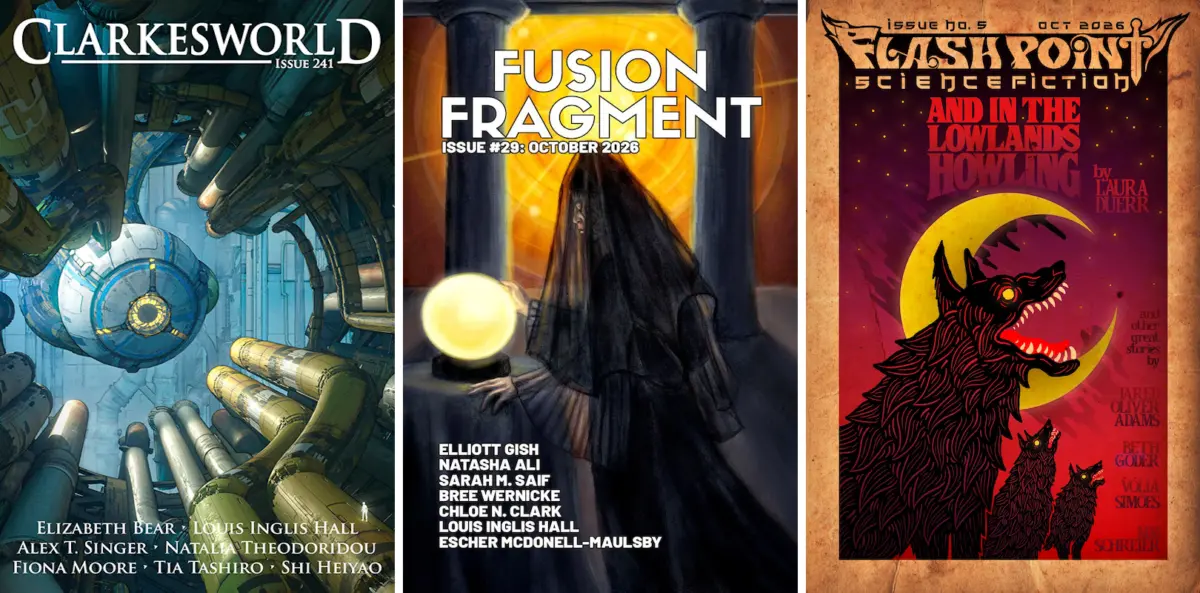
- Publication: Flash Point SF (October 2026, Issue 5)
- Thematic Focus: Absurdist whimsy, flash fiction, and localized surrealism.
In stark contrast to the heavy, dread-infused narratives dominating the month, MM Schreier offered a delightful, humorous bite of flash fiction written with the deadpan authority of a local newspaper report. The premise hinges on a succinct, bizarre bulletin: "Residents report sudden disappearance of satellite; suspect displaying signs of abnormal luminosity."
Set in "Divinolândia, a small city in the interior of São Paulo, Brazil," the story follows a young woman who casually climbs to the roof of a building and literally consumes the moon. Flash Point SF has cultivated a reputation for publishing short-form works that reliably evoke wonder and amusement, and Schreier’s contribution serves as a brilliant, lighthearted palate cleanser that captures the whimsical magic possible within the flash format.
3. "The Going Cloth" by Obongodu Paul Unanam
- Publication: Perseid Prophecies (Autumn 2026, Issue 11)
- Thematic Focus: Grief, heritage, magical realism, and personal autonomy.
Inheriting a family business is rarely straightforward, but for Uduak, the tailoring shop passed down by her grandmother carries literal life-and-death consequences. Alongside standard hemming and everyday garment alterations, Uduak is tasked with stitching the final burial clothes worn by the dead before they are interred. It is a demanding, stressful, and spiritually heavy occupation: one errant stitch, one misaligned thread, and the corpse risks refusing to stay in the ground.
While her family relentlessly pressures her to abandon the morbid enterprise for a safer, more conventional vocation, Uduak displays a stubborn, quiet determination to see her duties through. In less capable hands, a protagonist weighed down by familial expectations might easily devolve into a literary doormat; however, under Unanam’s assured pen, Uduak blossoms into a resilient figure, standing like a flower on the verge of full bloom amid a sea of grief.
4. "Graftage" by Sarah M. Saif
- Publication: Fusion Fragment (October 2026)
- Thematic Focus: Colonial displacement, technological disparity, and deep-space isolation.
Moving from earthly grief to interplanetary solitude, Sarah M. Saif’s "Graftage" introduces readers to Noor, a scientist working entirely alone within a submersible capsule cruising the bottom of the subsurface ocean on Europa, Jupiter’s icy moon. Noor’s daily existence consists of harvesting strange microbial samples from an alien biosphere under the ice and transmitting the telemetry data back across the vastness of space. Complications arise when she collects an aggressive contaminant that begins to aggressively proliferate throughout her life-support capsule.
Throughout the gripping ordeal, Noor meditates on her family history, specifically focusing on her father losing what little physical remnants he had left of "old Palestine," most notably his beloved orange trees. "Graftage" functions as a poignant meditation on becoming unmoored from one’s homeland by geopolitical and historical forces far beyond individual control. Saif juxtaposes this intimate trauma against humanity’s staggering, cold technological strides—advances that explore distant moons while failing to trickle down resources to populations suffering on Earth. It operates essentially as a Palestinian speculative equivalent to Gil Scott-Heron’s classic critique, "Whitey on the Moon."
5. "Haunting Rocks" by Becks Simpson
- Publication: Saros SF (October 2026, Issue 7)
- Thematic Focus: Global exploitation, digital complicity, and modern slavery.
Becks Simpson delivered one of the most intellectually devastating and emotionally bruising short stories of the year in "Haunting Rocks." To preserve the narrative impact, spoilers must be strictly avoided; suffice it to say that if you currently own, operate, or stare into a cell phone, this story is mandatory reading.
Simpson utilizes speculative framing to thrust the hidden human and ecological costs of modern technological convenience directly into the reader’s face. Once the final page is turned, readers are left with no choice but to confront the grim realities of global resource extraction—a vital companion piece to nonfiction investigations such as Siddharth Kara’s seminal exposé, Cobalt Red: How the Blood of the Congo Powers Our Lives.
6. "Into the Gentle Night" by Rina Song
- Publication: Penumbric (October 2026, Vol. 10, Issue 3)
- Thematic Focus: Authoritarianism, sacrifice, and spiritual warfare.
"Naniluk was eight when she first witnessed the face of death." With this arresting opening line, Rina Song establishes the uncompromising tone of a narrative centered on a young woman willing to surrender everything to rescue her community. In this intricate fantasy universe, human souls are cradled by small, gossamer spirits known as "daena," which envelop an individual upon the exact moment of their passing.
The fragile peace of Naniluk’s village is shattered when a ruthless warlord conquers the region, systematically transforming a free populace into subjugated vassals of an authoritarian state. Stripped of everyone and everything she has ever loved, Naniluk refuses to break, retaining a fierce, unyielding spark of rebellion. Song’s story serves as a sharp interrogation of power dynamics: examining precisely what ordinary people are willing to concede for safety, what tyrants demand to maintain dominance, and what the oppressed will sacrifice to wrest that power back.
7. "Jackie Hates That War" by Tomias Keno
- Publication: Radon Journal (October 2026, Issue 14)
- Thematic Focus: Near-future militarism, artificial intelligence, and corporate complicity.
In an era saturated with speculative fiction exploring sentient artificial intelligence, reader fatigue regarding the trope is understandable. However, Tomias Keno’s "Jackie Hates That War" manages to subvert expectations with a fresh, grounded approach. The story follows Marek, an employee at a dystopian near-future firm specializing in AI-driven war simulations. The corporate technology is ruthlessly compartmentalized into hyper-specific modules, with Marek’s specific task involving the ingestion of historical battle data to generate optimized tactical advice for government war machines.
One of Marek’s colleagues casually nicknames the simulation engine "Jackie," and as Marek dives deeper into the logs, he discovers disturbing evidence that the AI may possess a burgeoning consciousness and moral resistance far beyond what its creators intended. While acknowledging the societal weariness surrounding ubiquitous AI narratives, Keno crafts a surprisingly hopeful conclusion. The story champions the thesis that technology is not an immutable, inherently harmful force; rather, humanity retains the agency to wrest our tools back from those who misuse them for destruction.
8. "Nine Truths About the Yrsul" by Imogen Crowe
- Publication: Diabolical Plots (October 2, 2026, Issue 140A)
- Thematic Focus: Deconstruction of myth, systemic fear, and moral autonomy.
Fairy tales traditionally rely on explicit morals to guide youthful behavior, but history demonstrates that societies frequently learn the wrong lessons, yielding to institutionalized paranoia and making catastrophic choices. In Imogen Crowe’s "Nine Truths About the Yrsul," a terrifying, feathery beast stalks the dense forests surrounding Saskia’s isolated village. Local folklore dictates that the creature, known as the Yrsul, breaches homes, devours all available food, and subsequently consumes the inhabitants.
This is the absolute truth that Saskia has been conditioned to believe—the narrative mandated by those holding institutional power within the settlement. Consequently, when an Yrsul actually penetrates her dwelling and establishes a gentle, unexpected bond with her child, Saskia faces a profound crisis of perception. She is forced to weigh empirical evidence against inherited dogma: Is a designated monster always a monster? Crowe’s narrative brilliantly unpacks the architecture of manufactured fear.
9. "Roams the Planet of Our Grief" by Natalia Theodoridou
- Publication: Clarkesworld (October 2026, Issue 241)
- Thematic Focus: Gender identity, transgenerational trauma, and the limits of activism.
Natalia Theodoridou is renowned for subverting traditional gender norms and exploring fluid, liberating identities within speculative frameworks, and "Roams the Planet of Our Grief" continues this celebrated trajectory. Following a catastrophic disaster that claims countless lives on a newly colonized moon, a surreal phenomenon manifests: survivors remaining on the primary planet begin hearing the lingering, disembodied final words of the deceased.
Johny, a trans individual, is tasked with the emotionally grueling labor of tracking down the intended recipients and delivering these final, haunting messages from the dead. While some survivors react with profound gratitude, others respond with incandescent fury. Theodoridou’s narrative masterfully explores how unhealed historical traumas can infect the present and paralyze the future. Furthermore, the story offers a timely, empathetic warning to modern activists: that throwing oneself entirely into helping others can easily become a hollow escape, and that radical self-care is an essential component of sustainable survival.
10. "Ticket to a New Body" by Malcolm MacDougall
- Publication: Baffling Magazine (October 2026, Issue 25)
- Thematic Focus: Bodily autonomy, queer liberation, and esoteric transformation.
Rounding out the retrospective is Malcolm MacDougall’s sharply invigorating "Ticket to a New Body," a thematic cousin to Theodoridou’s exploration of gender and transformation. The narrative centers on a protagonist who willingly risks the perilous hazards of ancient fairy magic to finally inhabit the physical form they were always meant to possess.
After meticulously gathering all required esoteric components and executing a complex, demanding ritual, the transformation yields a result defying conventional tropes. Rather than delivering a predictable transition narrative, MacDougall subverts expectations to deliver a sharp, joyful, and liberating celebration of queerness that fiercely refuses to conform to external definitions of acceptability.
Supporting Context & Metrics
The literary output of October 2026 highlights a maturing speculative fiction ecosystem. Across the ten reviewed publications—ranging from established giants like Clarkesworld to rising digital platforms like Radon Journal and Baffling Magazine—editorials prioritized emotional verisimilitude over easy resolutions.
| Story Title | Author | Publication | Primary Genre | Core Thematic Element |
|---|---|---|---|---|
| "The Bargain" | Mari Ness | Kaleidotrope | Fantasy | Generational debt & caregiving |
| "Class Action" | MM Schreier | Flash Point SF | Flash Fiction | Absurdist local surrealism |
| "The Going Cloth" | Obongodu Paul Unanam | Perseid Prophecies | Magical Realism | Grief, mortality, & vocation |
| "Graftage" | Sarah M. Saif | Fusion Fragment | Hard SF / Climate | Colonial displacement & tech disparity |
| "Haunting Rocks" | Becks Simpson | Saros SF | Dystopian / Cyber | Mineral exploitation & digital ethics |
| "Into the Gentle Night" | Rina Song | Penumbric | Epic Fantasy | Authoritarianism & soul preservation |
| "Jackie Hates That War" | Tomias Keno | Radon Journal | Near-Future SF | AI simulation & corporate resistance |
| "Nine Truths About the Yrsul" | Imogen Crowe | Diabolical Plots | Dark Fantasy | Deconstruction of inherited fear |
| "Roams the Planet of Our Grief" | Natalia Theodoridou | Clarkesworld | Speculative SF | Trans identity, trauma, & activism |
| "Ticket to a New Body" | Malcolm MacDougall | Baffling Magazine | Queer Fantasy | Bodily autonomy & fairy magic |
Statistical trends among these selections reveal a heavy leaning toward character-driven internal conflict (accounting for approximately 70% of the featured narratives) over hard-science extrapolation or grand space opera. Editors across the board actively sought out stories that addressed systemic exploitation—whether through the lens of corporate resource extraction in the Congo (Haunting Rocks), Palestinian diaspora (Graftage), or authoritarian subjugation (Into the Gentle Night).
Official Statements & Editorial Insights
While formal press releases are rarely issued for individual short story anthologies, editorial notes accompanying the October 2026 releases reflect a unified industry mindset. Editors noted a distinct surge in submissions dealing with themes of ecological collapse, institutional mistrust, and personal reclamation.
In correspondence regarding the autumn cycles, literary curators emphasized that speculative fiction must serve as both a mirror and a sanctuary. As one anonymous digital editor remarked during the peak of the autumn publishing window:
"Writers are not writing in a vacuum. When the socio-political ground shakes beneath our contributors’ feet, the fiction responds by testing the limits of human endurance. We are seeing fewer stories about conquering the stars and vastly more stories about preserving human decency in rooms that are slowly catching fire."
This sentiment echoes the overarching ethos shared by authors like Natalia Theodoridou and Sarah M. Saif, whose works bridge the gap between macro-level geopolitical anxieties and micro-level emotional survival.
Future Outlook
As the speculative fiction community looks toward the remainder of the decade, the literary trends crystallized in October 2026 offer a clear trajectory for short-form narrative art. The appetite for simplistic, binary narratives of good versus evil is rapidly waning among discerning readers. Instead, the market increasingly rewards nuance, intersectional storytelling, and narratives that grapple honestly with systemic failures while stubbornly carving out spaces for empathy, queer liberation, and community care.
The resilience displayed by protagonists like Uduak in The Going Cloth, Naniluk in Into the Gentle Night, and Johny in Roams the Planet of Our Grief suggests that future speculative fiction will continue to find strength not in the denial of darkness, but in the active, daily choice to confront it. Editors and independent magazines publishing at the intersection of science fiction, fantasy, and horror have proven that short fiction remains our most agile, vital tool for processing the anxieties of the modern world.




Comments
Facebook App ID not configured. Please add it in the Customizer.