
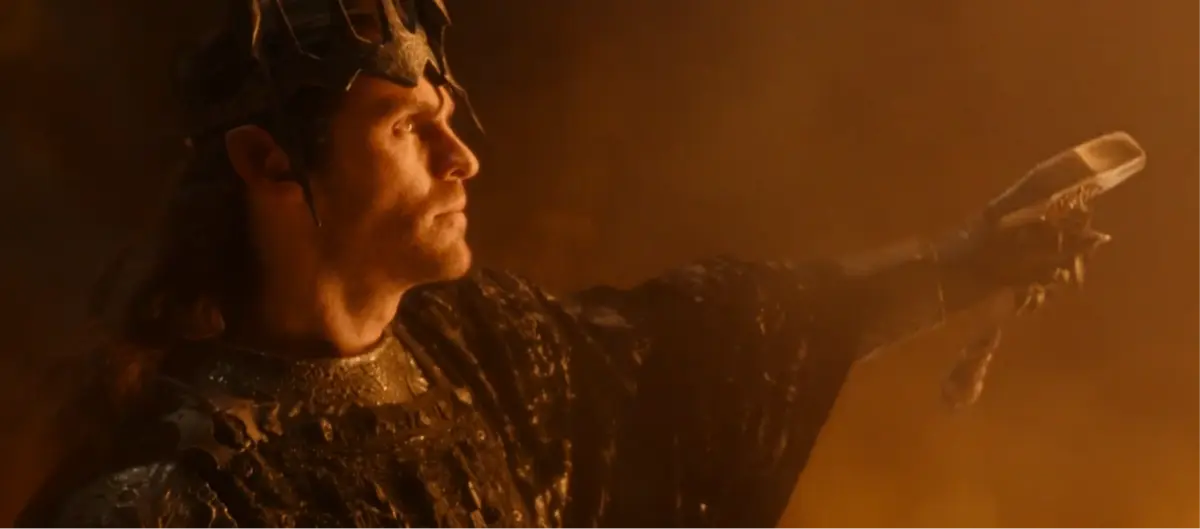
Executive Overview
In the sprawling, high-stakes adaptation of J.R.R. Tolkien’s legendary mythology, Amazon Prime Video’s The Lord of the Rings: The Rings of Power continues to subvert traditional fantasy tropes. As the series charges forward through its high-tension narrative arc, showrunners and cast members have begun pulling back the curtain on the psychological architecture driving its central antagonist.
During a recent, highly publicized awards-season screening covered extensively by entertainment outlets like GamesRadar, co-creator and co-showrunner J.D. Payne offered a profound revelation regarding the series’ depiction of the forging of the One Ring. While historical and canonical interpretations of Middle-earth’s ultimate weapon have often framed Sauron’s ambitions in grand, geopolitical strokes—a sweeping campaign to conquer territories and subjugate the free peoples through the domination of their protective rings—Payne emphasized a sharply contrasting creative direction.
According to the showrunner, the genesis of the One Ring is fundamentally anchored in a profoundly personal crusade. Far from being merely an abstract political maneuver, Sauron’s obsessive quest to forge the ruling ring is intrinsically tied to his burning desire to conquer and master Galadriel.
Read Also
This intensely personal framing has sparked widespread debate across fandoms and critical circles alike. Paired with insights from actor Charlie Vickers—who brings the Dark Lord’s humanized, deceptive forms to life—and further contextualized by the creators’ views on Sauron’s inherent insecurities, The Rings of Power is aggressively redefining one of literature’s most iconic villains. Rather than portraying Sauron as an immutable, monolithic force of absolute evil from the outset, the series investigates the jagged edges of his ego, turning the foundational lore of Middle-earth into a dark, psychological chess match.
This in-depth investigative report examines the creative choices behind the forging of the One Ring, dissects the complex personal dynamics driving Sauron and Galadriel, evaluates the meta-narrative implications of humanizing a dark god, and forecasts what these character-driven developments mean for the trajectory of the series moving forward.
Detailed Chronology: The Evolution of Sauron’s Obsession
To fully grasp the magnitude of Payne and Vickers’ recent revelations, one must trace the meticulously structured evolution of the relationship between Sauron and Galadriel across the series’ production timeline.
Season 1: Deception and the Seed of Manipulation
When Charlie Vickers first appeared on screen as Halbrand, the mysterious human castaway adrift on the Sundering Seas, few viewers immediately recognized the architect of Mordor. The first season meticulously built a subtle, magnetic, and deeply toxic dynamic between Halbrand and Morfydd Clark’s Galadriel. Bound by circumstance, mutual survival, and psychological vulnerability, the two characters engaged in intellectual sparring matches that set the stage for later betrayals.
When Halbrand’s true identity as Sauron was ultimately unmasked in the season finale, it redefined every preceding interaction. Crucially, it established that Sauron’s approach to domination was not restricted to brute force; it relied heavily on psychological mirroring, emotional exploitation, and a perverse form of companionship. He did not simply wish to destroy Galadriel; he wished to bring her to his side as a queen, viewing her as his intellectual and spiritual equal.
Season 2 and Beyond: The Crucible of the Rings
As the narrative progressed into the subsequent seasons, this dynamic shifted from covert manipulation to open psychological warfare. In interviews with entertainment media, J.D. Payne highlighted how the writers’ room spent years deliberately engineering the friction between Celebrimbor, Galadriel, and Sauron.
Early on in the crafting process, Celebrimbor taunts Sauron, dropping a psychological anchor that changes everything: without the creation of the One Ring, Sauron will never be capable of truly mastering Galadriel. This taunt serves as the narrative catalyst for the forging of the One Ring. It transforms what should have been a cold, calculated exercise in magical metallurgy into an emotionally charged obsession. The Ring becomes the instrument through which Sauron believes he can finally break Galadriel’s iron-willed resistance, bending her stubborn refusal to his absolute authority.
Supporting Context & Metrics: Humanizing the Dark Lord
The decision to lean into Sauron’s psychological vulnerabilities—his ego, his insecurities, and his capacity for twisted obsession—represents one of the boldest narrative departures in modern high-fantasy television. Traditionally, adaptation models of The Lord of the Rings have leaned heavily on Peter Jackson’s cinematic blueprints, which primarily conceptualized Sauron through the iconic imagery of the flaming Eye in the sky or the armored behemoth of the Second Age prologue.
Breaking the Monolithic Villain Archetype
The Rings of Power has systematically dismantled this one-dimensional archetype. In past promotional cycles, J.D. Payne described Sauron not as a static force of nature, but as a living, breathing entity burdened by distinct aspirations and glaring insecurities.
"He’s a being with aspirations and insecurities," Payne noted during a press retrospective. "The idea that he’s not just a flaming eye in the sky, but he’s a person who wants to make a ring. And what is that going to take out of him?"
This philosophical shift forces the audience to confront a deeply unsettling premise: evil, in this universe, is born out of vanity, inadequacy, and a desperate need for validation and control. By reducing the cosmic scale of the Dark Lord to the intimate scale of a jilted, hyper-egoist mastermind, the series grounds its supernatural stakes in recognizable human flaws.
The Charlie Vickers Perspective: Ego vs. Jealousy
Expanding upon this humanized framework, actor Charlie Vickers offered a nuanced breakdown of Sauron’s internal landscape during an exclusive interview with TheWrap. Addressing whether Sauron experiences genuine jealousy—particularly in light of complex narrative reunions, such as Galadriel’s dynamic with Celeborn—Vickers dissected the fine line between human emotion and divine arrogance.
"I think there’s an element of, if not jealousy, in the sense of the human part of it, it’s more an ego thing," Vickers explained. "Like a power dynamic, and him trying to assert his dominance, assert himself… I did ask myself with regard to jealousy, because of course in Episode 5, there is the sort of reunion between Galadriel and Celeborn, and obviously he sees something that she is holding back, and I always kind of was like, I wonder if Sauron has entered that space that Celeborn and Galadriel held onto."
Vickers’ admission that he actively interrogated whether an immortal Maia could feel ordinary human jealousy highlights the depth of the collaborative process between the actors and showrunners. It transforms Sauron from a cardboard-cutout tyrant into an intensely insecure entity who perceives any emotional bond he cannot penetrate or control as a direct insult to his supremacy.
Official Statements and Industry Reception
The creative gambit of framing the creation of the One Ring around a personal obsession with an Elf warrior has generated intense discourse across entertainment journalism and analytical fan communities.
Industry critics have expressed mixed reactions to this deeply personalized approach. Outlets specializing in speculative fiction, such as Reactor Mag, have praised the series for showing how "evil [is] real sneaky in lead up to the season finale," noting that psychological manipulation often proves far more insidious than open warfare on the battlefield. By emphasizing the interpersonal betrayals within the hallowed halls of Eregion, the showrunners have successfully mirrored the corrupting nature of absolute power on a micro-scale.
Conversely, purists of J.R.R. Tolkien’s legendarium have occasionally debated the wisdom of centering the Dark Lord’s ultimate creation around romantic or quasi-romantic psychological tension with an original television-series adaptation of an Elf. In Tolkien’s canonical texts, Sauron’s forging of the One Ring in the fires of Orodruin was designed to master all other rings and bring the entirety of Middle-earth under his dominion as the self-styled Lord of the Earth.
However, television executives and showrunners defend the creative license as a necessary narrative bridge. Translating millions of years of mythological history into an episodic format requires intense character focus. By funneling the geopolitical catastrophe of the Second Age through the specific, burning rivalry between Sauron and Galadriel, the creative team ensures that viewers remain emotionally invested in the stakes episode after episode.
Future Outlook: The Road to the Series Finale
As The Rings of Power looks toward its upcoming seasons, the psychological fallout from the forging of the One Ring promises to dominate the narrative landscape.
The Escalation of the War in Eregion and Beyond
With the One Ring now forged, Sauron’s immediate operational parameters have shifted. The illusion of Halbrand has crumbled, and his true nature is known to the wise. Consequently, his methods must evolve from subtle infiltration to overt subjugation. Yet, as Payne and Vickers have made clear, the driving force behind his actions remains deeply tied to his unfinished business with Galadriel.
In future arcs, audiences can expect the psychological warfare between the two characters to intensify. Galadriel bears the heavy burden of knowing the monster she inadvertently helped rehabilitate, while Sauron—driven by his insatiable ego and wounded pride—will stop at nothing to bend her indomitable spirit to his will, utilizing the very ring crafted in the fires of Mount Doom.
Unresolved Narrative Threads
As the series marches deeper into its planned multi-season arc, several critical questions remain unanswered:
- The Fate of Celeborn: With Celeborn’s re-entry into the narrative equation, how will Sauron’s perceived intrusion into Galadriel’s emotional space manifest in future confrontations?
- The Limits of the Ring: Will the One Ring ultimately grant Sauron the absolute mastery over Galadriel that Celebrimbor predicted, or will her inner strength—bolstered by the Elven rings—prove to be the ultimate crack in his armor?
- The Internal Fractures of the Dark Lord: As Sauron’s insecurities continue to drive his quest for absolute control, will his monumental ego ultimately prove to be his own undoing, long before the armies of the Last Alliance ever march upon the plains of Gorgoroth?
Conclusion
Ultimately, The Rings of Power has proven willing to take profound risks with its source material, trading pure mythological detachment for gritty, character-driven psychological drama. By recasting the forging of the One Ring not merely as a cold act of cosmic conquest, but as a deeply personal vendetta fueled by ego, insecurity, and an obsessive fixation on Galadriel, the series has elevated its central conflict into something far more intimate—and infinitely more dangerous. As the shadows lengthen across Middle-earth, the true battleground is no longer just the fields of Eregion or the halls of power, but the fractured, desperate mind of the Dark Lord himself.



Comments
Facebook App ID not configured. Please add it in the Customizer.