
Executive Overview
Apple TV’s critically acclaimed science fiction thriller Dark Matter—adapted from the bestselling novel by author and showrunner Blake Crouch—has officially concluded its second season. In doing so, it has cemented its place as one of the most intellectually ambitious and visually daring series on television. The season 2 finale delivered a masterclass in speculative fiction, balancing quiet, introspective emotional beats with breakneck, high-octane sequences that stretched the limits of modern television production.
At the center of this narrative vortex is "The Box"—the quantum superposition device that allows travelers to navigate an infinite multiverse of alternate realities. As Crouch explained in recent post-finale interviews, the core thematic exploration of the second season rests on a profound duality: the box is a catalyst that can manifest both breathtakingly beautiful experiences and utterly horrendous ones. The season 2 finale serves as the absolute encapsulation of this philosophy.
This comprehensive retrospective explores the creation of the finale’s most harrowing sequences, including a frantic corridor chase sequence through a war-torn downtown Chicago and a disorienting, low-gravity reality where the fundamental laws of physics broke down entirely. Furthermore, this report examines the serendipitous real-world discovery of the show’s war-zone set, the technical wizardry required to bring impossible physics to the screen, and what the ambiguous, cliffhanger-heavy conclusion means for the potential third and final season of Apple TV’s hit adaptation.
Read Also
Detailed Chronology: Unpacking the Season 2 Finale’s Terrifying Sequences
The climax of Dark Matter Season 2 did not ease viewers gently into its conclusion; rather, it plunged them headfirst into existential peril. The episode’s primary narrative engine followed Jason Dessen (portrayed by Joel Edgerton) and Blair (portrayed by Amanda Brugel) as they found themselves relentlessly pursued through the corridors of the box. What followed was a terrifying gauntlet through alternate realities that pushed the protagonists—and the production crew—to their absolute limits.
The War-Torn Chicago Nightmare
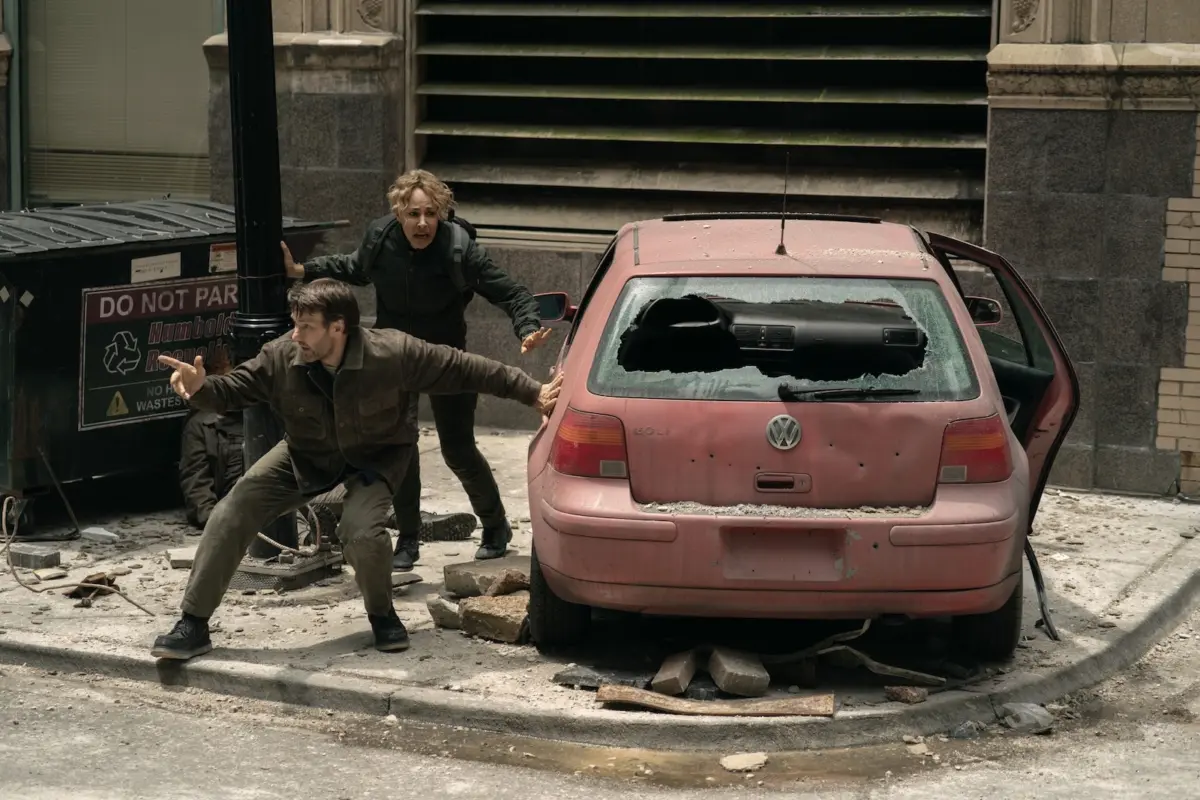
The first destination in this nightmarish sequence drops Jason and Blair into an alternate iteration of downtown Chicago. However, this is not the bustling, familiar metropolis of their origin. Instead, it is a literal battlefield—a smoking, cratered urban war zone where various unidentified factions engage in merciless, relentless warfare. Caught directly in the crossfire, Jason and Blair must navigate ruined infrastructure, sniper fire, and exploding vehicles just to survive.
According to series co-creator Blake Crouch, this harrowing sequence was envisioned early in the writers’ room as a "North Star" narrative goal—a visual and thematic benchmark that the production team aimed for from the inception of the season. The intention was to show the visceral, immediate consequences of a world collapsing into violent socio-political chaos, contrasting sharply with the serene or domestic realities the characters had previously visited.
The Zero-Gravity Anomaly
If the war-torn city represented humanity’s capacity for self-destruction, the subsequent reality Jason and Blair stumble into represented a fundamental unraveling of nature itself. Emerging from the box into a reality devoid of traditional gravitational physics, the characters find themselves in a surreal landscape where architectural structures, debris, and even the box itself float untethered into the open sky.
This sequence required an unprecedented blend of practical stunt work and state-of-the-art visual effects. The actors were suspended from elaborate wire rigs inside a secondary, custom-built box mounted on a massive gimbal. The resulting chaos on screen—characters struggling to maintain orientation while the ground literally drops away beneath them—delivered some of the most striking imagery of the television season.
Supporting Context & Metrics: From Page to Screen to Reality
Translating the boundless imagination of a literary multiverse into a tangible television production is a monumental task. Behind the breathtaking sequences of the Dark Matter Season 2 finale lies a fascinating intersection of serendipity, engineering, and literary history that highlights how modern prestige television is made.

The Accidental Location Scout
One of the most remarkable anecdotes surrounding the production of the finale involves the war-torn Chicago sequence. One might assume that such a complex, large-scale set would require months of meticulous scouting, permitting, and large-scale set dressing. As it turns out, reality occasionally imitates art in the most startling ways.
Blake Crouch and his partner and co-showrunner, Jacquelyn Ben-Zekry, stumbled upon the primary shooting location entirely by accident. While walking home following a lunch break during production, the duo took an impromptu shortcut through a downtown alleyway. To their shock and bewilderment, they emerged into a space surrounded by burned-out vehicles, architectural debris, and the eerie stillness of devastation.
"I’m looking around, and there’s these burned-out cars," Crouch recalled in an interview. "I’m like, ‘Wait, what the hell happened?’ And then I was like, ‘Oh, this is our show.’" The pre-existing environmental decay provided the production with a ready-made, highly authentic backdrop that would have cost millions to fabricate from scratch.
The Origin of the Zero-Gravity World
Interestingly, the mind-bending zero-gravity reality featured in the finale began its life as a casual joke during a writers’ room brainstorming session. Faced with the challenge of inventing a world that felt fundamentally alien yet grounded in the emotional stakes of the narrative, Crouch dug into his personal archives.
"We were brainstorming what that second world would be, and I immediately remembered there was this world I had written about in my journals for the book, but had never made it into the book," Crouch explained.
In these early, unpublished notes for the original bestselling novel Dark Matter, Crouch had conceptualized a reality where gravity had simply ceased to function reliably. Buildings peeled away from the earth, drifting lazily into the stratosphere alongside the quantum box. When Crouch initially pitched the concept to his writing staff, he did so half-jokingly, assuming it was logistically impossible or too expensive to execute.
Instead, the writers embraced the challenge, encouraging Crouch to flesh out the concept in script form. Once the script was delivered, the below-the-line production crews—particularly the stunt and physical effects teams—viewed the seemingly impossible script pages as a personal "throwdown," engineering the gimbal-and-wire setups that brought Crouch’s discarded journal entries to visceral life.
Official Statements: Behind the Scenes with the Creators
The collaborative effort required to bring Dark Matter Season 2 to its explosive conclusion involved a tight-knit creative team pushing the boundaries of what Apple TV’s production budget and technical infrastructure could achieve.
Reflecting on the shoot, Crouch noted the initial vulnerability of the production process, particularly when working with experimental practical effects. When filming the zero-gravity scenes with actors suspended in the gimbal-rigged box, the daily dailies often looked unorthodox or even slightly absurd out of context.

"It was wild, because seeing it like that on the day we shot it, you had no idea if it was really gonna work, because it just looked a little bit goofy," Crouch admitted.
However, any initial skepticism on set was swiftly eradicated in post-production. The visual effects department, spearheaded by visual effects supervisor John Heller, alongside editor Joe Leonard, took the raw, wire-supported footage and elevated it far beyond Crouch’s initial written vision. By seamlessly blending practical stunt choreography with digital matte paintings and physics simulations, the team delivered a sequence that felt both terrifyingly real and profoundly otherworldly.
Future Outlook: What Lies Ahead for Dark Matter Season 3?
As the dust settles on the season 2 finale, fans are left dissecting the myriad open narrative threads left in its wake. While Apple TV has yet to officially issue a formal renewal announcement for a third season, the creative team has made no secret of the fact that they are mapping out a definitive conclusion to the saga.
Unraveling the Final Twists
The finale’s closing moments deliberately subvert viewer expectations, raising more questions than answers while setting up an emotional chess match for the series’ potential final chapter. One crucial detail confirmed by Crouch himself involves the final destination of Daniela (Jennifer Connelly) and Charlie (Oakes Fegley).
While the episode’s editing and atmospheric tension might lead viewers to assume certain continuities, Crouch explicitly clarified that the world Daniela and Charlie step into at the end of the episode is not the reality they had just occupied—crucially, it is not the world where Max remains alive. This distinction radically alters the emotional landscape for the characters, ensuring that any subsequent journey will be fraught with fresh grief, unfamiliar variables, and high-stakes survival.
A Mind-Blowing Conclusion Awaiting Greenlight
When pressed on the broader narrative arc of a prospective third season, Crouch remained understandably tight-lipped, careful not to spoil the intricate web of quantum mechanics and character resolutions he and Ben-Zekry have devised. However, his confidence in the pitch remains absolute.
"We do have a very strong, mind-blowing idea for what the last season would be, if we’re fortunate enough to get to make it," Crouch teased.
Given the immense global popularity of the series, the critical acclaim garnered by its cast (including Joel Edgerton, Jennifer Connelly, and Oakes Fegley), and the fertile narrative ground left to explore in the infinite expanse of the multiverse, fans have every reason to remain hopeful.
For now, the complete first and second seasons of Dark Matter are available to stream in their entirety on Apple TV, inviting audiences to rewatch the labyrinthine journey, hunt for hidden multiversal clues, and prepare themselves for what promises to be an unforgettable final chapter in Jason Dessen’s endless quest for home.





Comments
Facebook App ID not configured. Please add it in the Customizer.