
Executive Overview
The contemporary South Asian music landscape witnessed a rare and momentous convergence of creative heavyweights as legendary vocalist Atif Aslam celebrated the launch of his fourth studio album, Subah Aye Na. Ending an eighteen-year hiatus from full-length record releases—his last being 2008’s critically acclaimed Meri Kahani—Aslam’s exclusive listening party and gathering transformed into an unprecedented cultural cross-pollination.
Held in an atmosphere charged with anticipation, the event drew an elite roster of Pakistan’s entertainment echelon, including powerhouse actor-host Fahad Mustafa, pop sensation Asim Azhar, rap icon and hip-hop trailblazer Talha Anjum, and reigning television and cinematic leading lady Hania Aamir.
What elevated this industry gathering from a standard promotional event to a historic milestone was the sheer eclecticism of the guest list. Rarely do figures representing such divergent verticals of the Pakistani entertainment ecosystem—spanning high-stakes television production, cinematic box-office dominance, underground hip-hop, and mainstream pop—share a single stage.
Read Also
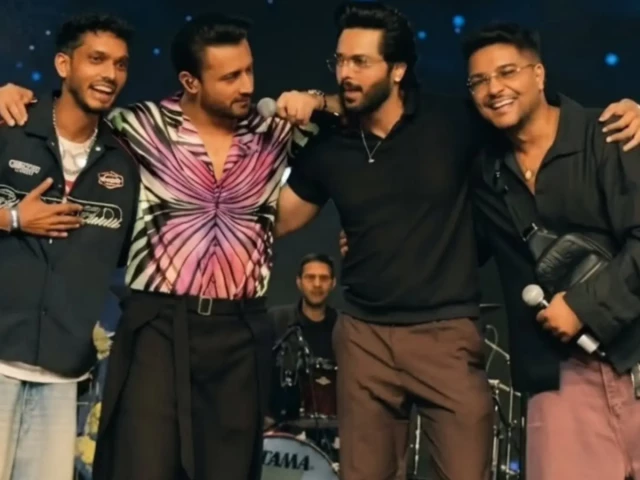
Footage from the evening quickly captivated digital audiences, capturing spontaneous performances and deep mutual admiration as Aslam, Azhar, and Anjum harmonized under the lights.
This glittering gala served as the physical manifestation of Subah Aye Na’s core ethos: a bridging of generational divides, sonic genres, and artistic communities. Released on July 31, the eight-track album represents far more than a commercial rollout; it is a profound artistic exorcism. For Aslam, an artist who spent nearly two decades navigating the relentless machinery of blockbuster film soundtracks, stadium tours, and televised music platforms like Coke Studio, this project represents a return to zero.
By stepping away from commercially motivated formulas to write and compose purely for himself, Aslam has not only revitalized his own discography—which includes foundational milestones like Jal Pari (2004) and Doorie (2006)—he has also provided a masterclass in creative reinvention. This in-depth report explores the anatomy of the launch event, the structural and thematic weight of Subah Aye Na, the strategic shift in Aslam’s career trajectory, and what this monumental comeback portends for the future of the region’s music industry.
Detailed Chronology of the Gala
A Convergence of Industry Titans
The evening air hummed with a palpable sense of occasion as Karachi’s premier venue filled with the undisputed royalty of Pakistan’s entertainment industry. The guest list read like a comprehensive directory of contemporary cultural influence, curated not by algorithmic popularity, but by authentic artistic merit and cross-genre respect.
The arrival of Fahad Mustafa instantly set a tone of industry-wide gravity. As a titan of both television programming and cinematic box-office hits, Mustafa’s presence underscored the respect Aslam commands across different entertainment mediums. Shortly thereafter, pop luminary Asim Azhar—a representative of the generation shaped directly by Aslam’s early 2000s sonic revolution—entered alongside Talha Anjum, whose lyrical dominance has cemented the commercial and cultural viability of Pakistan’s underground hip-hop movement. Completing the constellation of star power was Hania Aamir, whose magnetic cinematic presence and massive international social media footprint brought a distinct cinematic glamour to the room.
The Unprecedented Crossover
As the evening progressed, the initial polite mingling dissolved into a collective celebration of sonic artistry. The true talking point of the night, which quickly spilled over into viral social media commentary, was the organic fluidity with which these disparate names interacted. In an industry often siloed by genre—where pop acts, hip-hop artists, television stars, and film actors rarely collaborate outside of formal project constraints—Aslam’s gathering broke down traditional walls.
Footage that surfaced from the private event showed a transcendent moment of musical communion: Aslam, Azhar, and Anjum sharing the stage. The imagery was profoundly symbolic. Here was Atif Aslam, the undisputed maestro of emotional balladry who defined the soundscape of the 2000s; Asim Azhar, the polished pop architect bridging classic melodies with modern production; and Talha Anjum, the raw, street-level poet of Young Stunners fame, whose rhythmic cadence represents the new vanguard of Pakistani music.
As they performed and sang together, the room stood witness to a living timeline of Pakistani music history. The generational and stylistic gaps evaporated, replaced by a shared reverence for the craft. Hania Aamir and Fahad Mustafa looked on from the front rows, joining an enthusiastic crowd that seemed genuinely electrified by the historic nature of the room. The event successfully transformed from a traditional album launch into an informal summit of creative forces, proving that great music remains the ultimate unifying language.
Supporting Context & Metrics: Breaking Down the Eight-Year Gap
The Anatomy of an Eighteen-Year Hiatus
To fully grasp the magnitude of Subah Aye Na, one must contextualize the drought that preceded it. Atif Aslam’s trajectory is an anomaly in modern music history. Bursting onto the scene in 2004 with his seminal debut album Jal Pari, Aslam—alongside his former band Jal—redefined the Pakistani rock and pop landscape with generational anthems like Aadat and Woh Lamhe. His voice, characterized by a haunting, malleable register and an unmatched ability to convey raw anguish and euphoria, instantly propelled him to international superstardom.
Following Jal Pari and his sophomore solo effort Doorie (2006), Aslam released Meri Kahani in 2008. In the years that followed, the music industry underwent a seismic technological and economic shift. The traditional album format—long considered the ultimate statement of an artist’s creative maturity—was systematically dismantled by the digital streaming era, which favored single-track releases, algorithmic playlisting, and rapid-fire content consumption.
Simultaneously, Aslam became one of the most sought-after playback singers in Bollywood, a permanent fixture on the touring circuit, and a crown jewel of institutional platforms like Coke Studio. While these ventures cemented his financial success and global household-name status, they came at a cost to his personal discography. For nearly two decades, fans hungered for a cohesive, long-form artistic statement from an artist capable of so much more than standalone singles. Subah Aye Na breaks that eighteen-year silence, signaling a bold rejection of industry complacency in favor of artistic integrity.
Decoding Subah Aye Na
Released on July 31, Subah Aye Na is an eight-track masterclass in introspection and sonic maturity. Eschewing the pressure to pander to hyper-commercialized, fast-paced club tracks or formulaic film ballads, Aslam approached the studio with the mindset of a newcomer determined to rediscover his artistic voice.
| Album Metric / Detail | Description |
|---|---|
| Official Title | Subah Aye Na |
| Release Date | July 31 |
| Album Position | Fourth Studio Album |
| Previous Full-Length | Meri Kahani (2008) |
| Track Count | 8 Tracks |
| Core Themes | Creative Rebirth, Vulnerability, Roots Recovery, Anti-Commercialism |
| Collaborative Scope | Spans Pop, Rock, Hip-Hop, and Cinematic Influences |
Musically, the eight tracks on Subah Aye Na serve as a sonic bridge connecting Aslam’s nostalgic acoustic roots with contemporary production values. The arrangements are deliberate, prioritizing lyrical breathing room and atmospheric depth over over-produced pop gloss. It is an album designed to be listened to in sequence—a narrative journey of an artist confronting creative blocks, stripping away the armor of superstardom, and returning to the acoustic guitar that started it all.
Official Statements and Creative Philosophy
Returning to Zero: The Quest for Authenticity
In the lead-up to and wake of the album’s release, Atif Aslam has been remarkably candid about the psychological and creative hurdles that necessitated this project. In recent press interactions, the singer revealed that the catalyst for Subah Aye Na was a paralyzing sense of creative burnout. Despite operating at the pinnacle of commercial success, Aslam felt increasingly disconnected from the music he was making.
"I had to go back to zero to rediscover myself," Aslam reflected when discussing the genesis of the album. "When you spend years servicing everyone else’s vision—whether it’s for a film director, a brand, or an institutional platform—you eventually look in the mirror and ask, ‘Where am I in all of this?’"
This search for self led Aslam to deliberately step away from the commercial treadmill. He embraced vulnerability, confronting creative blocks not as an obstacle to be avoided, but as a necessary signal to recalibrate. The result was a radical unlearning of industry expectations. Subah Aye Na was written and composed entirely for himself, driven by a pure, unadulterated desire to make art without the safety net of corporate guarantees or box-office metrics.
By stripping away the external noise, Aslam tapped back into the raw emotional honesty that first captivated millions in Lahore and Karachi two decades ago. Industry analysts note that this level of vulnerability from an artist of Aslam’s stature is rare; most legacy acts prefer to ride the wave of past nostalgia rather than risk critical exposure with a deeply personal, uncompromising project.
Future Outlook: A New Paradigm for South Asian Music
Redefining Industry Dynamics
The success of Subah Aye Na and the celebratory energy of its launch event point toward a broader, highly encouraging shift in the South Asian music ecosystem. For years, the industry has operated in rigid silos: film music dominated by playback singers, pop music governed by radio-friendly formulas, and the burgeoning hip-hop scene carving out its own digital empire.
Atif Aslam’s recent gathering proves that these boundaries are increasingly porous. When mainstream television icons like Fahad Mustafa and Hania Aamir stand shoulder-to-shoulder with underground rap pioneers like Talha Anjum to celebrate a pure acoustic and lyrical project, it signals a maturing industry. It demonstrates that artistic excellence—regardless of genre—now serves as the ultimate currency of prestige.
What Lies Ahead for Atif Aslam
As Subah Aye Na continues to climb streaming charts and dominate critical discourse, the question on everyone’s mind is whether this album marks a permanent return to the studio format for Aslam. While the artist has not yet committed to a timeline for a fifth album, the sheer reception of this project provides undeniable validation.
The night of celebration in Karachi proved that Aslam’s gamble paid off. He did not need to chase commercial trends to command the room; by returning to his roots and focusing on authentic songwriting, he compelled the entire entertainment industry to come to him.
For the broader landscape, Subah Aye Na establishes a new benchmark. It challenges younger artists to prioritize long-term artistic vision over ephemeral single releases, and it reminds legacy acts that reinvention is always possible for those brave enough to return to zero. As the final notes of the launch party faded into the Karachi night, one thing was abundantly clear: Atif Aslam hasn’t just released an album—he has reignited a cultural renaissance.


Comments
Facebook App ID not configured. Please add it in the Customizer.