
Executive Overview
The path of Coyote vs. Acme through the machinery of Hollywood development is nothing short of a modern cautionary tale. Conceptually rooted in a 1990 New Yorker satirical piece by Ian Frazier that envisioned Wile E. Coyote taking legal action against the Acme Corporation, the project spent nearly a decade bouncing between script doctors, executives, and directors. James Gunn and Jeremy Slater initially conceptualized the current framework, which was subsequently passed through the hands of Chris MacKay, the Silbermans, and nearly a dozen uncredited writers before landing definitively in the hands of director Dave Green and screenwriter Samy Burch, who ultimately secured sole screenplay credit.
In an industry where "too many cooks" historically signals a disaster of creative compromise—especially when dealing with human-animation hybrid formats bound to the shadow of Who Framed Roger Rabbit—Coyote vs. Acme was widely projected to be mocked, panned, and buried. Instead, the final product emerges as an unexpectedly sharp, structurally daring spiritual successor to Space Jam. It is not merely a nostalgic romp, but an ambitious cinematic text loaded with biting socio-political commentary, profound existential grief, and a scathing critique of unchecked corporate impunity.
Set against a backdrop of contemporary real-world media monopolies—specifically, Warner Bros.’ ongoing absorption into the Ellison family empire—the film’s narrative serves as a Trojan horse. It delivers a deeply felt story about systemic corporate cruelty, the exploitation of marginalized "super users," and the simple, radical necessity of having one’s pain witnessed by another living soul.
Read Also
Detailed Chronology: From Concept to Courtroom
To understand how Coyote vs. Acme managed to subvert expectations, one must examine its intricate narrative architecture, which unfolds as a sprawling legal thriller set within the Looney Tunes universe.
The Setup and the Whistleblower
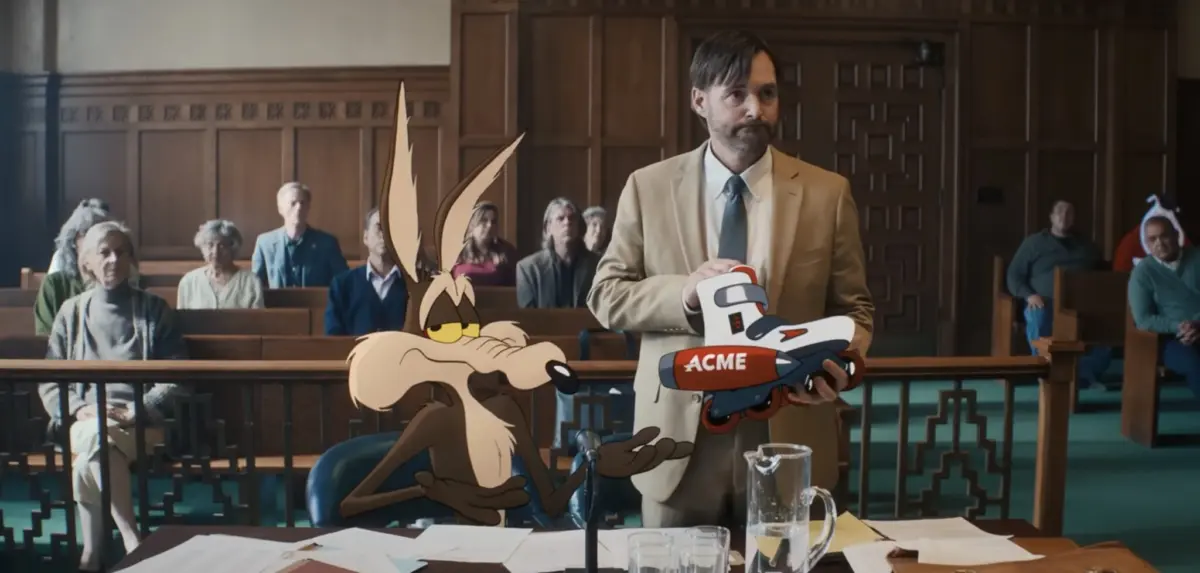
The narrative kicks off when Wile E. Coyote, perpetually battered by catastrophic engineering failures, stumbles upon an advertisement for the law firm Avery, Jones, & Maltese—with partners bearing names that pay direct homage to classic Looney Tunes animators and creators. Kevin Avery (portrayed with weary cynicism by Will Forte) has spent his career scraping by on small-claims payouts for cartoons injured by malfunctioning Acme products, collecting literal pennies while remaining completely uninvested in the systemic harm.
However, Avery’s apathetic routine is upended when a deeper, darker conspiracy surfaces. Thirty years prior, Dr. Peter Lorre—a staple Looney Tunes caricature since the 1940s—attempted to blow the whistle on Acme’s clandestine experimental wing. For his trouble, he was summarily "black-holed" by corporate goons.

Escalation and Investigation
Coyote elevates the stakes by introducing hundreds of defective, explosive, and gravity-defying products into evidence. This sudden influx of liability catches the attention of high-ranking Acme executives, including CEO Foghorn Leghorn (voiced by Eric Bauza) and top corporate attorney Buddy Crane (John Cena). When Acme’s lucrative settlement offers are flatly rejected by the Coyote, a high-stakes trial commences—much to the dismay of Avery, who never wanted a case of this magnitude, and the enthusiastic insistence of his intern/niece, Paige (Lana Condor).
As Avery and Paige dive into investigative mode, the plot thickens into a genuinely compelling corporate conspiracy. It is revealed that Acme abandoned traditional laboratories decades ago. Instead, the corporation uses toons as unwitting test subjects, flooding the open market with dangerous products and tracking consumer data. Wile E. Coyote is identified as a "super user"—an apex victim who unknowingly volunteered his body as a perpetual lab rat. The corporate justification is as chilling as it is absurd: Why should anyone care? Toons can’t be hurt.
Supporting Context & Metrics: Satire Meets Reality
The thematic resonance of Coyote vs. Acme extends far beyond cartoon slapstick. By framing the Acme Corporation as an entity that treats "undesirable" members of society as expendable test subjects, the film mirrors the grim historical realities of human experimentation in the United States. Historically, marginalized populations—including people of color, the unhoused, substance users, and animals—have routinely borne the brunt of unregulated testing for pharmaceuticals, consumer goods, and public infrastructure.
The Echoes of Roger Rabbit and Real-World Monopolies
In its disdain for modern mega-corporate control, Coyote vs. Acme acts as a direct narrative descendant of Who Framed Roger Rabbit, which famously utilized the destruction of Los Angeles’ public transit system (via the Red Car conspiracy) to address real-world urban dismantling.
| Film Element | Real-World Parallel | Thematic Consequence |
|---|---|---|
| Acme Corporation’s "Super User" Testing | Historical medical and consumer product testing on marginalized populations. | Highlights the expendability of vulnerable groups for corporate profit. |
| The Dismantling of Toon Safety Oversight | The gutting of regulatory agencies and labor protections in media. | Exposes the complete lack of accountability held by modern mega-corporations. |
| Warner Bros.’ Corporate Landscape | The Ellison dynasty’s acquisition of Paramount/Skydance media conglomerates. | Underscores the irony of a studio producing anti-monopoly art during a massive consolidation wave. |
The timing of this messaging is remarkably pointed. Coyote vs. Acme hit theaters as Warner Bros.’ parent company navigated a sweeping acquisition by the Ellison dynasty—a merger cementing a trend where a handful of ultra-wealthy families control virtually the entire pipeline of global media. Coming in the wake of the first Trump administration’s decision to dissolve the historic Paramount Consent Decrees—which for decades prevented movie studios from owning the theaters showing their films—the structural bones of the film are fiercely, subversively political.
Official Statements and Industry Reception
The journey of Coyote vs. Acme has been heavily scrutinized by trade publications and industry insiders alike, particularly following Warner Bros. Discovery’s infamous decision to temporarily shelve the completed film for tax write-down purposes in late 2023, before public outcry forced a reversal and eventual distribution path.

While studio executives initially framed the shelving as a "strategic financial decision," creative stakeholders and consumer advocates viewed it as the ultimate symptom of late-stage capitalist filmmaking—where finished art is treated as a disposable ledger item.
Creative Intent vs. Executive Coldness
Director Dave Green and screenwriter Samy Burch have consistently emphasized that the film’s heart lies in honoring the emotional truth of characters traditionally viewed as one-dimensional punchlines. In statements regarding the project’s development, Burch noted:
"We didn’t want to just make a nostalgia piece where characters wink at the camera. The goal was to give these classic figures genuine interiority, treating their frustrations not as gags, but as reflections of modern systemic exhaustion."
Critics have echoed this sentiment, praising the film for balancing broad, physical comedy with unexpected emotional depth. John Cena’s nuanced performance as the smooth-talking, corporate-backed lawyer Buddy Crane—who can seamlessly pivot from ruthless legal maneuvers to an earnest, deadpan conversation with Tweety in the middle of the desert—has been singled out as a masterclass in tone-wrangling.
Future Outlook: What Coyote vs. Acme Means for Intellectual Property
Despite its narrative triumphs, Coyote vs. Acme is not without structural flaws. Reviewers have pointed out that certain aspects of its worldbuilding remain undercooked. For instance, Kevin Avery’s debilitating ennui and self-loathing are presented as baseline character traits without fully explaining the professional or personal traumas that led to his midday arrival times and professional resignation. Similarly, the animated canon within the universe is played with frustrating vagueness; Avery’s encounter with Bugs Bunny relies heavily on meta-commentary rather than internal logic, leaving lingering questions about how the human populace views their cartoon co-inhabitants.
Yet, these minor worldbuilding inconsistencies dissolve in the face of the film’s masterstroke: its handling of Wile E. Coyote and the Road Runner.

The Triumph of the Silent Protagonist
By centering the narrative on a character who communicates exclusively via handwritten signs, the filmmakers allow pure visual language to drive the emotional core of the movie. Wile E. Coyote is instantly endearing, his relentless pursuit of the Road Runner reframed not merely as a predatory job, but as an existential quest for meaning, structure, and purpose in a chaotic universe.
The climax—featuring the Road Runner testifying before Congress via yes-or-no beeps to defend his lifelong predator—elevates the material into transcendent territory. When the Road Runner explicitly acknowledges that he has witnessed Wile E. Coyote’s pain and suffering across decades of explosions and gravity-defying drops, the film delivers an emotional payload that no viewer could anticipate. It asserts a profound philosophical truth: Having our pain witnessed is a foundational requirement for feeling real and whole.
Conclusion: A Lasting Legacy
Coyote vs. Acme ultimately triumphs because it refuses to talk down to its audience. It smuggles systemic critique, labor rights, and meditations on trauma inside a Looney Tunes IP wrapper. For an industry currently obsessed with algorithmic optimization and safe brand synergy, the film stands as a messy, brilliant reminder that even the most worn-out intellectual property can achieve greatness when infused with genuine empathy, anger, and heart. It may not have been on anyone’s bingo card, but Coyote vs. Acme has firmly earned its right to exist.



Comments
Facebook App ID not configured. Please add it in the Customizer.